English edition ·
// l0g investigation · energy & economics
Emergency oil reserves
From strategic stockpiles to pump prices
From announced barrels to the price paid at the pump: six investigations follow the product, its owners, transport, refineries, contracts and price formation. A book about each step in turning emergency stocks into usable supply.
- 6
- complete articles
- 24
- infographics
- EPUB 3
- offline reading

01 / introduction
Follow the fuel all the way
An oil reserve starts with a quantity. Its usefulness depends on a journey. Between a political decision and fuel available to a consumer, rights must be exercised, contracts agreed, facilities mobilised and prices formed. This investigation follows those stages while preserving the dates and limits of the public documents used to describe them.
Chapter one opens the tanks. Crude oil and refined products wait at different points in the industrial chain. A crude cargo still needs processing; finished fuel can enter the network further downstream. The product stored, its quality and the available equipment determine which operations remain. Refinery yields and product inventories retain their respective units throughout.
An original introduction connects the six investigations.
02 / reading journey
Follow the barrel to the pump
The book collects the investigation’s first six published parts. Each article remains available online with its references.
 01
From storage to diesel
Crude, refined products and the operations remaining before delivery.
 02
Who owns the emergency oil?
Ownership, funding, stock obligations and release authority.
 03
The remaining distance
Depots, loading, transport and filling-station tanks.
 04
The refinery sets the pace
Capacity, utilisation, maintenance and refined products.
 05
The contracts behind a release
Solicitations, awards, sales and repayment commitments.
 06
From the market to the pump
Exchange rates, price transmission, taxes and measuring effects.
03 / inside the book
See the mechanisms, read the figures
Two infographic extracts from chapter six. All 24 original compositions are included in the book.
The price of one litre


The time to pass through


04 / conclusion
Measure the response at each stage
The journey starts in a tank and ends with a user. At each stage, a different question matters. Is the product available in the required form? Who has the right to mobilise it? Which facility can load or process it? On what terms will it be delivered? Which price movement is observable, in which market and over which period? The six chapters provide identified documents with which to ask those questions.
A reserve retains its insurance value, but its composition matters alongside its total. Crude and finished diesel require different equipment. Ownership, finance and release authority are distinct from operating a tank. A contract may provide access to the product without settling how long its journey will take. Following these functions helps locate a constraint precisely.
The full conclusion sets out what to follow after a stock release decision.
05 / keep the investigation
An edition to read and check
This edition, published on 4 October 2026, brings together the six articles published on 3 October, an original introduction and a conclusion. Its documentary cutoff is 3 October 2026. The series announces seven parts; this book covers the six already published.
The text reflows to fit the screen. The contents, internal source references, tables and infographics are available offline. External documents and the online glossary require a connection. Image enlargement depends on the reading app.
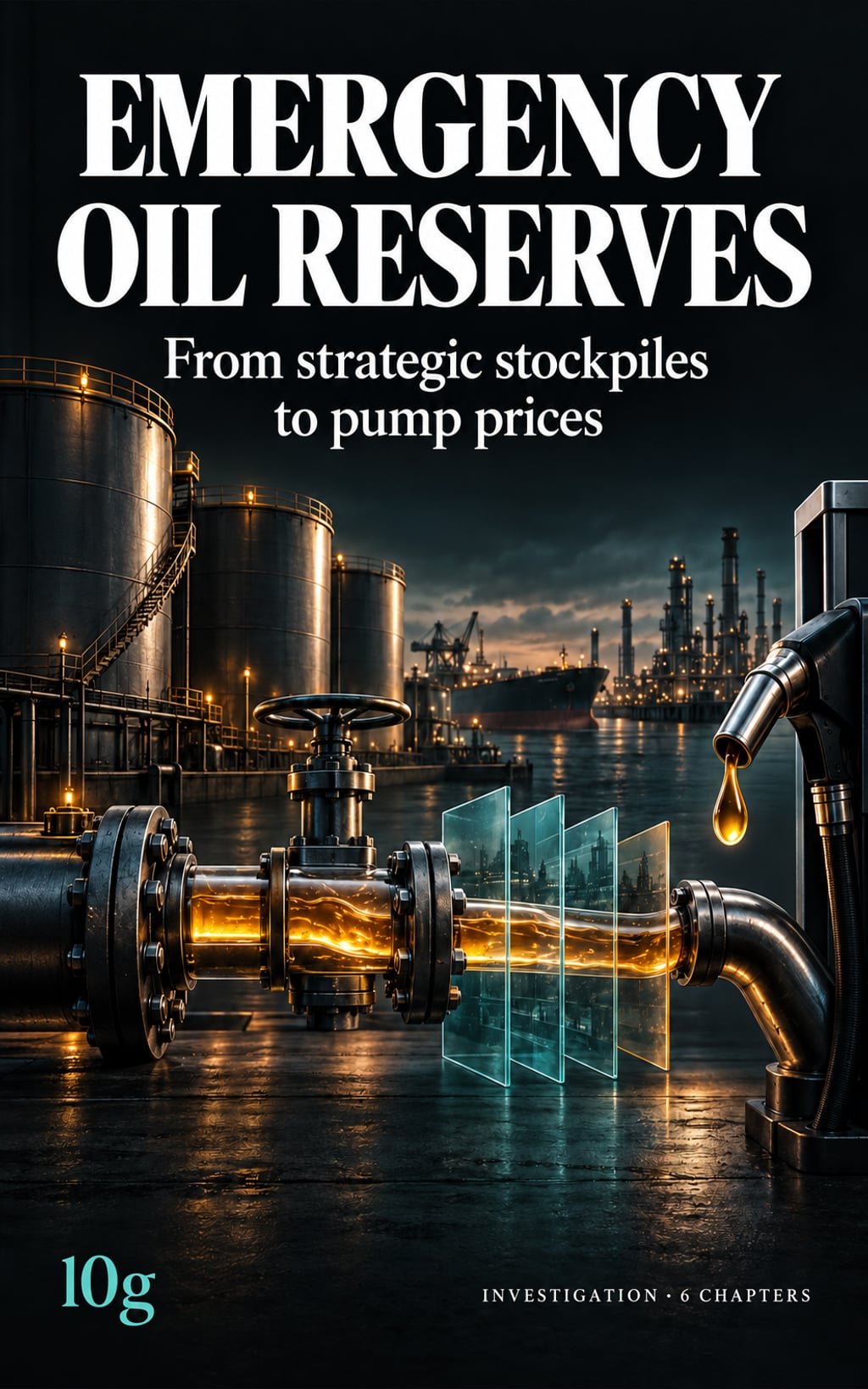
The cover and presentation artwork are conceptual illustrations created with AI assistance. The documentary infographics retain their periods, units and sources.
Free, without registration, embedded scripts or tracking. Creative Commons Attribution 4.0 International.
Check the file’s integrity
SHA-256
7ebd8dcb7a2ffc5171e681e3a568f0cb1e41c14fc6f655d218b0914c55edf152