// analysis
America built the magnet factory. Its biggest customer walked away.
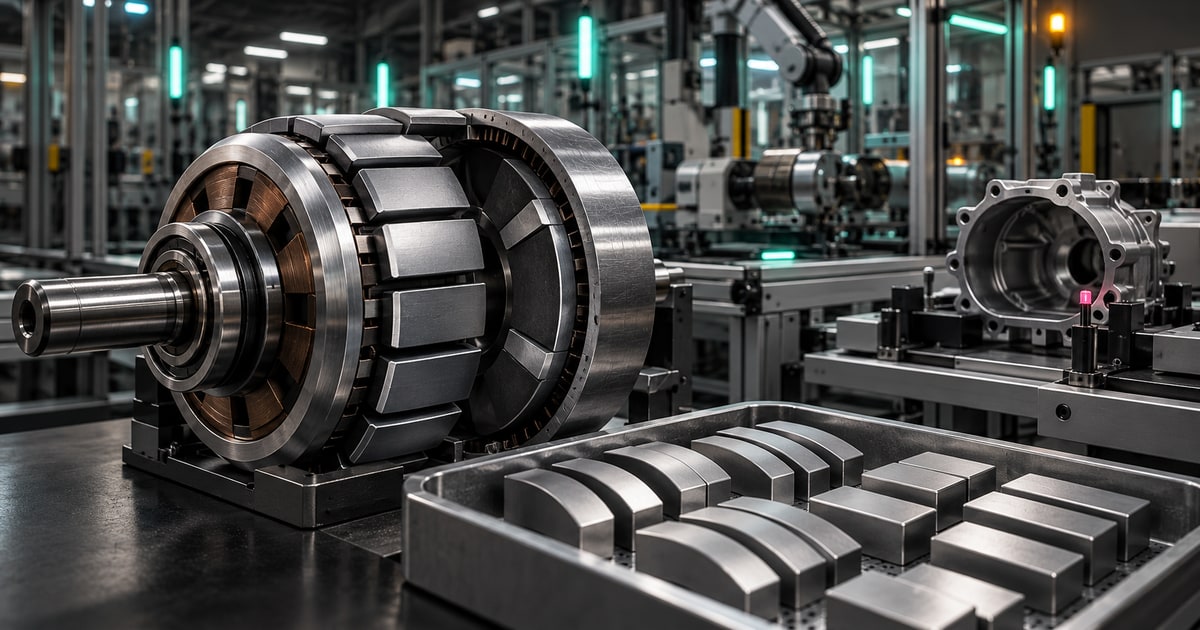
A South Carolina rare-earth magnet plant is producing. GM terminated the supply agreement behind its expansion. SEC filings trace the financing, subsidies and capacity risk.
// reading pathAsia in the global financial systemFollow the rates, currencies, credit and capital flows around this analysis.Investigation closed to new information on 24 October 2026. The interim accounts examined cover January–June 2026 and appeared in an October regulatory filing.
On 15 July 2026, officials in South Carolina gathered to inaugurate a rare-earth magnet factory in Sumter. The plant was already making magnets used in electric motors, and its opening was presented as a milestone in rebuilding American industrial capabilities. Yet its largest prospective customer, General Motors, had sent a termination notice two weeks earlier. The manufacturer had begun arbitration eight days before the ceremony. S01 S04 S08
That awkward sequence captures one of the hardest problems in industrial policy. Capital can build the factory, specialists can bring the equipment online, and governments can help finance the investment. None of those achievements guarantees that enough customers will keep placing orders at prices that cover the cost of production and debt. As the largest buyer steps back, a debate about supply-chain sovereignty becomes an argument about who bears the cost of unused manufacturing capacity.
An October filing by Energy Fuels with the US Securities and Exchange Commission allows that argument to be reconstructed in unusually concrete terms. It documents a dispute over how to calculate compensation when a plant runs below planned capacity, rising sales from a functioning factory, cash proceeds from a transferable tax credit, support from the owner, temporary lender forbearance and a pending acquisition whose terms now take the dispute into account. The supply contract and arbitration submissions themselves remain confidential. The public record takes the investigation far, but leaves some important doors closed. S01 S02 S11
The component that connects a car to a global supply chain
A permanent magnet creates a magnetic field without needing a separate electrical supply. Inside many electric motors, the field interacts with electrically driven windings to produce the torque that turns the shaft. High-performance magnets based on neodymium, praseodymium and iron help designers make motors compact and powerful. Similar materials also serve industrial machinery, robotics, aerospace equipment, defence systems and some wind turbines, although the specifications differ by application. S12
Manufacturing such a component calls for several distinct capabilities. Ore must be mined and processed. Rare-earth elements must be chemically separated, turned into oxides, reduced to metals, made into precise alloys and finally processed into sintered magnets. Expertise at one stage does not automatically deliver the equipment, feedstock or know-how needed at the next.
The International Energy Agency estimates that, in 2024, China accounted for 60% of global mining output of magnet rare earths, 91% of refining and 94% of sintered permanent-magnet manufacturing. Each percentage describes a different stage. Their divergence matters: reopening the final manufacturing step in the United States is a significant achievement, while the upstream chain can remain geographically concentrated. S12
Method and scope
A functional flow diagram, not a quantified supply balance or a guarantee that one batch of materials travels through every depicted facility. Existing assets are distinguished from proposed mines and expansions. The Australian Donald project is not presented as operating production. Sources: IEA, Energy Fuels and e-VAC.
Sumter was built to provide the technically demanding downstream step: mass-produced, high-performance sintered magnets. e-VAC announced its first shipments on 12 December 2025. It also said a partnership with MP Materials supplies key neodymium-praseodymium feedstock originating at the Mountain Pass mine in California. That identifies a relevant US input, although the mine’s location alone cannot establish where every subsequent separation, metal-making and alloying step took place. S14
Energy Fuels wants to connect its American rare-earth processing with capabilities acquired in South Korea and Australia, plus VAC’s magnet-making know-how. Some links already operate; others still depend on investment decisions, permits, construction and customer agreements. An allied-country supply chain may offer substantially more resilience than dependence on a single dominant supplier. Its true strength, however, comes from the capacities and contracts at each link, not from a map with promising arrows. S01 S09
Two thousand tonnes of capacity, one dominant customer
The Sumter facility has a stated nameplate capacity of approximately 2,000 tonnes of magnets a year. Nameplate capacity measures an industrial design target at sustained operation. It says nothing by itself about 2026 output, utilisation, qualification yields or shipments. Management has described room to expand to 4,000 tonnes with existing infrastructure and eventually to 12,000 tonnes with additional investment and sufficient demand. Those higher figures remain prospective. S01 S09
According to Reuters, VAC’s chief executive said in September 2025 that roughly 90% of the plant’s intended capacity was planned for General Motors, with the balance available for other buyers, including the US government. At a hypothetical full run rate of 2,000 tonnes, that would mean about 1,800 tonnes a year linked to the GM opportunity. The figure is useful as a measure of commercial concentration. It is not evidence of a legally binding annual minimum, a realised delivery volume or a contractual damages calculation. None of those numbers is publicly established. S04
Method and scope
2,000 tonnes × 90% = 1,800 tonnes; the residual is an illustrative 200 tonnes. The Reuters-reported allocation is a management statement from 2025. No contractually guaranteed purchase volume, actual shipments or lost revenue is inferred.
Why does a single buyer matter so much? A magnet factory keeps incurring costs even when orders slow. Skilled staff still need to be paid, production lines maintained, quality systems operated and lenders repaid. Energy and raw materials may vary with output, but much of the industrial investment must be covered over a long period. If the equipment produces fewer saleable magnets, fixed costs have to be spread across fewer units.
Long-term offtake agreements, under which a customer commits to receive future production on specified terms, can help solve that problem. Some contracts include minimum purchases; others compensate the supplier for reserving capacity that the customer leaves unused. Such provisions give the factory a steadier economic base and may allow lenders to model future cash flows. Their protection rests on contractual definitions: which costs count, when the buyer must pay, how the formula changes and when either party can terminate the agreement.
The quarrel began in April, long before the ribbon was cut
The SEC filing describes the subject of the dispute with unusual clarity. It began in April 2026 and primarily concerns how compensation for underutilised production capacity should be calculated under different contractual frameworks. The customer delivered a termination notice on 1 July 2026. On 7 July, e-VAC commenced arbitration, asking for a declaration that the termination breached the express contract terms and for payments it says would have been due during the agreement’s remaining life. These are e-VAC’s claims, not findings by an arbitrator. S01 S02
Energy Fuels did not identify the customer in its initial description. GM’s third-quarter SEC filing separately acknowledges that an EV traction-motor component supplier initiated arbitration in July after GM terminated a strategic sourcing agreement. Reuters matched the accounts and identified GM as e-VAC’s counterparty through a person familiar with the matter. GM and Energy Fuels declined to discuss the arbitration, citing confidentiality. S03 S04
The details matter to the economic outcome. Suppose a customer has reserved a large part of a new factory but needs less product than expected. A contract might require compensation for the unused capacity; the amount could depend on costs actually incurred or on an agreed reservation charge. A different formula, or a valid termination right, can produce a very different result for the buyer and the factory. The filings establish that these calculations are disputed. Without the contract, they do not establish who is right. Multiplying 1,800 tonnes by an invented magnet price would yield a headline-sized damages figure with no documentary foundation.
Method and scope
Events dated in the source documents: original customer agreement January 2023; bank financing September 2024; first shipments December 2025; dispute April 2026; acquisition agreement 23 June; termination notice 1 July; arbitration filing 7 July; ceremony 15 July; lender forbearance agreement 24 September; merger amendment 13 October. The ceremony followed the notice by 14 calendar days and arbitration by eight.
VAC’s 15 July ceremony was described by the company as a milestone in an industrial ramp-up already under way. Its release, dated the following day, reported 130 full-time manufacturing jobs and a plan to reach 300. It also announced an agreement with the Defense Logistics Agency to supply neodymium-iron-boron magnet blocks. No contract volume was given. These facts establish both operating activity and potential customers beyond GM. They provide no basis for assuming the other buyers could immediately absorb everything GM had been expected to purchase. S08
The public money and the project lenders served different purposes
The Sumter factory attracted several layers of support. Listing them without separating their economic functions would exaggerate what the company actually received.
South Carolina’s Department of Commerce described an investment expected to exceed $500 million and a target of 300 jobs when announcing the project in December 2023. The investment headline is a contemporary project estimate, not an audited statement of final construction costs. The US Department of Defense agreed to provide $94.1 million for machinery, technical infrastructure and manufacturing lines. The distinction between the face value of an award and cash paid during an accounting period is measurable: VAC’s notes report about $4.5 million of receipts from that grant during the first six months of 2026. S05 S02
The state also awarded $13 million under its Rural Infrastructure Fund and $2 million under the LocateSC programme to Sumter County, to support land, roads and infrastructure benefiting the project. Those grants were directed to a local public authority. They were not $15 million in unrestricted cash transferred to e-VAC. A further $111.9 million Section 48C tax-credit award, announced in April 2024, became an asset that VAC later sold to third parties for cash, at a discount and after fees. S05 S06 S02
On the private side, Ara Partners announced $335 million in non-recourse project financing in September 2024. The detailed accounts divide this into a $300 million construction facility later converted to a term loan, an $18 million revolving credit line and a $17 million debt-service letter-of-credit facility. A letter of credit is a contingent bank commitment rather than an ordinary cash advance. The revolving line was fully available as of 30 June 2026. The $300 million term loan, by contrast, was fully drawn, carried floating interest at SOFR plus three percentage points and matured on 31 March 2031. S07 S02
Method and scope
USD amounts as announced. The $335m private package comprises a $300m construction/term facility, $18m revolver and $17m letter-of-credit facility. The $94.1m DoD figure is contractual support; $111.9m is the awarded Section 48C credit; $15m covers infrastructure grants awarded to the county. No grand total is calculated across incompatible categories.
In a project-finance structure, non-recourse generally means the lenders primarily rely on the project’s assets and cash generation rather than enjoying an unlimited claim against its shareholder. Actual lender rights depend on the documents and exceptions. A long customer contract can therefore be a key part of the financing even though it is not a physical asset. It helps convert a new factory’s capacity into predictable cash flows. When the customer at the centre of the original investment case exits, the problem moves through the company’s forecasts, bank covenants, ownership support and proposed sale terms.
The factory was generating sales before its largest contract broke down
VAC’s interim financial statements offer an important corrective to any suggestion that Sumter is merely an empty project. For the six months to 30 June 2026, group revenue rose from €156.863 million a year earlier to €211.489 million, an increase of €54.626 million. Management attributes €38.050 million of incremental revenue to the start of commercial operations at Sumter. That is approximately 69.7% of the group’s revenue growth in the period. The filing does not break those sales into individual customers or magnet tonnages. S01 S02
Group gross margin improved from about negative 5.6% to positive 7.9%, with Sumter’s launch cited as a major contributor. But the operating loss widened from €25.452 million to €34.469 million. Administrative expenses increased by €24.292 million, driven significantly by legal and professional costs associated with the customer dispute and strategic transactions. These are consolidated VAC figures, covering other activities in Germany and elsewhere. They do not represent a standalone Sumter profit-and-loss statement. S01 S02
Method and scope
IFRS consolidated accounts, six months ended 30 June, EUR million. Change in revenue: €211.489m − €156.863m = €54.626m. The €38.050m attributed to Sumter equals 69.66% of that increase. It does not establish Sumter’s standalone margin or the proportion sold to GM.
The picture is nuanced but clear. Engineers have built a functioning plant, buyers have received commercial product and the new site is already significant enough to move the group’s sales. Yet those achievements arrived as the commercial contract intended to underpin the factory’s scale-up was being contested. A successful production launch answers the question of technical capability. It does not settle the future economics of underused capacity.
A tax-credit sale can change how operating cash flow looks
The cash-flow statement supplies another vital qualification. VAC reported €30.103 million of positive operating cash flow in the first half of 2026, compared with an outflow of €19.386 million a year earlier. Management explicitly identifies the sale of its transferable Section 48C tax credits, yielding €81.546 million net, as the main reason for the improvement, partly offset by higher trade receivables. Gross proceeds were equivalent to €87.005 million, with fees and insurance reducing the cash received. S01 S02
A transferable tax credit allows a qualifying business to sell some of its tax benefit to another taxpayer. The original recipient turns a future tax advantage into immediate liquidity. That can make an otherwise challenging construction or ramp-up period more manageable. But the proceeds come from a specific fiscal asset, with transfer costs and legal conditions. They are not a stream of magnet sales that can automatically recur next year.
As a simple illustration, subtracting the €81.546 million of net proceeds from the €30.103 million reported cash flow gives minus €51.443 million. This is not an officially restated or audited measure of recurring operating cash flow. A proper reconciliation would also have to examine the related receivable movements, working-capital timing, non-cash items and the precise IFRS classification of the credit sale. The calculation serves a narrower purpose: it shows how heavily a one-off fiscal transaction weighs on the headline cash-flow number. S02
Method and scope
Reported CFO +€30.103m; net Section 48C credit-transfer proceeds +€81.546m; arithmetic difference −€51.443m. The last number is a pedagogical residual, not an IFRS measure or verified normalised cash-flow figure. Management says the transfer primarily explains the improvement, partly offset by receivables.
At 30 June 2026, VAC reported €69.5 million of available liquidity. That comprised €43.7 million in cash and €25.8 million of committed, undrawn bank facilities. The group said both relevant borrowers complied with their financial covenants at that date. Between June and 25 September, when the accounts were authorised, Ara Partners advanced a further $28.4 million in shareholder-related loans. Letters of comfort cover funding support through 30 September 2027: the German TopCo letter is capped at €43.5 million, while the e-VAC commitment has no monetary limit in the published text. These commitments are distinct from cash already received. Management’s going-concern assessment reflects these resources and potential mitigating measures. Those resources form part of management’s going-concern assessment amid continuing contractual and funding risks. S02
On 24 September 2026, e-VAC and its entire lending syndicate signed a forbearance agreement covering specified events of default, including consequences of the disputed termination. The $300 million principal and the loan’s maturity remain unchanged. By 25 September, lenders had agreed to suspend specified remedies and neither acceleration nor a repayment demand had occurred. S02
The underlying question remains commercial. Support from an investor, a sale of tax credits or temporary forbearance from specified lender remedies can finance an interim period. Sustainable operation still requires customers to purchase enough magnets at prices that cover the relevant costs and capital spending. In that sense, temporary liquidity gives management time to find a durable market.
An acquisition price now has to account for a disputed contract
On 23 June, Energy Fuels announced an agreement to acquire VAC from Ara Partners for an equity valuation advertised at roughly $1.9 billion, calculated using Energy Fuels’ then-prevailing share price. The strategic plan would bring together rare-earth processing in the United States, metal and alloy-making capabilities added through Energy Fuels’ acquisition of Australian Strategic Materials in August and VAC’s magnet operations. The VAC acquisition had not closed by 24 October 2026. S09 S01
Timing matters here. The capacity-payment disagreement already existed when the June agreement was signed. GM’s termination notice followed in July. On 13 October, buyer and seller amended the merger agreement to address, among other things, the customer dispute, a potential settlement, repayment of relevant debt and possible purchase-price adjustments. Publicly disclosed wording establishes that the parties recognise a potential loss in the contract’s value. It provides neither a final settlement figure nor a definitive revised purchase price. S01 S11
An unaudited pro forma filing supplies a provisional accounting snapshot based on an Energy Fuels share price of $11.35 on 25 September. The estimated transaction consideration is $1.786 billion, incorporating an estimated value for common and potentially preferred shares, cash and European debt expected to be repaid on a change of control. Of the $718 million expected cash consideration, $379 million is allocated to the Ara seller, $300 million to repayment of the Sumter lender, and $39 million to an escrow account. The $300 million lender repayment is already contained within the $718 million. Adding it again would materially overstate the cash requirement. S10
Method and scope
$379m + $300m + $39m = $718m. Pro forma estimated total: $747.432m common shares + $135m estimated preferred shares + $718m cash + $185.948m European change-of-control debt repayment = $1,786.380m. Unaudited, based on the 25 September 2026 share price; the merger remains conditional and subject to adjustment.
This is where industrial and financial risks intersect. The original owner may be able to sell part or all of its interest. The US project lenders are expected to be repaid in the acquisition. A new owner could inherit an asset with proven manufacturing capabilities but reduced certainty about its largest intended customer. Whether this works depends on the final acquisition price, the arbitration, the ability to qualify other buyers and the cost of operating the plant. Those outcomes cannot yet be calculated from the public record.
GM’s commercial position and alternative customers
GM may have commercially legitimate reasons to reconsider a decade-long procurement programme. EV model plans can change, sales forecasts can weaken, motor designs can evolve and automakers can seek lower-cost solutions. GM has reported costs connected to the realignment of its electric-vehicle activities. The IEA has documented softness in the US EV market following the expiry of certain federal consumer credits, while global EV sales still grew strongly in 2025. These facts make shifting commercial assumptions plausible. They do not reveal the actual grounds for GM’s termination notice. S03 S13
A capacity-payment formula can also involve genuine disputes over what the factory could have produced, what costs it saved by running less, which investment expenses a customer agreed to support and how long that support was intended to last. The customer may believe it properly invoked a contractual exit provision; e-VAC says the exit breached the agreement. Without the complete text and an arbitration decision, the merits of those competing positions remain unresolved. S01 S03
Nor should the factory’s future be reduced to one automaker. VAC has operating experience, a new US facility, government-backed investment and a publicly reported defence supply agreement. Industrial and defence customers may provide additional demand. Winning them requires technical qualification, reliability and sometimes line reconfiguration. New buyers cannot simply be assumed to take over volumes associated with another customer’s specifications. The contracts and quantities that would establish such a transition have yet to be disclosed. S08 S12
Commercial commitments and the cost of industrial sovereignty
Sumter demonstrates both the achievement and the unresolved economics of strategic manufacturing. The plant has shipped magnets, generated additional revenue and benefited from government support intended to create production capabilities outside Asia. Bank finance helped turn that policy objective into physical capacity. The GM agreement was designed to provide a commercial foundation for its scale-up. The termination notice has now made that foundation the subject of arbitration.
The case puts a precise question to policymakers and industrial customers: who should pay to keep strategic domestic capacity available when private buyers value it as supply insurance but do not need to run it at full speed? Buyers, owners, lenders and governments can all carry part of that burden through firm orders, availability payments, financing guarantees or defence procurement. Each arrangement allocates risk differently. Those choices matter most when the original demand forecast turns out to be wrong.
Four sets of records would materially advance this investigation: the supply agreement and its amendments; actual volumes ordered, produced and delivered in 2025–26; disbursement schedules for public support and financing covenants linked to the contract; and the arbitration submissions, ruling or settlement together with the final Energy Fuels closing statement. As of 24 October 2026, those records are either not public or incomplete. The evidence already explains the industrial mechanism and the financial exposure, while the legal outcome rightly remains open.
For related mechanisms, JPMorgan’s industrial investment programme examines commitments needed to bring projects into operation, Nebius’s Citi facility connects customer contracts to bank maturities, and US copper stocks and their return to market considers constraints on reorganising industrial flows.
Sources and documentary limits
Research current to 24 October 2026. Event, filing, announcement and accounting-period dates are kept separate. Company projections and claims are identified as such. The links below lead to the documents examined.
- [S01] Energy Fuels / SEC, Form 8-K. Earliest reported event dated 13 October 2026; merger amendment, VAC business disclosures, the April–July dispute, financial commentary and financing terms. Source document
- [S02] VAC / SEC, Exhibit 99.2. Unaudited condensed IFRS interim accounts for the six months ended 30 June 2025 and 2026. Cash flow, Section 48C tax credits, grants, borrowings and going-concern support. Filed in October 2026. Source document
- [S03] General Motors / SEC, Form 10-Q. Quarter ended 30 September 2026. GM’s acknowledgement of an EV traction-motor supplier arbitration; does not name the counterparty in the quoted section. Source document
- [S04] Reuters, Eric Onstad. Published 22 October, syndicated by EnergyNow on 23 October 2026. Independent identification of GM and the 2025 intended capacity allocation; full contract and arbitration materials remain private. Source document
- [S05] South Carolina Department of Commerce. Project announcement, 13 December 2023. Projected investment and employment, DoD agreement and grants awarded to Sumter County. Source document
- [S06] VAC. 9 April 2024 announcement of a $111.9m Section 48C tax-credit award. Subsequent monetisation is documented by S02. Source document
- [S07] Ara Partners. Announced 5 September 2024; website publication dated 6 September. $335m project-finance package and long-term GM relationship. Source document
- [S08] VAC / e-VAC. Published 16 July 2026 on the 15 July ceremony, operating jobs, nameplate capacity and DLA supply agreement. Manufacturer-supplied figures; DLA volume undisclosed. Source document
- [S09] Energy Fuels. 23 June 2026 announcement of the proposed $1.9bn VAC acquisition; industrial integration plan and future capacities. Source document
- [S10] Energy Fuels / SEC, Exhibit 99.3. Unaudited pro forma combination, 25 September share-price reference, $1.786bn estimated consideration and $718m cash allocation. Source document
- [S11] Energy Fuels / SEC, Exhibit 2.1. Merger agreement amendment signed 13 October 2026 addressing customer dispute, project-lender repayment and possible adjustments. Source document
- [S12] International Energy Agency. Rare Earth Elements (2026 edition). The 2024 geographical shares by mining, refining and sintered-magnet production stage. Source document
- [S13] International Energy Agency. Global EV Outlook 2026. 2025 EV market assessment and outlook; does not identify GM’s contractual motive. Source document
- [S14] e-VAC. 12 December 2025 announcement of first shipments and reported MP Materials feedstock relationship. Statements by the manufacturer. Source document
- [S15] VAC / SEC, Exhibit 99.1. Audited consolidated 2024 and 2025 accounts. Group-level background, not a standalone set of Sumter accounts. Source document
- [S16] US Internal Revenue Service. Official explainer of clean-vehicle credit changes. Relevant policy context; not direct evidence of GM’s reason for terminating the supply agreement. Source document
This analysis is not investment advice.
// cite this analysis
l0g, “America built the magnet factory. Its biggest customer walked away.”, l0g.fr, published October 24, 2026, updated October 24, 2026, https://l0g.fr/en/analysis/us-rare-earth-magnets-gm-vac-offtake-risk/
$ cd ../analysis