// analysis
Nebius: building an AI cloud with a 364-day Citi facility
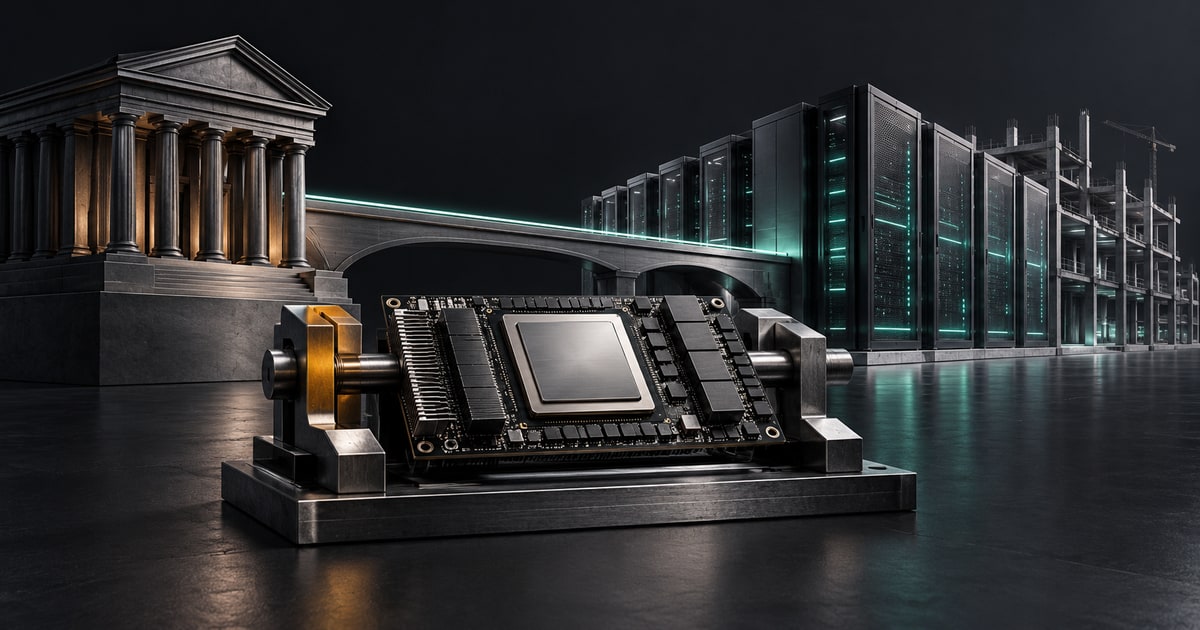
A $3.5bn secured Citi facility matures in October 2027. SEC filings reveal the interplay of client advances, GPU spending, collateral and Microsoft's and Meta's contracts.
Investigation · Financing artificial intelligence · Documentary cut-off: October 24, 2026
On October 17, 2026, Nebius signed a $3.5 billion credit agreement with Citi. The press release followed five days later. The money is available under a facility that matures on October 16, 2027, just 364 days after signature. Yet the GPU clusters the company is racing to install are supposed to supply computing power for years. The important story begins where those two schedules meet. S01 S02
Nebius, headquartered in Amsterdam, has secured major commitments from Microsoft and Meta. Customers can fund part of the buildout in advance. Investors can supply convertible debt or equity. Banks can lend against hardware already deployed and the cash generated by the contracts attached to it. The new Citi facility adds another, shorter instrument to that stack. Its margin steps up every 90 days; its security package reaches across much of the assets of three group borrowers; and it contains a minimum-liquidity covenant whose numerical threshold is absent from the public filing. S01 S04
The first-half accounts reveal why timing matters. They record $4.50 billion in positive operating cash flow and $8.13 billion in cash purchases of property, equipment and intangible assets. Both figures are real. Understanding their economic meaning requires following the customer’s money into the servers, and then looking ahead to the computing service that Nebius still owes. S03 S04
Short-term borrowing for infrastructure used over several years
An AI cloud provider spends heavily before most new clusters can be billed for productive work. It secures land and electricity, develops a site, orders servers and networking equipment, installs GPUs, tests the system and makes computing capacity available to customers. Construction requires cash immediately. Service revenues are ordinarily recognized over the period for which that capacity is provided, even when some of the customer’s payment arrives earlier.
A lender works to a contractual repayment schedule. It advances funds under a contract, collects interest, may take collateral and expects repayment or refinancing on a particular date. Those arrangements can each be commercially sound while leaving a demanding intersection in the middle. A five-year customer commitment gives visibility into future activity. It does not guarantee freely available cash on the day a one-year loan falls due.
The Form 6-K Nebius filed with the US Securities and Exchange Commission on October 22 identifies three borrowers: Nebius Group N.V., Nebius Inc. and Nebius B.V. It describes a senior secured term loan facility with a $3.5 billion principal amount, arranged and provided by Citibank, N.A., with Citi affiliates serving in agency and security roles. The company has filed a summary of the bridge agreement rather than its complete contractual text. That summary establishes the size of the facility; it does not disclose how much had actually been drawn as of the filing date. A borrowing limit and an outstanding loan balance are different measurements. S01
Method and boundaries
The $4.395bn deferred-revenue cash-flow movement covers January–June 2026. The corresponding balance-sheet increase is $4.3977bn; it is not the amount of cash available on October 17, nor an amount exclusively attributable to Microsoft or Meta. The $3.5bn Citi facility was signed on October 17; the disclosed summary does not identify its actual drawn balance. The separate $775m July GPU financing is not treated as part of the October facility.
Nebius describes the facility as a way of accelerating construction while arranging other sources of financing. In its October release, management sets out an intended sequence that includes customer prepayments, operating cash flow, convertible securities and asset-backed debt. A bridge is useful when it crosses a period in which permanent funding is still being put together. The public record shows that this bridge exists. It does not yet identify which financing, if any, will replace the Citi balance by October 2027. S02
The lender margin rises every 90 days
At inception, loans bear interest at Term SOFR plus a 2.75-percentage-point margin. SOFR is a reference rate based on overnight borrowing secured by US Treasury securities; Term SOFR translates that market into a forward-looking term benchmark. The contract adds a lender margin to the reference rate. The disclosed margin increases by 0.25 percentage points after each 90-day period starting October 17, subject to other adjustments, until it reaches 3.50 percentage points. S01
That produces four identifiable steps: October 17, 2026; January 15, 2027; April 15; and July 14, followed by maturity on October 16, 2027. Changes in the underlying reference rate will affect the all-in interest cost independently of these predetermined margin increases. No forecast of SOFR is needed to understand the incentive built into the contract: refinancing sooner avoids later, higher margins. S01
Suppose, purely for illustration, that the entire $3.5 billion were outstanding. Every extra 25 basis points would add $8.75 million to the annualized margin cost. At 2.75%, that margin alone corresponds to $96.25 million per year; at 3.50%, to $122.5 million. These are annualized sensitivities, not reported interest expenses. They exclude SOFR, fees, possible contractual adjustments, partial time periods and any changes in the amount borrowed. Without a draw schedule, adding the four annualized figures would manufacture a misleading bill. S01
Reproducible calculation
$3,500m × 2.75% = $96.25m; × 3.00% = $105m; × 3.25% = $113.75m; × 3.50% = $122.50m. Each additional 25bp implies $8.75m annually if the full $3.5bn is outstanding. The three step dates add 90, 180 and 270 days to October 17, 2026. Actual draws, SOFR and contractual adjustments are excluded.
The SEC filing also permits voluntary repayment without a premium or penalty. That provision matters. If Nebius finds longer-term funding on attractive terms, it can retire the bridge before its final step. The increasingly expensive margin rewards doing so. Whether attractive long-term credit will be available at the required time is a separate market question. S01
A loan against deployed GPUs, and a loan against a corporate group
The Citi transaction follows another, structurally different financing. In July, Nebius announced approximately $775 million of secured debt, maturing October 31, 2030, priced at SOFR plus 2.50 percentage points. The company said that debt was backed by already deployed GPU infrastructure and cash flow from a contract with a creditworthy customer. MUFG led the syndication, with Citi among the participating lenders. A completed and operating computing asset can therefore support longer-dated credit on the strength of an identified income stream. S06 The July 6-K names two separate borrowers, Nebius Compute II, LLC and Nebius Compute II Oy, with broad security over their assets and shares. The announcement describes the deployed GPU and customer cash-flow basis; the filing specifies the borrower-level legal scope. S06
The October bridge comes with a broader perimeter. The Form 6-K describes security over substantially all the assets of each of the three borrowers, including the shares that the parent holds in its US and Dutch borrowing subsidiaries. It also expressly allows excluded assets and permitted liens. Calling the entire financing merely “a loan backed by GPUs” would obscure this distinction. The enforceable ranking of creditors depends on which assets are included, what prior claims exist and how applicable laws and intercreditor arrangements interact. Those details cannot be fully reconstructed from the disclosed summary. S01
Collateral perimeter
The October disclosure covers the three named borrowers, substantially all their assets and the two subsidiaries’ shares owned by the parent, subject to exclusions and permitted liens. July’s $775m transaction is described by Nebius as secured by deployed GPU infrastructure and related contractual cash flows. Complete agreements and intercreditor documentation would be needed to rank every claim.
The October facility additionally contains a minimum-liquidity financial covenant. A covenant is a condition a borrower agrees to observe throughout a loan’s life. Breaching it can have legal consequences, depending on any cure periods, exceptions and thresholds. The SEC filing discloses the covenant’s existence and references customary events of default, but gives neither the required dollar threshold nor the full definition of eligible liquidity. Anyone claiming to know how close Nebius is to a breach from this document alone is claiming a calculation the evidence does not support. S01
The distinction also matters to holders of Nebius’s convertible bonds. Convertible debt carries creditor claims alongside rights to receive equity under specified conditions. A larger pool of secured borrowing can change the assets available to other creditors in a downside scenario. Estimating that effect would require a current, entity-level debt schedule and a complete collateral register. The public October material does not provide both.
Customer advances fund construction and future services
The strongest financial evidence comes from the unaudited accounts for the six months ended June 30. Nebius reported $4,504.1 million of net operating cash provided by continuing operations. Within the cash-flow reconciliation, the deferred-revenue line contributed $4,395.0 million. Deferred revenue arises when a company receives consideration, or has an unconditional right to bill, before it has completed the promised service. It records an obligation to provide that service as revenue is earned over time. S03 S04
The deferred-revenue cash-flow movement is therefore equivalent to approximately 97.6% of reported first-half operating cash flow, as an arithmetic comparison of the two items. The remaining $109.1 million is the net effect of everything else in that cash-flow statement: other working-capital movements, operating results and non-cash adjustments. It should not be presented as underlying recurring operating profit, or projected mechanically into the second half. S04
Over the same six months, Nebius paid $8,130.3 million for property, equipment and intangible assets. Subtracting those payments from the operating cash inflow gives minus $3,626.2 million. This deliberately narrow subtraction leaves out acquisitions, other investing cash flows and financing transactions; it is not the group’s complete change in cash. Net investing cash outflow was $8,288.8 million, while financing activities supplied $9,160.4 million net, notably through convertible notes, treasury-share sales and prefunded warrants. At June 30, unrestricted cash and equivalents stood at $8,042.1 million, with another $1,056 million classified as restricted cash. The two balances have different legal and operational uses. S03 S04
Cash-flow reconciliation
Unaudited consolidated continuing-operations cash flow for January–June 2026, USD millions: operating cash 4,504.1; deferred-revenue adjustment +4,395.0; other net contributions +109.1; cash purchases of property, equipment and intangibles −8,130.3; financing net +9,160.4. Operating cash minus the specified asset purchases equals −3,626.2. No subsequent July, August or October transaction is retroactively added.
An advance from a customer is valuable because it shifts liquidity towards the infrastructure provider early in the buildout. The customer receives a promise in return, and the operator still faces the costs of construction, electricity, maintenance and delivery. At June 30, Nebius carried $5,975.2 million in total deferred revenue, current and non-current combined. The notes say some of those balances may be refundable. The cash is genuine; its associated future obligation is genuine too. S04
There is another subtlety. Under the accounting policies disclosed by Nebius, a sufficiently material financing component in advance customer payments can generate accounting interest expense as the service is delivered. Its June notes explicitly include interest recognized on advances from major customers among the components of interest expense. The company does not separately quantify that amount. A headline suggesting that all customer prepayments are costless financing would therefore outrun the accounting evidence, just as assigning the entire period’s interest expense to customers would. S04 S15
A $37.5 billion order book that has to be earned
In its October announcement, Nebius points to more than $40 billion in long-term, investment-grade customer commitments. The June 30 financial statements contain a more precisely defined number: $37,490.6 million in remaining performance obligations, or RPO. In US GAAP revenue accounting, RPO is the transaction price assigned to promised services still to be performed. It includes qualifying unbilled commitments and deferred revenue. Nebius omits obligations from contracts originally lasting one year or less under the accounting disclosure exemption. The balance-sheet measurement date and accounting perimeter are different from the commercial claims made in October. S02 S04
Management expects to recognize 36% of that amount in the following 24 months, 40% in months 25 through 48 and the rest later. Applied to the June balance, these rounded percentages yield about $13.497 billion, $14.996 billion and $8.998 billion, respectively. They are a schedule of anticipated revenue recognition, rather than a bank-account forecast. Variable consideration can change with performance and timing constraints. The $5.975 billion in deferred revenue already sits within the larger RPO number; counting it again would overstate the contractual pipeline. S04
Definitions and arithmetic
Reported RPO: $37,490.6m at June 30, 2026. Management’s approximate distribution: 36%, 40%, 24%. Implied dollar amounts: $13,496.616m, $14,996.240m and $8,997.744m. Deferred revenue of $5,975.2m is included in RPO. Figures do not imply equivalent cash receipts, profit, present values or guaranteed outcomes.
The business is indeed expanding. Consolidated second-quarter revenue reached $582.3 million, versus $105.1 million a year earlier. Consolidated adjusted EBITDA was $236.2 million, a non-GAAP measure requiring reconciliation to ordinary accounting profit. The company nevertheless posted a $190.4 million net loss from continuing operations for the quarter. Its cited 50% adjusted EBITDA margin in AI cloud applies to a narrower business unit than the consolidated figures. An improving cloud unit and a still-lossmaking group can coexist. S05
RPO gives investors meaningful visibility on the demand customers have already contracted. Its scale says much less, on its own, about eventual margins, financing requirements or the amount of cash available on October 16, 2027. The construction and delivery calendar remains indispensable.
Microsoft and Meta: delivery and availability commitments
The Microsoft agreement, signed in September 2025, covers dedicated GPU computing capacity at Vineland, New Jersey, deployed across nine tranches during 2025 and 2026. The company’s annual report describes potential fees of up to $17.3929 billion through October 2031, conditional on deployment and availability. Aggregate contractual upfront payments are approximately $6.9581 billion, with the remainder billed monthly across the tranches. That upfront contractual amount must not be mistaken for cash already collected at a particular reporting date. S08 S10 Subject to the agreed delivery and availability conditions, Microsoft must pay whether or not it actually uses the GPUs. S08 S15
Availability is central to the relationship. Microsoft can receive service credits and, in specified cases of delay or recurrent service failure, terminate an individual tranche. That allocation of risk explains both the attraction and the limitation of lending against a marquee client agreement. Microsoft’s financial standing reduces the concern that an otherwise payable bill goes unpaid. It does not manufacture a completed GPU cluster, guarantee on-time delivery, or fix future power and maintenance costs. Nebius’s revenue policy recognizes services as they are delivered. S08
Meta’s agreement announced on March 16, 2026 takes a different form. It commits $12 billion for dedicated capacity, beginning in early 2027, and provides for the purchase of up to $15 billion in additional computing capacity at certain other clusters. Nebius first intends to market that second set of resources to third-party cloud customers. Under the announced arrangement, Meta purchases the capacity that remains unsold within the specified scope. The widely cited $27 billion is therefore a contract value up to that amount, shaped by deployment, market demand and the availability of eligible unsold capacity. It is not $27 billion in already recognized revenue. S09
What the amounts measure
Microsoft: up to $17.3929bn of estimated contracted fees conditional on deployment and availability; approximately $6.9581bn in aggregate contractual upfront payments, not cash necessarily collected as of June 30. Meta March 2026: $12bn dedicated plus up to $15bn depending on unsold eligible capacity and the applicable contract terms. A separate November 2025 Meta agreement represented about $2.8807bn in initial contracted consideration.
Nebius also signed an earlier Meta agreement in November 2025, with approximately $2.88 billion in initially contracted consideration according to its 20-F. These large customers are real, and so are the service-level conditions attached to their contracts. Lumping every advertised maximum into an undifferentiated pile of guaranteed revenue would conceal why the agreements have different values to a lender. S08
Contracted power, grid connections and active GPU capacity
Physical capacity offers another easy source of confusion. Nebius separates contracted power, connected power and active power in its annual reporting. Contracted power is electricity and associated site capacity secured through agreements. Connected power is capacity made available through an actual grid connection. Active power describes the operating infrastructure available for computing work. The sequence represents distinct engineering and commercial milestones. S08
In August, the company raised its end-2026 target for contracted power to five gigawatts. A February shareholder letter had targeted 800 megawatts to one gigawatt of connected power by end-2026. The historical figure of approximately 170 megawatts of active power reported in the annual filing refers to December 31, 2025. Those are observations or projections at different dates and on different definitions. Dividing 170 MW by 5 GW and calling the result a project completion rate would amount to a false comparison. S05 S08 S16
Time bases
5GW is the August 12, 2026 target for contracted power at end-2026. 0.8–1GW is the February 2026 forecast for connected power at end-2026. Approximately 170MW of active power was observed at December 31, 2025 in the annual filing. These figures are not three simultaneously observed measurements.
The gap between a power reservation and an operational server is precisely where capital goes. Securing electricity may open the route to construction; customers pay for functioning systems, with uptime and delivery obligations. Nebius projects deployment of more than one gigawatt a year beginning in 2027. Its disclosed contractual commitments for future minimum or fixed payments linked to electricity, power and colocation reached $5.3241 billion at June 30, including $541.8 million scheduled for 2027. Those numbers represent the stated commitments and time buckets, not an estimate of all future electricity expenses or a single immediate payment obligation. S05 S04
NVIDIA supplies the technology, and some of the capital
One distinguishing feature of this expansion is that NVIDIA has supplied $2 billion of equity-linked financing to Nebius. The March 11, 2026 SEC filing describes the instrument as a prefunded warrant exercisable for 21,065,936 Class A ordinary shares at a residual exercise price of $0.0001 per share, subject to its terms. Nebius included the resulting proceeds among its first-half financing inflows. A prefunded warrant is an equity-linked instrument for which the investor has effectively paid almost the full share price upfront. S11 S04
NVIDIA is also a major technology supplier to the very type of GPU cloud Nebius is building. The investment helps its customer expand the market for computing infrastructure. That raises a productive analytical question: to what extent are suppliers financing customers’ demand for their own products? The warrant and its funding are documented. A legal requirement to spend those particular proceeds on NVIDIA chips has not been established from the documents reviewed; a full answer would need purchasing flows and the relevant commercial terms. S12 S11
Nebius closed $5.75 billion in new convertible notes on August 24, split across maturities in 2030 and 2034, while separately exchanging $800 million of original principal in older notes for approximately 15.8 million shares. Because these transactions occurred after June 30, the debt and liquidity figures in the interim balance sheet cannot be presented as a definitive October capital structure. The company’s ability to raise capital is evident; its current unencumbered liquidity after several more months of construction still needs an updated reconciliation. S07
Refinancing under changing credit conditions
In its October 16 report on CoreWeave, another AI-cloud operator, Reuters interviewed analysts and fund managers about the financing of projects whose revenue develops over several years. Its October 22 report on the Citi facility also placed Nebius’s announcement in that context. Those assessments concern financing conditions across companies with different contracts, collateral and capital structures. S13 S14
The channels through which tighter financial conditions could matter are straightforward. Higher reference rates increase the expense of floating-rate debt, while higher credit spreads make refinancing more costly. A late cluster can delay recognized revenue and activate service remedies. Lower resale or collateral values for computing equipment can weaken borrowing capacity. If those pressures coincided, shareholders might face dilution or the company might defer commercially promising projects. These are plausible mechanisms, rather than events established as having occurred together at Nebius.
The strongest counterargument deserves equal weight. Nebius had $8.042 billion in unrestricted cash and equivalents on June 30. It has demonstrated access to convertible capital markets, arranged a longer-term GPU financing in July, attracted strategic equity funding and collected major customer advances. Revenue is growing rapidly. The flexible, prepayable Citi bridge may be an instrument for preserving expansion speed, rather than evidence of imminent funding distress. Public documents available on October 24, however, do not reveal a full October liquidity bridge, the facility’s actual draw or the threshold for its new covenant. S04 S06 S07 S01
The evidence needed to assess refinancing risk
The missing contractual evidence is specific: the amount drawn against the facility, its use over time, the complete liquidity covenant and definitions, the excluded collateral, any intercreditor agreements, and a complete entity-level breakdown of unrestricted and restricted cash. These would allow an analyst to test repayment capacity and collateral availability without pretending that a loan commitment is an outstanding balance.
On the industrial side, the decisive evidence would be actual grid connections, operational clusters delivered on schedule, remaining construction costs and service availability against the Microsoft and Meta commitments. The agreements establish valuable demand. Execution determines when that demand turns into accounting revenue, operating cash and durable funding capacity.
Nebius provides a documented example of a broader AI-finance problem: customers can pay ahead of service delivery, infrastructure providers can borrow against assets that will earn money for years, and lenders can still demand repayment after only twelve months. The public record shows substantial financial resources and several ways of funding that interval. Assessing the risk now requires equipment-delivery milestones, remaining costs, customer receipts and creditor repayment dates, with a clear distinction between completed steps and future commitments.
For related mechanisms, GPU-backed debt and its fourth year examines the maturity risk, the GPU-collateral analysis explains lender rights, and AI circular financing considers the connections between suppliers, customers and investors.
Glossary: SOFR, covenants, collateral, capital expenditure, remaining performance obligations and deferred revenue.
Sources and documentary limitations
Evidence reviewed through October 24, 2026. The half-year figures cover January–June 2026 and were published in August 2026. August convertible issuance and the October credit agreement are subsequent events. Forward-looking statements are attributed to the company. Filing a Form 6-K or Form 20-F does not mean the SEC guarantees an issuer’s economic claims. The interim financial statements are unaudited.
- [S01] SEC / Nebius, Form 6-K, October 22, 2026. Agreement signed October 17; maturity, pricing, collateral and minimum-liquidity covenant. Source document
- [S02] Nebius, October 22, 2026 announcement. Management’s account of the intended financing sequence and commercial commitments, distinct from the contract itself. Source document
- [S03] SEC / Nebius, Operating and Financial Review, August 12, 2026. Cash flow and investments for January–June 2026. Source document
- [S04] SEC / Nebius, unaudited interim consolidated statements, August 12, 2026. June 30 balance sheet, operating and investing cash flow, debt, deferred revenue, RPO and contractual commitments. Source document
- [S05] SEC / Nebius, second-quarter earnings and shareholder letter, August 12, 2026. Financial results and power targets; some metrics are non-GAAP. Source document; Source document
- [S06] SEC / Nebius, secured $775m facility, July 17, 2026. GPU and contract cash-flow collateral; October 2030 maturity. Source document ; Parent 6-K
- [S07] SEC / Nebius, convertible financing close, August 24, 2026. $5.75bn new original principal and separate legacy note exchanges. Source document
- [S08] SEC / Nebius, 2025 Form 20-F filed April 30, 2026. Revenue policies, commercial agreements and definitions of power capacity. Source document; Source document
- [S09] SEC / Nebius, Form 6-K filed March 16, 2026; contract signed March 13. $12bn committed dedicated capacity and up to $15bn of additional available capacity. Source document
- [S10] SEC / Nebius, Microsoft agreement filing, September 8, 2025. Tranches, delivery conditions and customer protections. Source document
- [S11] SEC / Nebius, NVIDIA financing, March 11, 2026. $2bn prefunded warrant and associated shares. Source document
- [S12] NVIDIA, March 11, 2026 announcement. Technology supplier and investor’s account, treated as an interested statement. Source document
- [S13] Reuters, October 22, 2026, syndicated by KSL. Independent secondary reporting on the Citi financing. Source document
- [S14] Reuters, October 16, 2026, syndicated by MarketScreener. Analysts’ and fund managers’ assessments of AI-infrastructure financing around CoreWeave. Source document
- [S15] SEC / Nebius, 2025 annual financial accounting policies, XBRL note. ASC 606 revenue recognition and significant financing component; same source family as S08, not independent corroboration. Source document
- [S16] SEC / Nebius, fourth-quarter 2025 shareholder letter, February 12, 2026. End-2026 forecast of 800MW–1GW of connected power. Source document
This analysis is not investment advice.
// cite this analysis
l0g, “Nebius: building an AI cloud with a 364-day Citi facility”, l0g.fr, published October 24, 2026, updated October 24, 2026, https://l0g.fr/en/analysis/nebius-citi-364-day-gpu-credit/
$ cd ../analysis