English edition ·
// l0g publication · investigation
Banking on Oil
Credit, cargoes and the power of oil.
From a bank loan to an oil terminal, eight investigations follow the money that buys, transports and delivers a cargo. A book about the firms, contracts and dependencies behind commodity trading.
- 8 investigations
- 24 infographics
- Original introduction
- Clickable sources
EPUB 3 · offline reading · CC BY 4.0
01 / introduction
Following the money in oil
An oil tanker leaves port. Its cargo has a buyer, a price and a destination. It also has a financial timetable: money advanced to buy it, guarantees required by a bank, cash tied up in a price hedge, and payment expected on arrival. Someone has to fund the gaps between those dates.
Banking on Oil follows that money through eight investigations. The journey starts with the financing of a cargo and moves to the banks that lend to commodity traders. It then follows Chad’s oil revenues pledged to creditors, the construction of a price benchmark, and the refineries, terminals and filling stations that give trading a physical base.
Two court cases open a different perspective. Trafigura’s nickel case examines the controls around a financed cargo. The Trafigura–Petrobras case traces bribery through contracts and payments. Each has its own parties, dates and legal findings. They help explain responsibilities and failures of control; their conclusions cannot be extended to the whole industry.
The final chapter connects these mechanisms to the continuity of deliveries. When collateral falls due before a sale brings in cash, timing becomes critical. Energy-sector cases from 2022 help examine the available backstops. They concern gas and electricity in particular and do not describe a worldwide interruption of oil trading.
Contracts, accounts, decisions and institutional publications accompany the analysis throughout. Hypothetical examples remain labelled, and figures retain their dates and scope. This edition brings together the English articles published from 6 to 8 September 2026 in one continuous reading order, with their source references and links to the online versions.
02 / the eight investigations
From the cargo to the credit chain
Every chapter is also available online, with its sources and any subsequent updates.
Who pays for an oil cargo before you do?
Credit, collateral and the financial timetable of a cargo.
The banks behind Trafigura’s oil trading
The lenders and instruments that finance commodity trading.
Chad and Glencore: the oil revenues pledged to creditors
Debt, export receipts and the government budget.
Trafigura and the making of a fuel-oil benchmark
The CFTC case and the construction of a Platts price assessment.
Vitol’s refineries, terminals and the power to choose suppliers
Infrastructure ownership and conditions of competition.
Trafigura’s nickel fraud and the limits of paper collateral
Misdescribed cargoes and the controls around trade finance.
Trafigura and Petrobras: how bribery entered the oil trade
Intermediaries, payments and penalties.
Can a credit squeeze disrupt oil supplies?
Margin calls, liquidity and supply backstops.
03 / the digital edition
Take the investigation with you
A continuous reading experience
The text reflows to fit your screen. The contents link to chapters and their sections. All 24 infographics are included, with dark backgrounds and text alternatives. Image enlargement depends on the reading application.
Sources stay with the text
These are the English articles published from 6 to 8 September 2026, with their notes and references preserved. Links between the eight investigations work within the book; external documents require an internet connection.
An edition you can share
The EPUB contains no scripts, remote fonts or tracking tools. You can share it under the CC BY 4.0 licence.
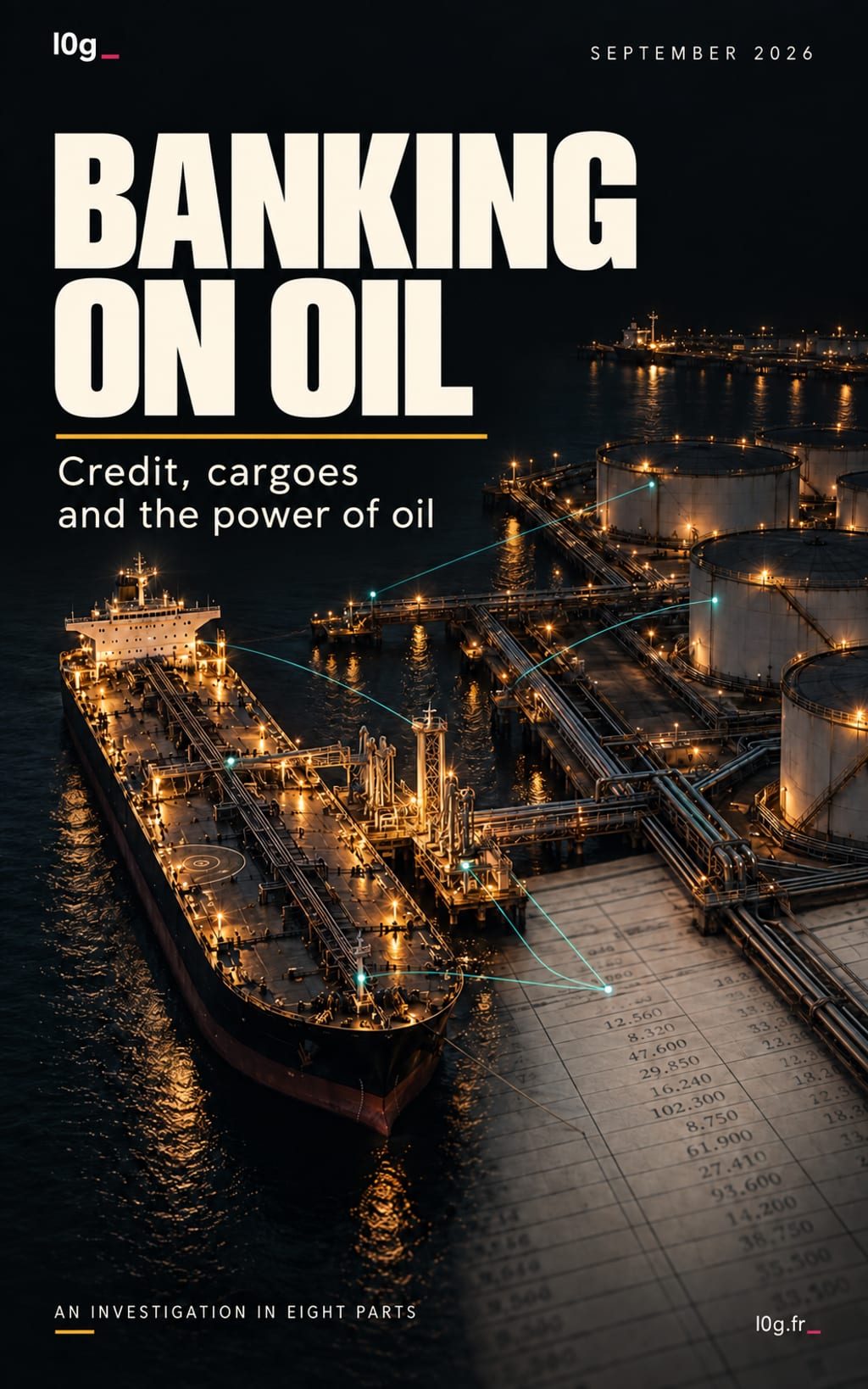
The cover was created with AI assistance. It is a conceptual illustration, depicting no real company, facility or transaction. Its ledger contains no data from the investigation.
File information
- Format
- EPUB 3 · English · 360 KB
- Edition
- 8 September 2026
- SHA-256 checksum
2519b777cd019d6f6ccde5deb81b7949beb2e70ea074319bb401771b2da97ee7