// analysis
Chad and Glencore: the oil revenues pledged to creditors
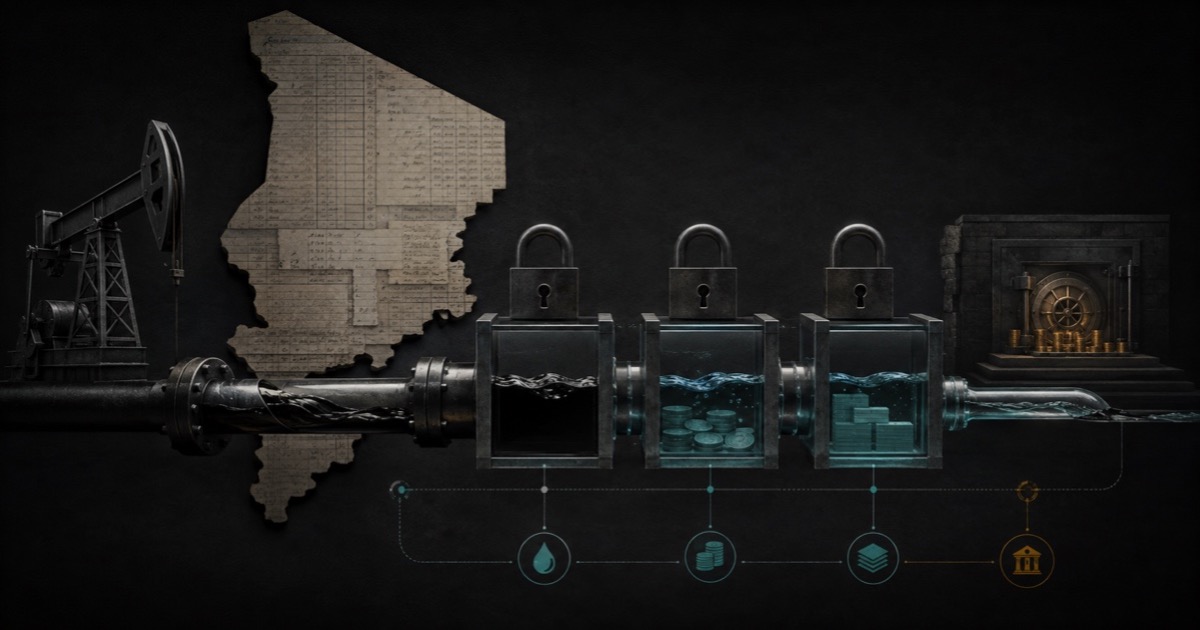
How Chad’s oil-backed Glencore debt shaped public cash flow: the restructurings, the reported balance and gaps in payment verification.
Banking on Oil : Part 3
In 2016, the government oil sales described by the IMF generated $271 million after operating and transport costs. Of that amount, $231 million went towards servicing the Glencore debt. The Chadian Treasury was left with $40 million. The figures came from the authorities and appeared in an IMF report published in August 2017. They describe a particular stream of public oil receipts: not all of Chad’s exports, and not its entire budget. [1]
Even with that qualification, the arithmetic is striking. Debt service absorbed 85.2% of this revenue stream after costs. Debt service means the principal repayments and financing charges due. The percentage is not a measure of Glencore’s profit: returning money that was previously lent is different from earning income on that loan.
Part 1 followed the financing of an individual cargo; Part 2 mapped the banks behind a commodity trader. In Chad, credit reaches into the public finances. It helps a government buy oil assets while committing revenues that the government will later need to meet its other obligations. The available records show how this arrangement worked, how it was renegotiated and where the public record still has gaps.
Buying Chevron’s stake before the downturn
On 13 June 2014, Chevron announced the sale to the Republic of Chad of its 25% non-operated interest in a producing oil concession in southern Chad, together with the associated export pipeline interests. The transaction closed that day for approximately $1.3 billion. Chad was acquiring a stake in operating assets, rather than simply borrowing to cover current expenditure. [2]
Glencore helped finance the acquisition. The IMF identifies a $1.356 billion loan contracted in 2014, separate from an earlier 2013 facility that had been increased to $600 million. The earlier financing covered budget needs; the later transaction funded the purchase of Chevron’s interest in the Doba consortium. [1][3]
Those amounts need to be kept separate. An asset’s purchase price, the amount stated in a credit agreement and the principal outstanding years later are different quantities. The Extractive Industries Transparency Initiative, or EITI, lists the 2014 agreement at $1.45 billion. The documents reviewed do not fully reconcile that figure with the IMF’s $1.356 billion. Treating the difference as fees would supply an explanation that the evidence does not establish. [5]
The familiar label “Glencore debt” is also shorthand. The financing involved the trader and other lenders; it should not be read as a claim held entirely on Glencore’s own balance sheet. Société des Hydrocarbures du Tchad, the state oil company known as SHT, sits at the intersection of oil ownership, marketing and repayment. [5][9]
The economic proposition is straightforward: buy an income-producing asset now and repay the financing from its future earnings. The difficulty arises when the commodity price falls sharply but payments do not fall at the same pace. The borrower’s revenues and its ability to service the acquisition debt then depend heavily on the same uncertain variable.
The account that sets the payment order
An oil-backed loan gives creditors rights over future receipts. That does not, by itself, make the lender the owner of a country’s oil reserves. The World Bank distinguishes formal security interests from arrangements with similar economic effects, including dedicated collection accounts and rights to draw on specified revenues. Their purpose is to make repayment less dependent on the borrower voluntarily sending money when it falls due. [7]
For the arrangements described in the EITI report covering 2023, receipts from sales to Glencore pass through an SHT escrow account at Citibank. An escrow account holds money subject to agreed restrictions on its use. Oil operating and transport costs, followed by debt-related payments, are deducted before the balance is transferred to the state. [5][5]
Operating costs matter. Owning part of an oilfield provides an entitlement to production but also entails contributing to expenditure. The documents refer to cash calls: requests for the owners to fund those operations. Counting them as interest on the loan would substantially overstate the financing cost. [5]
There is a further distinction between national production, privately owned barrels and the oil belonging to the government or its companies. The arrangement concerns identified public revenue streams. EITI also describes exceptions, including a 2023 cargo sold to PETCO and volumes handled under agreements with OPIC. It would be wrong to route every Chadian oil sale through one hypothetical Glencore account. [5]
For the budget, payment priority has immediate consequences. Debt can be serviced from a sale before the Treasury receives the remaining cash. The oil revenue exists, but its full value is not available to finance new spending. The creditor has an established route to certain receipts, rather than merely a general promise of repayment.
That makes gross reporting more important, not less. A record of the final transfer alone would omit the costs and financing payments made along the way. EITI explicitly distinguishes commercial receipts from the repatriations through which they enter the government budget. Following the money requires both sides of that record. [5]
How the squeeze reached suppliers and banks
Oil receipts were not the only pressure on Chad in the mid-2010s. The IMF describes security spending, regional instability, drought and the displacement of people alongside the oil shock. In December 2016, the World Bank announced additional budget support intended, among other aims, to protect essential social programmes. [1][16]
The transmission mechanism is nevertheless documented. Lower revenue and heavy debt service restricted the budget. Spending cuts and payment arrears hurt businesses supplying the state. Some of those businesses then struggled to service their own bank loans. A public cash shortage spread into private borrowers and bank balance sheets. [1]
In these circumstances, public salaries for November and December 2016 were paid only in early 2017, after external budget support arrived, according to the IMF. That is evidence of severe fiscal strain. It does not identify a particular Glencore payment as the cause of each delayed salary. The budget faced several competing demands, and spending decisions remained the authorities’ responsibility. [1]
The $271 million example isolates one part of the problem. After the expenditure needed to produce and transport the oil, a substantial financing payment still stood between the sale proceeds and the Treasury. An oil asset could retain economic value while the government had very little cash from its sales available to spend.
Borrowing supplies money at the outset; repayment uses money later. The key question is whether the resulting revenue arrives in sufficient amounts, and at the right times, to meet both the debt schedule and the state’s other obligations.
The restructurings of 2015 and 2018
The first restructuring consolidated and rescheduled the 2013 and 2014 loans. The IMF reports that the 2015 transaction increased the debt’s net present value because of additional fees. Net present value expresses future payments as their economic equivalent at a given date, allowing a distinction between genuine relief and a change in timing. [1]
Postponing a payment can ease a cash shortage without reducing the overall burden. With extra charges, it can make that burden larger. The amount consolidated in a restructuring should therefore not be described as another fresh loan of the same size entering the country.
The next negotiation changed more of the arrangement. An agreement in principle was reached in February 2018, followed by a final agreement signed on 28 June 2018, according to the authorities’ letter included in the IMF report. It lengthened repayment, lowered the interest rate and restructuring fees, and introduced mechanisms linking debt service to oil receipts. [3][4]
Interest-rate descriptions require care. A margin over a benchmark is not an all-in fixed rate. The 2018 documents use LIBOR as the reference and establish a 1% floor for that benchmark, with the contractual components added to it. These are historical provisions, not a verified statement of the interest formula applying in September 2026: the documents assembled do not provide access to every amendment needed to establish that. [4]
The IMF also records an agreement to outsource the financial accounting for government oil exports, operating costs and debt service to an agent other than Glencore. Separating those functions matters. It does not establish that every subsequent payment was independently verified. [4]
Higher oil receipts also bring faster repayment
An important feature is the cash sweep: a provision directing part of additional receipts to debt service when oil conditions are stronger than the contractual baseline. Mechanisms also allow debt service to slow in specified adverse circumstances. The IMF presented this adjustment as protection against a fall in oil receipts. [3][4]
Consider the principle without assigning invented terms to the contract. A producer’s revenues rise while its ordinary repayment schedule remains unchanged. Without an additional provision, more cash may remain available. With a cash sweep, some of the extra money goes towards earlier repayment. Outstanding debt falls faster, but the immediate increase in spendable cash is smaller.
That does not mean the state loses the whole benefit of a higher oil price. Repaying principal reduces a future obligation. The issue is how the additional resources are shared and when the government benefits: more room in today’s budget, or less debt to service tomorrow.
The lenders’ side of the bargain is also visible. They accept protections in less favourable conditions while securing faster repayment when receipts improve. That can make a schedule more manageable without providing comprehensive insurance against an oil shock. Production volumes, operating costs and the government’s other needs still affect the outcome.
A 2022 agreement focused on payment schedules
The next stage took place under the G20 Common Framework, the process for coordinating debt treatments involving the relevant official and private creditors. In December 2022, the IMF described Chad as the first country to reach a debt-treatment agreement with both groups under that framework. [10]
The package included commitments to revisit debt treatment if needed and to reprofile part of the service due to Glencore in 2024. The debt sustainability analysis published in January 2023 envisaged official-creditor contributions if the private creditor’s contribution was insufficient to bring the debt-service-to-revenue ratio below the stated threshold. Those were conditional arrangements, not an automatic transfer of cash or cancellation of a fixed sum. [8]
Cleary Gottlieb, counsel to Chad and SHT, dates the memorandum of understanding with Glencore to 7 December 2022. Its account corroborates a legal step, but comes from a participant, not an independent assessment of whether the terms were fair. EITI subsequently records, on SHT’s information, an amendment signed on 24 March 2023 and effective in the second quarter. [9][5]
Looking back in its 2025 report, the IMF describes the 2022 treatment as a reprofiling of repayments without a principal haircut or reduction in the debt’s net present value. The benefit was flexibility over timing and conditional protection, rather than the elimination of the claim. [11]
The IMF also acknowledged that high oil revenues had improved the government’s financial position in 2022. The negotiations should not be narrated as though Chad’s circumstances had remained frozen in the crisis of 2016. [10]
The $191 million balance at the end of 2024
Repayments substantially reduced the outstanding amount. In the IMF report published on 13 August 2025, debt recorded under Glencore stood at $191 million at the end of 2024. That was 6.2% of the external debt used in the relevant annex, whose denominator excludes the position associated with the IMF’s allocation of special drawing rights. It is not a percentage that can be applied to any other published external-debt total. [11]
The Fund attributes the acceleration of repayments to the cash-sweep mechanism when oil prices were elevated. The original size of the 2014 facility plainly no longer described the exposure at the end of 2024. [11]
The chart distinguishes the end-2024 position from the subsequent amounts projected in 2025. The $131 million shown for the end of 2026 is not an observed balance in September 2026. It belongs to a forecast. Equally, an IMF projection made in 2018 that the debt would be fully repaid by early 2026 is not evidence that repayment actually occurred. [11][4]
As of this investigation, we have not found sufficient public confirmation that the debt has been repaid in full. Glencore’s disclosures on purchases from state-owned enterprises still describe purchases from SHT for 2025, but a trading relationship does not establish outstanding loan principal. Neither the group’s 2026 half-year report nor the IMF’s May 2026 mission statement provides, in the documents reviewed, a Chad-specific balance that closes this reconciliation. [12][13][14]
The missing bank-statement check
The EITI report for 2023, dated 30 December 2025, carries a particularly important qualification. The independent administrator states that the engagement was neither an audit nor a limited review providing assurance on the accounts. It involved collecting information, checking consistency and reconciling data. [5][15]
For the oil-revenue stream at issue, the limitation is concrete: without the Citibank escrow-account statement, receipts and charges could not be independently verified. Operating cash calls and debt repayments could not be reconciled with the relevant operators’ and Glencore’s records either. The information in that section therefore rests on SHT’s declarations, without independent external confirmation. [5]
Published data remain useful under such a qualification. They identify amounts that can be questioned and supporting records that can be requested. But a detailed table is not a bank statement, however many decimal places it contains. The separation of accounting functions announced in 2018 and the evidence actually available to the EITI administrator are different issues.
The verification gap does not demonstrate misappropriation. Nor does it establish which party was responsible for the absence of a document. It cannot be turned into an allegation that Glencore, Citibank or SHT refused access. What the report establishes is a break in the publicly documented chain of verification.
It would also be wrong to claim that no contractual information has been published. EITI cites a 2014 prepayment agreement on the former Chad EITI website, although that link could not be retrieved during this investigation. This article relies on the documents actually reviewed and does not claim access to the complete set of contracts and amendments. [5]
The asset belongs in the assessment too
A complete economic assessment must include what the financing bought. An oil interest can produce income and retain value after the acquisition debt has been repaid. The World Bank recognises that collateral and dedicated revenue arrangements can open access to finance or improve some borrowing terms. It also warns that resource-backed loans are not necessarily cheaper and require explicit scrutiny of their risks. [6][7]
Assessing Chad’s acquisition would require the purchase price, operating expenditure, receipts actually collected, every financing charge and the assets’ remaining value. It would also require a credible comparison with the financing options genuinely available in 2014. The assembled evidence does not establish a full investment return or prove that another offer would necessarily have been better.
It does support a narrower conclusion. At particular points, the repayment mechanism sharply restricted the cash from public oil sales reaching the Treasury. Renegotiations changed the allocation over time, and the outstanding debt fell substantially. Public verification of some account movements remains inadequately documented.
A debt balance confirmed by the parties, the applicable amendments and a reconciliation of cargoes, escrow-account statements and Treasury transfers would take the assessment further. Those records are still needed to establish the financing’s full cost and how much of the oil income the country was actually able to use.
Sources and method
Documentary investigation completed as of 7 September 2026. No interviews, sent requests for comment or access to confidential records are claimed. Dollar amounts are nominal unless otherwise stated. Source notes use printed page numbers; PDF links target the corresponding file pages. Participant accounts and data lacking independent verification are identified. Historical figures and projections are kept separate.
- FMI / IMF : Chad : IMF Country Report No. 17/246. Published August 2017; staff report completed 19 June, Board meeting 30 June 2017. Box 1, p. 4: loans and the 2016 flows of $271m, $231m and $40m, based on information from the authorities. Pp. 4–6: other shocks, arrears and banking transmission. These are the figures reported at the time, not a 2026 revision.
- Chevron : Chevron Announces Sale of Interests in Chad and Cameroon. Release dated 13 June 2014, when the transaction closed. Approximately $1.3bn consideration, a 25% non-operated interest and pipeline interests. A seller’s statement; the IMF also corroborates the purpose of the acquisition. Content accessed through the indexed result after direct retrieval failed.
- FMI / IMF : Chad : IMF Country Report No. 18/108. Published April 2018; staff report completed 30 March. P. 6, paragraph 9, and Box 1, p. 12: agreement in principle, maturity extension, reduced interest and fees, contingent payments. Debt analysis p. 63: 2013 budget financing and 2014 acquisition. Sustainability scenarios were projections at the time.
- FMI / IMF : Chad : IMF Country Report No. 18/260. Published August 2018; staff report completed 16 July. Authorities’ letter p. 25: agreement signed 28 June. P. 6 and memorandum pp. 31–32: LIBOR floor, separate accounting agent and contingent payments. Full repayment by early 2026, discussed on p. 6, was a conditional projection made in 2018.
- ITIE Tchad / EITI Chad : administrateur indépendant / independent administrator : Rapport ITIE 2023 du Tchad. Dated 30 December 2025, covering 2023. P. 11: agreed-upon procedures, not an audit opinion. Pp. 157–158: payment routes and exceptions; p. 161: missing account statement and independent reconciliation; pp. 166–170: agreements, amendment and payment priorities. P. 166 cites a 2014 agreement on a former website, not retrieved during collection. SHT declarations are not treated as audited. Complex tables were not reproduced in the charts.
- Banque mondiale / World Bank : Marcello Estevão, Diego Rivetti, David Mihalyi : Developing economies should think hard about taking on resource-backed loans. Analysis dated 16 June 2022. Potential benefits, transparency problems and the absence of a guaranteed borrowing-cost advantage. An authored policy analysis, not an audit of Chad’s transaction.
- Banque mondiale / World Bank : Susan Maslen, Cigdem Aslan : Enhancing Debt Transparency by Strengthening Public Debt Transaction Disclosure Practices. 2022, especially pp. 13–14: collateral, collateral-like arrangements, dedicated accounts, access to finance and implications for other creditors. A general analytical framework, not a substitute for the provisions of Chad’s agreements.
- FMI / IMF : Chad : IMF Country Report No. 23/7. Published January 2023; staff report completed 7 December 2022. Debt sustainability analysis, paragraph 8, pp. 6–7 of that analysis (PDF pages 86–87): treatment, conditionality, private and official contributions and review commitments. The threshold belongs to this analysis, not a universal legal rule.
- Cleary Gottlieb : Republic of Chad and Société des Hydrocarbures du Tchad in $1.3 Billion Oil Pre-Financing Debt Restructuring. 7 December 2022. Counsel to the Republic and SHT confirms that the MoU was signed that day. A transaction participant’s account. The amount in the headline is not a statement of principal outstanding on that date.
- FMI / IMF : IMF Executive Board Completes First and Second Reviews of ECF Arrangement for Chad. Release dated 22 December 2022. Common Framework agreement, downside protection and the improvement associated with high oil revenues. Expected programme outcomes are not presented as completed results.
- FMI / IMF : Chad : IMF Country Report No. 25/236. Published 13 August 2025; staff report completed 26 June, Board meeting 25 July. Annex III, pp. 49–50, Table III.1: $191m Glencore debt at end-2024, with projections of $131m, $131m and $71m for 2025–2027. The published 6.2% share uses external debt excluding the SDR position; rounded amounts do not justify more precision. Footnote 2: 2022 reprofiling without a haircut or NPV reduction. Table inspected in a PDF screenshot.
- Glencore : EITI commodity trading transparency. Consulted 7 September 2026, 2025 section: purchases from SHT. Company-reported data, not independently audited evidence. Qualitative use only: volumes and the aggregate value covering more than one seller are not repeated as Chad-specific figures. No current debt balance inferred from the trading relationship.
- Glencore : 2026 Half-Year Report. 5 August 2026, six months ended 30 June. Reviewed for an updated Chad receivable. No individual Chad balance found; the absence of a country-specific disclosure does not establish that no claim exists.
- FMI / IMF : IMF Staff Conclude a Mission to Chad. Release dated 21 May 2026, following the 4–15 May mission. Current-information check: no Glencore debt balance is given. Discussions are not treated as an IMF Board decision.
- EITI : Chad 2023 EITI Report : publication page. Institutional landing page: published December 2025, covering 2023. The administrator’s letter dated 30 December in the PDF provides the report date. An inconsistent date on a separate national webpage was not used.
- Banque mondiale / World Bank : Chad: World Bank Approves an Additional $80 Million for the 2015 Fiscal Consolidation Program. Release dated 21 December 2016. Fiscal stability and protection of social programmes. No artificial equivalence drawn between this support and a payment to Glencore. Content accessed through the indexed result after direct retrieval failed.
This analysis is not investment advice.
// cite this analysis
l0g, “Chad and Glencore: the oil revenues pledged to creditors”, l0g.fr, published September 07, 2026, updated September 07, 2026, https://l0g.fr/en/analysis/banking-on-oil-3-chad-glencore-oil-backed-debt/
$ cd ../analysis