// analysis
Trafigura and Petrobras: how bribery entered the oil trade
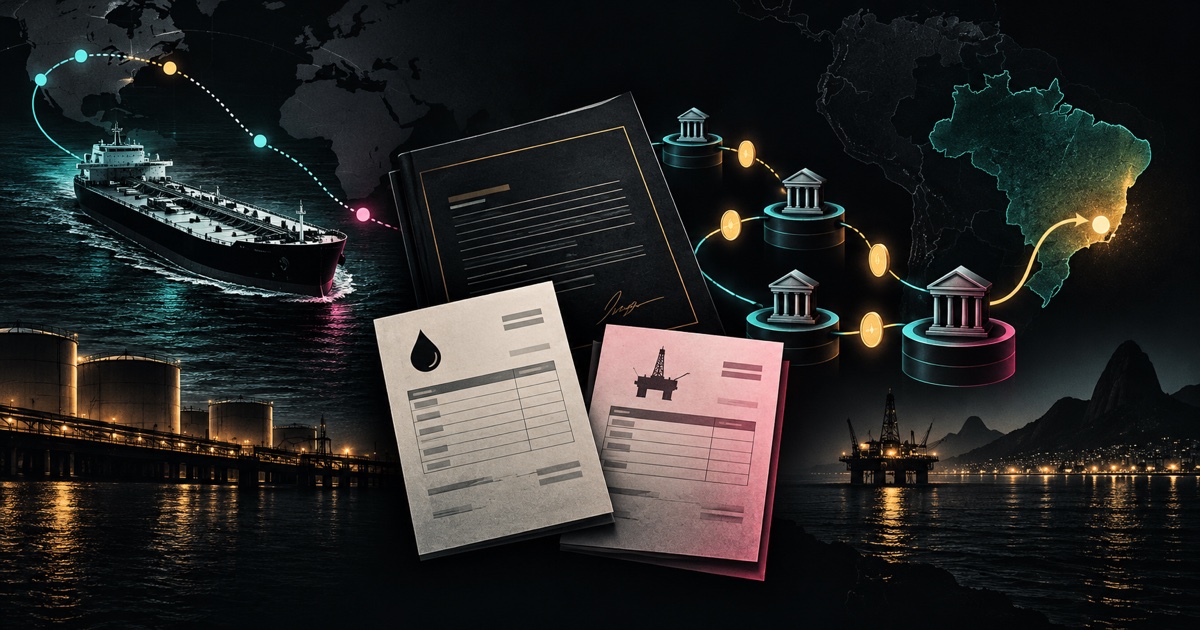
Trafigura pleaded guilty in the United States over bribery tied to Petrobras. Follow the payments, penalties and controls from contract to settlement.
Banking on Oil · Part 7 / Research cut-off: 7 September 2026
On 7 February 2014, an intermediary sent a Trafigura executive an invoice for US$390,240, supposedly for oil-business consulting. Three days later, the intermediary received another invoice for exactly the same amount. This one came from a Hong Kong company and described services connected with sourcing, buying and arranging the logistics of Brazilian floor and wall tiles. Court documents then trace the payments intended ultimately to benefit Petrobras officials. The shift from fuel oil to tiles happened in the supporting paperwork.[1]
The sequence is part of the facts admitted by Trafigura Beheer B.V., the group’s parent during the relevant period, in its US guilty plea on 28 March 2024. The company pleaded guilty to conspiring to violate the anti-bribery provisions of the Foreign Corrupt Practices Act, or FCPA. The case concerned business obtained or retained with Brazil’s state-controlled oil company, Petrobras, between approximately 2003 and 2014.[2]
Part 1 followed the financing of a cargo, Part 2 mapped the banks behind Trafigura, Part 3 reconstructed Chad’s oil-backed debt to Glencore, Part 4 entered the making of a Platts benchmark, Part 5 examined Vitol’s physical assets and Part 6 tested the limits of paper collateral. Part 7 looks at another commercial advantage: influencing the person on the other side of a deal. Trafigura admitted paying for business and arranging negotiations in advance. Brazil’s federal prosecutor describes the payments as a way to obtain improper advantages in the commercial relationship. The 2025 resolutions show where the settlement money is meant to go and which controls the authorities require.[3] [10]
Negotiations with a pre-arranged result
The US account begins around 2003. A Houston-based Petrobras trader told a Trafigura representative that winning business in the Caribbean market required bribes. Under that initial arrangement, payments were about five to ten US cents per barrel bought from or sold to Petrobras. The statement of facts attributes roughly US$500,000 in bribes to that official over the period from 2003 to 2008.[3]
The commercial process is described in unusual detail. A Trafigura representative and a Petrobras official agreed prices and bribe amounts in advance. The representative then instructed Trafigura traders to negotiate with Petrobras, knowing those discussions were meant to arrive at the agreed price. The document does not automatically attribute the same knowledge to every trader asked to conduct the negotiations.[3]
No global oil benchmark has to move for such an arrangement to create an advantage. It can sit inside the terms of an individual transaction. A buyer who knows or can influence the price a supplier will accept faces a different negotiation from an outsider. A seller may gain access to a customer on preferential terms. The bribe compromises the judgment of someone expected to protect their employer’s interests, while the resulting trade can still look ordinary to those outside the arrangement.
The documents do not establish the counterfactual price of every cargo or quantify an effect on petrol-station prices. Profits attributed to Trafigura’s corruptly obtained business cannot simply be relabelled as Petrobras’s loss. Measuring that loss trade by trade would require competing offers, product specifications and the relevant delivery, timing and payment terms.[3] [6]
Payments tied to trading volume
From around 2009, another arrangement provided for bribes of up to twenty US cents per barrel. This was a term of the scheme described in the case, not an industry-standard commission or a rate applicable to all Trafigura business. Linking illicit payments to volumes gives their recipients a direct interest in keeping the trades coming, even when the amount per barrel looks small.[2] [3]
The admitted facts put the corrupt commissions covered by the conspiracy at approximately US$19.7 million, portions of which were used to bribe public officials. That is not a claim that the entire US$19.7 million reached those officials. It covers the commission arrangements through which the scheme operated. Treating the whole amount as money received by officials would invent an allocation the agreement does not supply.[3]
Nor can the conduct be reduced to an outside agent deceiving an otherwise uninvolved company. A former Petrobras trader became a Trafigura agent and then an employee in Brazil, while continuing to use companies he controlled to receive commissions. A December 2012 intermediary agreement with Trafigura Singapore involved executives who knew that some of the fees would finance bribes.[4]
These are corporate admissions concerning specified people and conduct. They should not be turned into guesses about the identities of people anonymised in the document. The company’s guilty plea is also not a personal conviction of every employee or executive mentioned in its account.
Following the US$390,240
The February 2014 sequence connects trading records with the payment trail. An email passed on fuel-oil volumes for part of a Trafigura subsidiary’s Petrobras business. The intermediary issued the purported oil-consulting invoice that day. On 10 February, another participant in the payment network sent him the Hong Kong company’s invoice referring to Brazilian tiles.[1]
Trafigura Singapore instructed its bank to make the payment on 12 February. The intermediary received the euro equivalent of approximately US$390,240. On 17 February, he transferred US$390,240 to the Hong Kong bank account of the company named on the second invoice, through a US financial institution. The statement of facts identifies the intended ultimate beneficiaries as Petrobras officials.[1]
The figure separates invoices from transfers. Two invoices and successive movements of funds must not be added together as separate bribes. The account does not identify exactly how much of this payment reached each ultimate recipient.
The presence of a bank in that chain does not establish that it knew the purpose of the transfer. And the US case cannot be explained by the blanket assertion that every dollar payment creates American jurisdiction. The agreement also describes acts on US territory, including a meeting in Miami Beach on 24 October 2011 at which participants discussed continuing the bribery arrangement.[5]
A deal reference can make a payment look legitimate
An invoice needs more than a bank account and an authorised signature to justify payment. It needs an underlying service. In January 2013 correspondence, executives sought trade references against which to book commissions. The admitted facts explain that matching commissions to trades helped both calculate the payments and conceal them as legitimate expenses in the books.[4]
This is a practical problem for financial controls. A payment can have a named supplier, a contract, an invoice and a deal reference while serving an illicit purpose. Checking that the documents agree with one another does not answer whether the work was done, who benefited or why the payment was necessary.
There is a close parallel in a separate Petrobras case. In the resolution announced on 3 December 2020, Vitol Inc. admitted buying confidential pricing and competitor information. That account also describes staged negotiations designed to settle at a price agreed through back channels. Vitol entered a deferred prosecution agreement at the time, a different legal outcome from Trafigura’s 2024 guilty plea. The comparison establishes a similar mechanism in two documented cases; it does not establish that all commodity trading works this way.[7]
The opposite shortcut would be equally misleading: treating every intermediary fee as inherently corrupt. A service provider can contribute useful expertise, find a customer or perform an identifiable task. What matters is what the service and payment are actually for. The compliance provisions attached to Trafigura’s US agreement address the business rationale for using a third party, its reputation and links to officials, whether it performs the contracted work and whether its compensation is appropriate.[8]
Unpacking the US$127 million resolution
The admitted facts attribute approximately US$61 million in profits to corruptly obtained Petrobras business. The US agreement provides for a criminal fine of US$80,488,040 and a forfeiture money judgment of US$46,510,257, representing proceeds of the offence. Together they amount to US$126,998,297, excluding a mandatory US$400 special assessment.[6]
The US$61 million in profits, US$19.7 million in commissions and US$46.51 million subject to forfeiture are not ready-made entries in a single profit-and-loss account. Their definitions and legal scope differ. The public document does not fully reconcile the profit attributed to the business with the proceeds used for forfeiture. Subtracting one from another to calculate “profit retained” would not be justified.[6]
Part of the US fine also anticipates the Brazilian resolution. Under the agreement, up to US$26,829,346 paid to Brazilian authorities can be credited against the US criminal fine, subject to the specified conditions. That potential credit sits inside the US$80.49 million fine; it is not an extra penalty. The figure shows agreed obligations, not verified cash receipts.[6]
Coordination between enforcement authorities means that several national announcements need not represent wholly separate, cumulative charges. It does not, by itself, verify payment. That requires the amounts actually credited and received, rather than the maximum figures in a resolution.
Brazil specifies who is meant to receive the money
On 28 March 2025, Brazil’s federal comptroller-general, CGU, and attorney-general’s office, AGU, signed a leniency agreement with Trafigura Beheer B.V. Their announcement on 31 March put fines and recovery for the federal government and Petrobras at R$435,410,672.26. On 16 July 2025, the federal prosecutor’s office announced ratification of its coordinated agreement. The Brazilian sum should not be counted twice because more than one institution announced a resolution.[9] [10]
The published financial annex provides a more precise allocation. R$367,158,685.65 consists of two fines payable to the federal government. R$68,251,986.61 is designated for Petrobras: two forfeiture-related items and a damage-compensation item of R$15,073,685.62. Describing the entire R$435.41 million as compensation to Petrobras would therefore be wrong, as would treating it as a single measure of the company’s loss.[11]
The annex records the exchange rate used to express the amounts in reais: R$5.7292 per US dollar, quoted on 26 March 2025 and used for the conversion on 27 March. This is a historical input to the agreement, not a current exchange rate. Trafigura’s own announcement described an additional payment of approximately US$49 million, while referring to the credit allowed by the United States. The gross Brazilian amount and that incremental cost answer different questions.[11] [12]
The arithmetic is consistent with the company’s rounded figure. Converting the real-denominated total at the annex’s rate gives approximately US$76 million. Subtracting the maximum US credit leaves about US$49.17 million. This explains the order of magnitude; it does not establish that the credit was used in full or that the authorities and Petrobras received every amount due.[11] [6] A complete record of executed payments was not verified for this investigation.
Remediation has specific requirements
Trafigura says it stopped using third-party agents to originate new business in 2019. The DOJ recognised that decision and improvements to its controls in the 2024 agreement. But its assessment also records that the company did not promptly and voluntarily disclose the conduct, failed to preserve or produce some evidence in a timely manner early in the investigation, and was slow to take certain disciplinary measures. Reporting only the positive findings would leave out part of the official assessment.[13] [14]
Removing business-origination agents addresses an identified channel for bribery. It does not remove the need to oversee other service providers or people inside the group. The US agreement requires third-party checks and ongoing controls. It sets a three-year term from acceptance of the plea, with annual reports and meetings at least quarterly. The DOJ decided not to impose an independent monitor in light of the remediation and enhanced reporting. No external monitor does not mean no oversight obligations.[8] [14]
The Brazilian annexes go further than a broad pledge to improve compliance. Annex IV requires the submission of integrity-programme reports produced under the US agreement. It also requires people involved in the misconduct to be excluded from the relevant Brazil-related activities and from contacts with Petrobras on the group’s behalf, even informally. Other provisions require local compliance responsibility and training specifically addressing dealings with Brazil’s public sector.[15]
The reference to informal contacts matters. A supplier name or an individual’s employment status can change without necessarily changing who influences a commercial relationship. Asking who still speaks to the public-sector customer supplements checks on an approved-vendor list. That is an interpretation of the risk addressed by the annex, without implying that the agreement was later circumvented.
Testing controls against actual business
In December 2025, Trafigura reported updates to its code of conduct, policies and training for the financial year ended 30 September. The DOJ has separately acknowledged improvements, while the US and Brazilian agreements set monitoring requirements. That record provides grounds to take the remedial measures seriously rather than dismiss them as a public-relations promise.[16] [14] [15]
Whether those controls work consistently in practice is a separate question. Detailed submissions to the DOJ are intended to remain non-public, subject to the agreement’s exceptions. Brazil’s published annexes tell readers what is required, but they are not audit reports confirming that every requirement has been met. This investigation did not obtain a comprehensive account of compliance tests, failures detected and the changes made in response.[14] [15]
The bribery documented here was embedded in real petroleum trading, with contracts and commercial references. Confirming that a cargo exists cannot establish that the business was won legitimately. That also requires understanding why a particular buyer or seller obtained the deal and what each fee actually paid for. Trafigura’s admissions establish how that commercial decision was corrupted in the Petrobras case. The required controls are public; their performance remains distinct from the text that requires them.
Scope. This documentary investigation draws on US corporate admissions, official Brazilian disclosures and the public CGU–AGU annexes, checked against Trafigura’s statements. No interviews or private responses are claimed. Figures and legal outcomes retain the scope of their respective proceedings. The article draws no sector-wide conclusion or estimate of an effect on pump prices.
Sources and documentary references
The sixteen references below identify passages in ten main documents. Several refer to the same US agreement and are not independent confirmations. Research cut-off: 7 September 2026.
- United States : February 2014 invoices and transfers
Plea Agreement, case 1:23-cr-20476-KMW, document 33 filed 29 March 2024. Attachment A, paragraph 38(e)–(i), attachment p. 11 / PDF p. 38. Visually checked. Expressly admitted facts, not merely a press allegation.
- DOJ : announcement of the guilty plea
28 March 2024; webpage updated 6 February 2025. Entity: Trafigura Beheer B.V.; offence: conspiracy to violate the FCPA anti-bribery provisions. Read with paragraph 16 and the introduction to Attachment A for the admissions.
- Plea Agreement : pre-arranged prices and volume-based commissions
Attachment A, paragraphs 14–20, PDF pp. 31–32. Approximately US$19.7m in corrupt commissions covered by the conspiracy, portions used as bribes. Five to ten cents per barrel concern one arrangement; up to twenty cents another from around 2009. Paragraph 17 describes staged negotiations.
- Plea Agreement : agents, employees and deal references
Attachment A, paragraphs 19–23 and 28–32, PDF pp. 32–35. Former Petrobras trader’s move to Trafigura, controlled companies, December 2012 intermediary agreement and commissions assigned to trade references. Anonymised individuals are not identified by inference.
- Plea Agreement : acts on US territory
Agreement paragraphs 2–3; Attachment A, paragraphs 26–27, PDF pp. 33–34. Miami Beach meeting on 24 October 2011. Routing funds through a bank does not establish that the bank knew of the bribery.
- Plea Agreement : fine, forfeiture and Brazil credit
Paragraph 22, PDF pp. 19–22, and Attachment A, paragraph 40, PDF p. 39. Fine US$80,488,040; forfeiture US$46,510,257; maximum credit within the fine US$26,829,346; special assessment US$400. The original terms include a twelve-month condition for the credit. Agreed obligations, not cash receipts. The public documents do not fully reconcile roughly US$61m in profits with the proceeds forfeited.
- DOJ : the separate Vitol–Petrobras case
3 December 2020; page updated 5 February 2025. Confidential information and staged negotiations. Vitol Inc. entered a deferred prosecution agreement in 2020, not a guilty plea. No claim about the agreement’s current status.
- Plea Agreement : third-party and service verification
Attachment C, paragraphs 16–18, PDF pp. 48–49. Business rationale, reputation and public-official relationships, work actually performed, appropriate compensation, monitoring and audit rights. The prescribed standard does not, by itself, describe its implementation.
- CGU–AGU : the 2025 Brazilian agreement and public register
Official register: Trafigura 2025 row, R$435,410,672.26 total. The register links the agreement signed on 28 March and Annexes II to V. This is an agreed amount, not a record of sums already paid.
- MPF : ratification of the coordinated agreement
Announcement dated 16 July 2025 at 20:10. The MPF describes payments intended to obtain improper advantages in the commercial relationship. Its Fifth Chamber ratified the agreement; this is not a new sum to add to the CGU–AGU announcement. 16 July is the announcement date, not a payment date.
- CGU–AGU : Annex III, allocation and payment instructions
SEI document 3569398, two pages, electronically signed on 27–28 March 2025; upload date not displayed. Page 1 table read from the page image and checked by summation. Two fines payable to the federal government; two forfeiture-related items and damages to Petrobras. Rate quoted on 26 March: US$1 = R$5.7292; conversion dated 27 March. Page 2 requires payment evidence to the CGU. These are not receipts.
- Trafigura : the announced incremental Brazilian payment
31 March 2025. Corporate statement from a party to the agreement. Reports an additional US$49m, approximately R$282m, and recalls the US credit of up to US$26.8m. The US$49.17m reconciliation is our calculation assuming the maximum credit, not a receipt or confirmation of final credit use.
- Trafigura : response to the US resolution
28 March 2024. Corporate source. Dates the end of third-party business-origination agents to 2019; the change is recognised in US agreement paragraph 7(e)–(g). Not an independent assessment of current control effectiveness.
- Plea Agreement : cooperation, reporting and confidentiality
Paragraphs 1, 7(b)–(g), 8(j), 25; Attachment D, PDF pp. 51–54, especially paragraphs 11–13. DOJ criticisms and recognised remediation; initial three-year term, annual reports, meetings at least quarterly, no independent monitor. Reports are intended to remain non-public, with exceptions. No public certification of full compliance was verified for this article.
- CGU–AGU : Annex IV, integrity requirements
SEI document 3569506, one page, electronic signatures on 27–28 March 2025; upload date not shown. Entire page read visually. Points 1–2: US-agreement reports and exclusion of people involved, including informal Petrobras contacts on the group’s behalf. Points 7–9: training and local responsibility. Obligations, not findings of implementation.
- Trafigura : FY2025 compliance update
16 December 2025; financial year ended 30 September 2025. Corporate announcement of updates to its code, policies and training. This is the company’s own communication, not an audit of the effectiveness of its anti-bribery controls.
This analysis is not investment advice.
// cite this analysis
l0g, “Trafigura and Petrobras: how bribery entered the oil trade”, l0g.fr, published September 07, 2026, updated September 07, 2026, https://l0g.fr/en/analysis/banking-on-oil-7-trafigura-petrobras-bribery/
$ cd ../analysis