// analysis
Who pays for an oil cargo before you do?
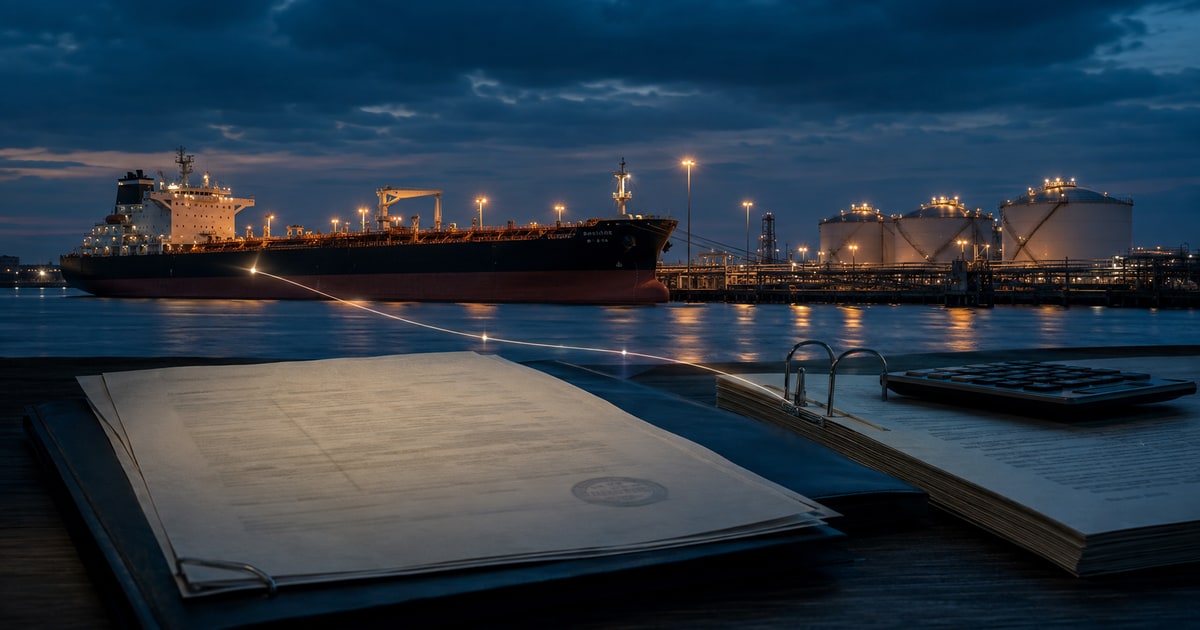
From the Sienna court case to Trafigura’s accounts, an investigation into the credit, collateral and cash that finance the oil trade.
Banking on Oil : Part 1
BP was paid on 2 April 2020. Its invoice covered 80,000 tonnes of fuel oil aboard the Sienna. The buyer was Gulf Petrochem; the financing came from UniCredit. Discharge would take place weeks later. The original shipping document intended to help secure the bank’s exposure would not reach it until August. These dates come from an English court judgment. [1]
The cargo was very low sulphur fuel oil, not automotive petrol, and the record does not trace it to an identified filling station. The litigation left something unusually useful: a record of who had to pay, who was waiting to collect and the rights the financing gave the bank. [1]
A commodity trade needs someone who can wait between paying for a purchase and collecting the proceeds of a sale. That may be the seller, extending payment terms. It may be a trader using its own cash or borrowing. A bank may provide a conditional payment undertaking. The arrangements allocate funding needs and credit risk differently; there is no single payment sequence for every international trade. [4]
In the Sienna transaction, UniCredit’s role extended beyond supplying finance. Gulf’s onward buyers were to be approved by the bank and were supposed to pay it directly. The terms of the financing helped shape the sale itself. They also raise the question running through this series: how much control does the ability to finance a cargo actually buy? [1]
The bank is waiting for the next buyer’s money
BP agreed the sale to Gulf on 30 January 2020. A bill of lading signed at Rotterdam on 19 February recorded the loading of just over 101,693 tonnes. UniCredit’s letter of credit, issued on 12 March, covered only part of that shipment: 80,000 tonnes, with a contractual tolerance of 10%. The invoice ultimately paid was for 80,000 tonnes. The appeal judgment expressly leaves the balance of the shipment unaccounted for; neither party could give the court further information about it. [1]
A documentary letter of credit is a bank’s undertaking to pay a seller on the agreed terms if the required documents are presented and comply. The seller gains a bank commitment rather than relying solely on the buyer’s promise. Issuing that commitment is a separate event from making a payment under it. [3] [5]
For this transaction, the documents needed to obtain payment were a commercial invoice and BP’s warranty of title. The original bill of lading was not required to pay BP. Complying documents were presented on 1 April and payment followed on 2 April. Gulf then acquired ownership of the financed cargo, and the bank’s security interest attached to it. [1]
Repayment was meant to follow a different timetable. Gulf and UniCredit intended the cargo to be sold on to bank-approved buyers. Those buyers were to pay UniCredit directly, 90 days from the date of their invoices. That is not 90 days from loading, nor necessarily 90 days from the bank’s payment to BP. [1]
The economic service is straightforward. BP can collect its money before Gulf receives the proceeds of its onward sales. UniCredit carries credit exposure in the meantime: the possibility that the financing will not be repaid as agreed. Buyer approval, payment routing and security over the cargo are ways to contain that exposure. [1]
The sequence also corrects a familiar mental picture of trade finance. The bank did not necessarily hand over the money before the ship was loaded. Here, the documentary commitment came after loading and payment came later still. Some letters of credit do permit pre-shipment advances, but through specific provisions; an advance is not an automatic feature of the instrument. [1] [5]
Credit terms can reach into the sale
UniCredit’s arrangements included a pledge: security giving a lender rights over specified assets or documents if the borrower defaults. The agreements covered the bill of lading and the goods, with the latter pledge attaching once Gulf acquired an ownership or possessory interest. Taking security did not make UniCredit the commercial buyer of the fuel oil. [1]
A bill of lading does several jobs. Issued in connection with shipment, it records receipt of the goods. Depending on its form and the legal relationship involved, it can also contain or evidence the contract of carriage and support rights to delivery. In the Sienna litigation, the document’s contractual status and the rights transferred to the bank became central issues. Describing it as merely a receipt misses that function; treating it as an unconditional certificate of ownership would also be misleading. [1]
The payment arrangements offered another kind of protection. The onward buyers were supposed to send their money to the bank. The financing therefore did more than create a claim against Gulf: it specified a route by which sale proceeds should reach the lender. [1]
Similar principles can be applied to pools of inventory and receivables. Deutsche Bank’s 2025 trade finance guide describes facilities in which borrowing capacity is tied to eligible collateral, revalued regularly. Proceeds may flow into a collection account pledged to the lenders’ security agent. This is a banking practitioner’s account of the product, not independent evidence of its market share. [7]
The commercial implications follow from the terms. A creditworthy buyer, a receivable the bank accepts and a verifiable payment route can make a transaction easier to finance. An apparently attractive resale may be difficult to execute within the available credit arrangements. That is an inference from how the financing works, not a finding that a lender dictates all its customer’s business. [1] [7]
Approval rights and control over receipts are ordinary protections against non-payment. They also give the lender a say in which counterparties are acceptable. The public record establishes that role in this transaction. It does not establish abusive terms, an imposed exclusive relationship or the absence of alternatives.
The cargo arrives before the paperwork
Between 26 April and 2 May 2020, the financed cargo was transferred from the Sienna to two other vessels at Sohar, Oman. No original bill of lading was presented. The shipowner acted on Gulf’s instructions and relied on Gulf’s indemnity. BP endorsed the original bill to UniCredit on 7 August; the bank received it on 13 August. [1]
Late paperwork, on its own, is not proof of fraud. The Court of Appeal describes discharge against a letter of indemnity, without the original bill of lading, as a widespread and longstanding practice. Under that arrangement, the party requesting delivery undertakes to indemnify the carrier on the stated terms. Original documents may take time to pass along a chain of trades. BP had also pointed to Covid-related working restrictions when explaining the delay in endorsing the bill in this case. [1]
The letter of indemnity and the letter of credit have different beneficiaries and purposes. One provides protection to the carrier under its terms. The other is the bank’s conditional payment undertaking to the seller. Confusing them obscures who has promised what to whom. [1]
Gulf did not repay UniCredit. The bank sued Euronav, the vessel’s owner at the time, over delivery without production of the bill of lading. The first-instance judgment records a claim for $24,701,600 in damages. That is the amount sought in that judgment, not an award to the bank. [1] [2]
The Court of Appeal’s decision on 4 May 2023 requires careful reading. UniCredit succeeded on the issue of breach of the carriage contract, yet its appeal was dismissed. The decisive problem was causation. On the findings upheld by the court, had the carrier sought the necessary instructions, the bank would have authorised discharge without the original bill. The breach was therefore not the cause of the loss claimed. [1]
The UK Supreme Court subsequently refused permission to appeal on 29 August 2023. That refusal was not a fresh hearing of the merits. [8]
The appeal judgment itself warns against reading too much into the outcome. It points to the particular facts and questions the sweeping consequences argued for by the bank. It does not establish that bills of lading are worthless security, or give carriers a general licence to discharge without them. The lender’s rights mattered, but so did the instructions it would have given and the other protections it believed it had. [1]
The public materials examined do not establish UniCredit’s ultimate recovery across all claims and insurance arrangements. The outcome of this action against Euronav is known. A claim that the bank recovered nothing from any source would go beyond the evidence.
The contract decides who carries the payment gap
Litigation makes a transaction unusually visible. It also creates a selection problem: the deal is in the public record because something went wrong. Ordinary international payment arrangements range from cash in advance to payment after delivery. A seller who allows the buyer to pay later carries an exposure of its own, which it may in turn insure or finance. [4]
Shell’s published terms provide a narrowly defined example. The version 1.1 FOB barge terms, published in July 2025 and effective from 1 July 2026, set a default deadline of three New York banking days after title passes, where no other payment date has been specified and subject to the provisions on delivery of payment documents. These are barge-delivery terms, not the Sienna contract or a universal rule for oil cargoes. [6]
The same document says that “Letter of Credit” in its payment-security section means a standby letter of credit. In this use, the bank provides a backstop for failure to pay, rather than the routine channel for settling the invoice. Finding the words “letter of credit” in a contract does not, by itself, establish that the bank has already advanced money. [6] [5]
For a trader, financing sits alongside purchase, transport and storage costs. Earnings depend on the difference achieved between purchases and sales after costs and risks are taken into account. The Financial Stability Board describes, among other activities, arbitrage between locations and between grades of a commodity. A bank may charge for its undertaking and, where lending is actually used, for providing the funds. [11] [3]
None of this yields a defensible “normal margin per barrel” for this case. The full financing cost of the Sienna transaction has not been established. It cannot be inferred from a large trader’s consolidated accounts, and the damages sought by a lender do not measure the profit earned on the sale.
A profitable trader can still need more cash
Moving from one cargo to a group balance sheet changes the scale, but the distinction between earnings and cash remains essential. Consider Trafigura, with no connection established here to the Sienna transaction. Its interim accounts, published on 4 June 2026, cover 1 October 2025 to 31 March 2026. They include the whole group, including metals and other businesses, rather than oil trading alone. The statements were prepared under IAS 34 and are unaudited. [9]
For those six months, the group reported $4.09 billion in net profit. It also reported a net operating cash outflow of $7.039 billion. These are not competing descriptions of the same measure. Profit records an accounting outcome; the cash-flow statement shows the effects on cash. [9]
The reconciliation explains the difference. After accounting adjustments, the cash-flow statement starts with $7.883 billion of operating cash flow before working-capital changes. Changes in inventories, receivables, payables and prepayments then absorb a net $13.860 billion. Both the receivables and payables lines include derivatives. The number cannot be read simply as customer invoices waiting to be paid. Interest, taxes and dividends received within the operating section bring the final net operating cash flow to minus $7.039 billion. [9]
In ordinary business usage, working capital concerns money tied up in the operating cycle: inventory to be paid for and customer payments still to be collected, offset by credit obtained from suppliers. Trafigura’s cash-flow presentation covers a broader set of movements, including derivatives. That distinction matters when interpreting what has absorbed cash. [9]
Banks help fund the cycle at this scale. The same statement records a $12.343 billion net increase in short-term bank financing during the six months. That is a financing flow, not the closing stock of bank debt. An operating cash outflow alone does not establish that the group has run out of cash or is insolvent. [9]
Price hedging can create a further timing mismatch. A trader holding physical goods may sell futures to reduce its exposure to a fall in their value. If prices rise, the futures position can require cash to meet margin calls before the higher value of the physical cargo is realised through a cash sale. A hedge can therefore reduce price exposure while creating an immediate funding need. Differences in grade, location or timing can leave other risks in place. [11]
This general mechanism explains why access to liquidity matters. It does not allow every movement in Trafigura’s cash flow to be attributed to a particular cause from the published aggregates alone.
Borrowing capacity is part of the business
Funding needs have to be considered alongside available resources. At 31 March 2026, Trafigura’s management reported $19.4 billion of liquidity, comprising $7.7 billion of immediately available cash and $11.7 billion of undrawn committed facilities. A $3 billion contingent facility arranged in early March was already included. Adding it again would overstate the total. [10]
An undrawn facility is borrowing capacity available on the contractual terms, not money already sitting in a bank account. This management liquidity measure is therefore distinct from the accounting cash balance. It adds information about the resources available to support the business; it does not erase the operating cash outflow. [10]
The useful service provided by trade finance should remain part of the analysis. Bank undertakings and lending can make transactions possible that would otherwise be harder to conclude. Research by Matthieu Crozet, Banu Demir and Beata Javorcik finds evidence consistent with a two-sided role: letters of credit can cushion a rise in uncertainty but transmit stress when the banks supplying them are in difficulty. Their study is not an estimate of the global oil market in 2026. [12]
The experience of 2022 also provides a check on sweeping crisis narratives. In its February 2023 report, the FSB identified liquidity strains and vulnerabilities but found that the commodities ecosystem had largely absorbed the shock, with a limited impact on the rest of the financial system. The London Metal Exchange nickel market was its major exception for market-functioning disruption. That historical finding is neither a promise of future stability nor evidence of a general collapse. [11]
The conclusion supported by this first investigation is specific. Financing can confer rights over a cargo, its proceeds and the buyers acceptable to the lender. Those rights are visible in the Sienna record, as is a judicial limit on their effectiveness. At group level, borrowing capacity helps bridge timing gaps that accounting profits alone cannot resolve. [1] [9]
The next instalment will follow that financing upstream: to the banks funding commodity traders, the conditions attached to their commitments and the room they leave customers when cash requirements rise.
Sources and method
Documents checked as of 6 September 2026. This article draws on public records, not interviews or confidential bank documents. The legal case is not a representative sample of the industry. Trafigura’s figures are company-reported; they are not used to estimate the financing cost of a litre of fuel sold in France. The graphics contain no invented scenarios or reconstructed vessel-tracking data.
-
UniCredit Bank A.G. v Euronav N.V. : [2023] EWCA Civ 471. Court of Appeal of England and Wales, 4 May 2023. Judicial decision; copy hosted by Quadrant Chambers. Chronology: paragraphs 3–23; causation and limits: paragraphs 105–119.
-
UniCredit Bank AG v Euronav NV : [2022] EWHC 957 (Comm). High Court, 28 April 2022. Judgment copy hosted by Quadrant Chambers. Amount sought: paragraph 1. Read alongside the appeal judgment and the Supreme Court permission decision.
-
Letter of Credit. International Trade Administration, US Department of Commerce. Institutional guide; update date not established. Bank undertaking, documents and bank costs.
-
Methods of Payment. International Trade Administration, US Department of Commerce. Institutional guide; update date not established. Payment methods and allocation of risk.
-
Types of documentary credit: A comprehensive guide. Dave Meynell, ICC Academy, 21 October 2024. Practitioner guide: sight and deferred payment, advance clauses and standbys. Not a substitute for the rules and contracts governing a specific transaction.
-
STASCo General Terms and Conditions : FOB Deliveries by Barge. Shell International Trading and Shipping Company. Designated 2023 edition, published July 2025, version 1.1 effective 1 July 2026. Clauses 46 and 47, printed pages 25–27. Published commercial terms, not the Sienna contract.
-
A Guide to Trade Finance : 2025. Deutsche Bank, 2025 guide, section 4.2, printed pages 56–57. Description of borrowing-base finance. Practitioner source from a provider of the product.
-
Permission to Appeal : August 2023. UK Supreme Court, case UKSC 2023/0073. Permission to appeal refused on 29 August 2023. This is the decision date, not a website republication date.
-
2026 Trafigura Half Year Report. Trafigura Group Pte. Ltd., published 4 June 2026; six months from 1 October 2025 to 31 March 2026. Consolidated IAS 34 statements, unaudited. Printed pages 10, 14 and 15. Company data; grouped calculations disclosed in the graphic caption.
-
2026 Half Year Report: Financial review. Trafigura, CFO review, published 4 June 2026. Liquidity at 31 March 2026: $7.7bn + $11.7bn = $19.4bn. Management source, using a measure broader than accounting cash.
-
The Financial Stability Aspects of Commodities Markets. Financial Stability Board, 20 February 2023. Executive summary and sections 2.1, 2.2 and 3.1. Institutional analysis, principally of the 2022 shock; not a September 2026 assessment.
-
International trade and letters of credit: A double-edged sword in times of crises. Matthieu Crozet, Banu Demir and Beata Javorcik, author version dated 8 July 2021, hosted at Oxford. Empirical international-trade study, not an oil-specific estimate.
This analysis is not investment advice.
// cite this analysis
l0g, “Who pays for an oil cargo before you do?”, l0g.fr, published September 06, 2026, updated September 07, 2026, https://l0g.fr/en/analysis/banking-on-oil-1-cargo-trade-finance/
$ cd ../analysis