// analysis
Google’s French data center: the grid bill behind the billions
Open the documentsThe source documents
The documents cited in the analysis and, where identified, their associated passages. An automatically detected association is not a verified claim.
- Décision n° 2026/85/CENTRE DE DONNEES GOOGLE/2 du 7 octobre 2026 ↗Source date not identified
- Code de l’énergie : Article L.341-2 ↗Source date not identified
- Arrêté du 30 novembre 2017 relatif à la prise en charge des coûts de raccordements aux réseaux publics d’électricité ↗Source date not identified
Sources and reading context
Topics
Contents11 sections
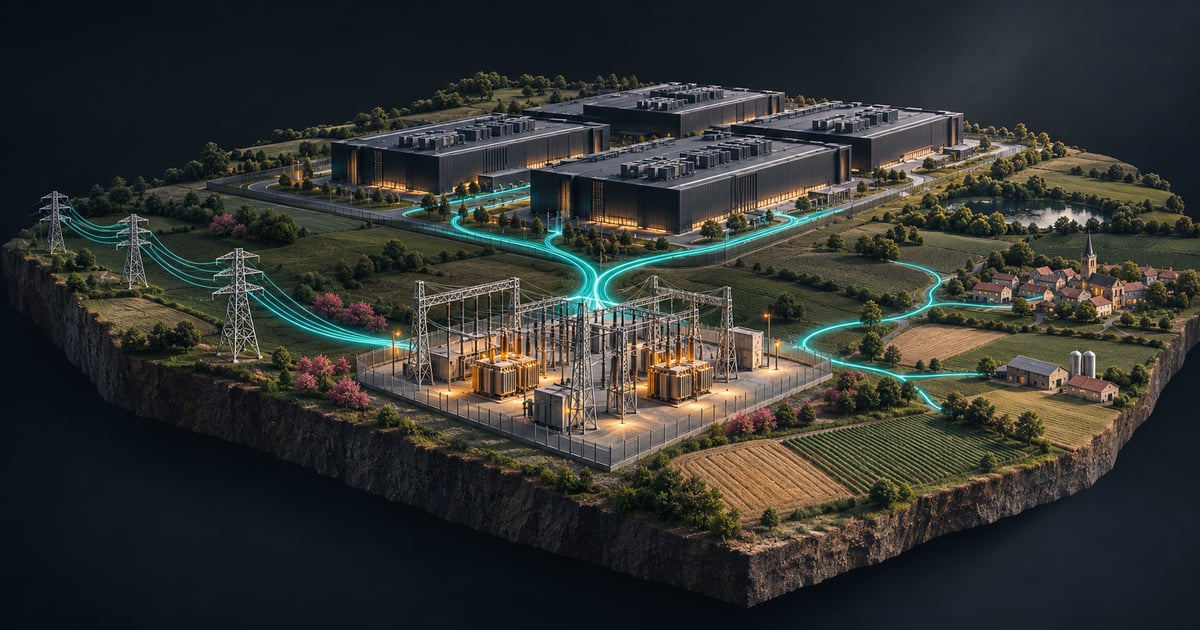
Google’s proposed campus at Ozans depends on power lines, roads and shared networks. Following the money reveals the commitments behind the project and their implications for the region.
Before Google can run servers at its proposed Ozans campus, the site needs a connection to France’s electricity grid. Google would fund 70% of the public substations and the first power links supplying its Ozans campus. France’s electricity transmission operator, RTE, would cover the remaining 30%. Google would pay the full cost of the second links, designed to provide a redundant supply. The project summary shows the same allocation. 120
Those percentages provide a useful starting point for a wider question. When a global company reserves substantial grid capacity, who advances the money, who benefits from the infrastructure, and who carries the risk if development slows? Answering it means following several financial channels. An upfront connection charge, a regulated network tariff and the proceeds from selling land each do a different job.
The proposed campus occupies roughly 200 hectares at Étrechet, east of Châteauroux in the Indre department. Google envisages six to eight buildings developed over ten to twenty years, with the first targeted for around 2030. Public consultation opened on 2 November 2026 and is scheduled to run until 10 January 2027. As of 6 November, the project remains at a preparatory stage: the dossier places applications for authorizations after consultation. 134
The investment estimate conveys the scale. The dossier puts the completed site at about US$10 billion, presented as approximately €8.6 billion excluding VAT. That figure excludes IT equipment and software, while including Google’s share of the electricity connection. Google describes the campus as financed from Alphabet’s own funds, without public subsidies, while exploring technical and financial partnerships with third parties at a European scale. The estimate covers a future development built in stages. 1
The buildings depend on the power connections
A data center combines servers with electrical equipment and systems that remove the heat they produce. At Ozans, the construction schedule depends on the power the grid can make available. Connection power, measured in megawatts, defines the electrical capacity made available to the site. Annual electricity use will depend on the actual load and how long it runs.
The first connection, at 225 kilovolts, would supply 120 MW to the first building. It involves a public substation within the Ozans development zone and two underground links of roughly 300 meters each. Grid availability is envisaged ahead of the building’s opening, targeted for around 2030. 1
The later buildings require a larger connection. A second public substation would connect to the 400 kV network, with two overhead lines linking it to the campus. This branch would initially provide an additional 300 MW, with connection envisaged for early 2031. It could subsequently rise to 1,200 MW following reinforcement of the Éguzon–Marmagne transmission route. RTE gives 2032 as the earliest commissioning date for that reinforcement. Authorizations, engineering studies and the pace of industrial development all qualify these schedules. 19
Method and scope
The bars share a common MW scale. The 225 kV connection supplies 120 MW and remains available when the 400 kV branch adds 300 MW and subsequently reaches 1,200 MW: the totals are 120, 420 and 1,320 MW. The increase from 300 to 1,200 MW replaces the earlier capacity on the same branch. The Éguzon–Marmagne reinforcement is required for that last stage, 2032 at the earliest. Dates are indicative and approvals remain pending. Maximum contracted capacity is a ceiling, distinct from annual electricity consumption. The double links are symbolic.
The move from 300 MW to 1,200 MW concerns the same 400 kV branch. The original 120 MW connection remains alongside it. The dossier therefore gives total maximum contracted capacity of 1,320 MW. Estimating annual electricity consumption would require a separate set of assumptions: which buildings open, how quickly they fill, and their operating load. The dossier explicitly states that the maximum power would not be drawn continuously. 1
That distinction matters to the public debate. Substations and cables have to be sized before the servers reach their operating load. Grid spending anticipates future use. The quality of that forecast, together with the commitments binding the applicant, determines part of the economic risk.
The 70/30 split depends on the assets
France’s connection rules include a mechanism known as réfaction tarifaire: part of eligible connection costs is covered through network tariffs, with the applicant paying the balance. For electricity consumers connected to the high-voltage HTB network, the ministerial order of 30 November 2017 sets that share at 30%. The Energy Code provides for tariffs to cover part of connection expenditure and all grid reinforcement costs. 561416
The Ozans dossier applies this framework to both connections. Google would meet 70% of the cost of the public substations and first links, with RTE carrying 30%. The second links and their connections inside the substations would be funded entirely by Google. These provide redundancy: a second connection helps secure the electricity supply. Google would also fund its own private 400 kV substation in full. 120
Method and scope
The project allocates 70% of public substation and first-link costs to Google and 30% to RTE. The ribbon divides that same cost category in those proportions. Google fully funds the second, redundant links and their substation connections, as well as the campus’s private 400 kV substation. Network tariffs recover costs accepted by the regulator; this diagram calculates no net effect on bills. The provisional €25 million and €100 million envelopes do not break down those categories: applying 30% to their sum would extend tariff funding to assets fully paid for by Google.
The published cost estimates are approximately €25 million for the 225 kV connection and €100 million for the 400 kV connection. Both are provisional. The dossier does not break each estimate down between assets subject to the 70/30 split and assets paid for entirely by Google. That missing allocation prevents a reliable calculation of RTE’s total contribution in euros. Applying 30% to the whole amount would extend tariff support to items that the funding diagram assigns entirely to the applicant. 1
There is also an overlap with the €8.6 billion campus estimate, which already includes Google’s share of the connection. Adding the full cost of both connections to that figure would count some spending twice. The published amounts describe overlapping scopes. 1
Following the money beyond RTE leads to the TURPE, France’s regulated charge for using public electricity networks. It remunerates the networks and covers costs accepted under the regulatory framework. RTE’s share of eligible investment enters this collective funding channel. The current transmission framework is TURPE 7 HTB, with rates revised from 1 August 2026. 58
The future campus would itself generate network revenue through its use of the system. Assessing its net effect on other users would require comparing incremental costs, upfront contributions and expected tariff revenue over time. The public documents examined do not supply that calculation for Ozans. They establish part of the funding allocation, while leaving its eventual effect on bills unresolved.
A regional line with several potential beneficiaries
The larger transmission project creates a further attribution problem. RTE describes the Éguzon–Marmagne reinforcement as approximately 100 kilometers of line, with €300 million of investment and 5,400 MW of additional transmission capacity. That figure describes additional transfer capacity across the shared network, potentially serving several users. 9
The campus would depend on this reinforcement to increase its 400 kV connection from 300 MW to 1,200 MW. RTE, however, presents the line as serving national electricity flows and regional industrial development. At a public meeting in Ambrault on 30 September 2026, the operator said the project would remain necessary if Google withdrew. This is RTE’s explanation, recorded in the meeting minutes; the minutes are not an independent appraisal of the line’s economic value. 110
Shared infrastructure can improve supply to several users, accommodate changing power flows and retain value beyond its first prominent prospective customer. A very large applicant can also influence the timing, size or location of an investment.
Sound cost attribution would compare two documented network plans: one with Ozans and another without it, using the same dates and other known demand. That comparison could identify the additional expenditure actually caused by the campus. The technical dependency alone cannot justify assigning the entire €300 million regional project to Google.
Transparency therefore also means explaining RTE’s assumptions: which needs justify each asset, when they arise, and how much of the asset’s usefulness depends on each stage of the campus proceeding.
Land sales pay for roads, after public cash has been committed
For Châteauroux Métropole, the local intermunicipal authority, the funding channel runs through land development. The dossier says it would build peripheral roads serving Google’s plots and other sites in the development zone, with land sales financing the work. Google would build roads inside the campus. Water infrastructure provided by the authority would likewise serve the wider zone. 119
This model ties up cash. The developer acquires land and equips the zone, then receives proceeds as plots are sold. The executed accounts offer a concrete example: in 2025, the Ozans development-zone budget received an advance of approximately €3.266 million from the authority’s main budget. The figure covers the whole zone. It measures public financing carried by the development operation, without establishing a grant to Google or the campus’s net cost to the authority. The accounts were approved on 30 June 2026. 13
Future land-sale receipts can repay earlier expenditure. Evaluating the outcome requires comparing cash actually received with acquisition costs, infrastructure spending, maintenance and the cost of committing public funds over time.
The zone’s general land-sale specifications, dated February 2023, place a plot’s connection to the public water network at the buyer’s expense. They also allocate certain additional connections and equipment for higher water pressure to the buyer. These general rules help distinguish zone-wide infrastructure from private facilities. Google’s specific obligations would need to be examined in the deeds and agreements governing its own project. 12
In the public material reviewed, we found no confirmation of the complete 2026 land-receipt schedule or an updated account isolating the local infrastructure required by the campus. That gap prevents a conclusion about the authority’s eventual net gain or net cost.
Water circulates; heat has to leave
Much of the electricity used by computing equipment becomes heat. Removing that heat is a continuous function of a data center. Ozans is designed around dry cooling, using a closed water loop and transferring heat to the outside air. Water circulates within the system; evaporative cooling is excluded from the proposed normal operating design. 1
This explains the different water figures in the dossier. For one building, the initial cooling-loop fill is estimated at approximately 1,000 cubic meters, followed by occasional top-ups. Sanitary uses form a separate flow, averaging an estimated 10.4 cubic meters a day. Sanitary wastewater is also estimated at 10.4 cubic meters a day. The initial fill is a one-off input; the daily figures describe incoming water and outgoing wastewater. 1
Method and scope
This functional schematic simplifies the proposed design: servers produce heat; a closed water loop carries it to an air-cooled unit, which releases heat into the outside air. No efficiency, temperature or cooling-flow value is assumed. The project gives about 1,000 m³ for the initial fill of one building, followed by occasional top-ups without a published annual total. Sanitary supply and estimated sanitary discharge are each about 10.4 m³ per day on average. The initial volume and daily flows remain separate. No net catchment consumption or total for future buildings is derived.
Treating these volumes as interchangeable would distort the demand picture. Initial filling follows the building-opening schedule. Sanitary demand depends on operation. Cooling-loop top-ups need separate monitoring. The project also includes other requirements, notably construction and fire protection. The daily sanitary estimate describes water supplied through a network, with an estimated discharge to wastewater treatment. It is not a measure of net water consumption across the wider catchment. 1
The dossier envisages supply from the authority’s water network, without direct groundwater abstraction to supply the campus’s uses. Hydrogeological studies will also assess whether construction requires temporary groundwater drawdown. Assessment must therefore follow that network back to its water source and account for seasonal constraints. The proposed dry-cooling system reduces recurring water demand associated with evaporation. Performance and volumes will still need to be established through further studies and eventual operation: the documents currently describe a proposed design. 1
Heat also offers a possible local benefit. The dossier considers recovery for uses including agricultural greenhouses and drying. Recoverable heat becomes useful when a customer can receive it at an appropriate temperature, within an economically viable distance and at the times it is needed. Transfer equipment and, where required, equipment to raise the temperature add costs of their own. 1
Studies of potential users are continuing. We found no contracted volume of delivered heat or supply agreement in the reviewed material from which to calculate local revenue or savings. Heat recovery remains an option to develop. Its value will depend on matching the campus’s operation with a sufficiently regular nearby demand. 1
The employment estimates reach across France
The published employment ranges are substantial: an annual average of 10,600 to 14,200 jobs supported during construction, followed by 1,800 to 2,600 in the early operating years. The project summary specifies the geographical scope as the French economy. Both ranges combine direct, indirect and induced employment, and both are estimates from the project sponsors. 120
The calculation extends beyond the people entering the campus each morning. Construction spending supports contractors, which buy materials and services from suppliers. Income paid along that chain supports further household spending. Economic-impact models seek to capture this propagation. Their results depend on assumptions about procurement, imports, productivity and consumption.
For residents of Indre, the immediate question is how much of this activity will remain in the department. The published national totals give neither the campus’s permanent direct workforce nor a local allocation of supported employment. We found no methodological annex allowing the Ozans ranges to be reproduced. They should be read as sponsor estimates, within the geographical and employment categories those sponsors identify.
An annual average describes a level of employment supported over a period. Presenting it as that many additional hires every year would change the measure. Construction and operation also involve different activities; the gap between their ranges does not measure jobs destroyed. 120
Local benefits will also depend on practical choices: access to contracts for nearby businesses, available skills, training and the retention of expertise. A national estimate may be economically relevant while only partly answering the community’s question. Bridging that gap requires location assumptions, expected occupations and a staffing timetable for people working directly at the campus or providing services on site.
Tax receipts have their own geography
The dossier discusses property tax, the property-based business levy known as CFE, and the business levy on value added, CVAE, among potential fiscal benefits. It says definitive amounts are for the tax administration to determine. The reviewed documents provide no verifiable annual tax yield specific to Ozans. 1
One detail changes how CVAE should be understood locally. Since 1 January 2023, receipts from this business levy on value added have been allocated to the central government budget. Affected local authorities receive compensation based on a share of VAT. The French tax administration’s local-government portal explains that, since 2025, the allocation of the dynamic component for municipalities and intermunicipal bodies takes property rental values and employee numbers into account. Local activity therefore retains a connection to the distribution formula, but through a different mechanism from an individual company’s CVAE being paid directly to its local authority. 15
Current law also schedules CVAE’s abolition for 1 January 2030, around the first building’s target opening. Projections therefore need to use the regime expected at commissioning and be updated if legislation changes. 15
Any local fiscal benefit has to be established tax by tax, using the relevant bases, rates, exemptions, recipients and commissioning dates. Expected revenue then needs to be compared with associated local spending. We found no public confirmation of a campus-specific net figure, or of a specific exemption that would allow that calculation to be completed.
The contract matters when development slows
A campus built over ten to twenty years raises a central question: how do Google’s commitments develop alongside those of the grid? The dossier says the first building could operate on its own if later phases were abandoned. It also mentions the possibility of returning undeveloped land to the authority. Phased development makes the provisions governing expenditure already committed particularly relevant. 1
RTE’s general rules govern entry into the connection queue, monitoring of project maturity and the circumstances in which capacity is released. The procedure approved by the energy regulator, CRE, in February 2026 includes annual progress monitoring for the relevant applications and transitional provisions for older applications. The rules applicable to a specific project depend on the signed documents and their dates. 717
For termination, the procedure first defers to the terms of the contract. Where those do not provide otherwise, it sets out rules including the treatment of payments made to enter or remain in the queue. Fixed payments permanently retained by RTE, together with their accrued remuneration, reduce the costs to be recovered through network tariffs. Conversely, potential stranded expenditure on upstream reinforcement studies and works increases those costs if a project fails to proceed. Assessing those costs requires distinguishing expenditure made redundant by the project’s exit from assets that could still serve other users. 7
This general mechanism explains the risk. It does not quantify the amount the network would carry if Ozans were abandoned. The dossier says the maximum capacity has been contracted, but the reviewed public material did not contain the technical and financial connection offers, signed connection agreements or financial annexes. Guarantees, conditions for reducing reserved power and the precise allocation of consequences from delays therefore remain to be documented publicly. 17
The central issue is the timing of commitments. Which works become irreversible, when does Google commit to paying for them, and which assets would remain useful if ultimate demand were lower? Staged construction can limit some premature spending. It also requires coordination between buildings, reserved capacity and the grid’s investment decisions.
Financial commitments still open to public scrutiny
The dossier already allows part of the money to be followed. Google would fund its campus and much of the connection infrastructure. The grid would carry the share provided for under tariff rules. The local authority would use land-sale receipts to finance development. The eventual outcome depends on actual expenditure, use and the timing of revenues.
The most useful next documents would be an asset-by-asset breakdown of connection costs, a schedule of financial commitments, an updated account of land and local infrastructure, and a verifiable description of on-site employment. Water volumes and heat arrangements should become clearer as studies progress. For the grid, explicit scenarios with and without successive campus phases would help establish shared value and residual risk.
Ozans could bring a long-term user to shared infrastructure, business to suppliers and revenue to local authorities. The strength of that benefit will depend on connecting the promised returns to the spending and commitments required to achieve them. These details can still inform consultation before authorization applications and the main commitments to construction.
Method and cutoff
Documentary analysis verified on 6 November 2026. Google and RTE materials describe a proposed project and sponsor estimates. Funding arrangements were checked against official rules, and the development zone’s financial carrying against executed public accounts. No site visit, interview or audit of confidential contracts was undertaken. Statements that public confirmation was not found refer to the material reviewed. Future dates remain conditional. The references identify the passages, definitions and documentary limits. The sharing image is a conceptual illustration, separate from the project’s actual layout or construction status.
Further reading
The wet megawatt connects power generation with its water dependencies. The investigation into AI compute prices and GPU debt examines equipment financing and the risk of falling compute revenue.
Sources
- Projet de centre de données sur la ZAC d’Ozans à Étrechet et son raccordement électrique : Dossier de concertation
Passages and scope
Printed pages 38–39, 43–44, 49, 57–59, 70–74, 90, 95–97, 105, 113–115, 119; physical PDF page is printed page plus 2. Sponsor dossier, proposed design and estimates. The 70/30 allocation applies to public substations and first links; second links are fully Google-funded. Contractual annexes are not supplied.
- La mise en œuvre du projet global
Passages and scope
Project timetable, costs and funding. Sponsor web summary; read alongside dossier pages 114–115 and synthesis page 2 for asset-level allocation. Dates remain conditional.
- Décision n° 2026/85/CENTRE DE DONNEES GOOGLE/2 du 7 octobre 2026
Passages and scope
Articles 1–3. Decision adopted 7 October 2026, published 15 October. Consultation runs 2 November 2026–10 January 2027; this is a consultation decision, separate from permission to build or operate.
- La concertation préalable sur le projet de centre de données Google et son raccordement électrique se tiendra du 2 novembre 2026 au 10 janvier 2027
Passages and scope
Project summary and attached 15 October 2026 release. Grid operator and connection developer communication. Job estimates cover France, as specified in S 20. The date in a URL alone does not date the entire page.
- Code de l’énergie : Article L.341-2
Passages and scope
Article L.341-2, especially paragraph 3 and provisions on efficient costs and capital. Current legal framework for tariff recovery of eligible connection costs and reinforcement costs; no project-specific net bill effect is calculated here.
- Arrêté du 30 novembre 2017 relatif à la prise en charge des coûts de raccordements aux réseaux publics d’électricité
Passages and scope
Article 1, effective 4 December 2017. Current consolidated text checked 6 November 2026. The 30% rate concerns HTB consumption connections and is distinct from other customer or connection categories.
- Documentation technique de référence : Article 1.2.2, Procédure de traitement des demandes de raccordement au RPT
Passages and scope
Approved 4 February 2026, applicable 12 February 2026; section 5, pages 33–40; transitional provisions in section 11, page 49. Termination follows the contract first. The fallback treats retained fixed payments and possible stranded upstream reinforcement expenditure. These general rules do not reveal Google’s contract.
- Délibération n° 2026-104 du 21 mai 2026 portant décision sur l’évolution au 1er août 2026 de la grille tarifaire du TURPE 7 HTB
Passages and scope
Decision and tariff schedules, especially annex 2, pages 33–49. Transport tariffs applicable from 1 August 2026. No automatic extrapolation to commissioning around 2030 or attribution of general tariff changes to Google.
- Renforcement du réseau électrique entre Éguzon et Marmagne
Passages and scope
Current project figures and timetable: about 100 km, €300 million, 5, 400 MW additional transfer capacity, 2032 at the earliest subject to industrial development. Shared transmission infrastructure, distinct from the campus connection. All project costs cannot be attributed to Google on this evidence.
- Compte rendu de la réunion publique d’ouverture à Ambrault du 30 septembre 2026
Passages and scope
Meeting held 30 September 2026; report pages 12–13. The claim that the line would be needed even without Google is attributed to RTE, rather than an independent assessment of economic utility.
- Concertation préalable sur le projet de centre de données à Ozans
Passages and scope
Official consultation announcement, 2 November 2026. First public meeting scheduled 9 November 2026 at 18:30, after this article’s cutoff; no later meeting reactions are reported.
- Parc d’activités d’Ozans : Cahier des charges de cession de terrains, février 2023
Passages and scope
February 2023 general land-sale conditions, section 10.3.6, pages 15–16. Purchaser-funded water connections and, where applicable, supplementary connections or pressure equipment. General rules do not reconstruct Google-specific sale terms.
- Compte financier unique 2025 : Budget annexe ZAC Ozans ; délibération n° 2026-112
Passages and scope
2025 executed development-zone accounts, physical PDF page 2; decision 2026-112 adopted 30 June 2026 and displayed 6 July. The€3, 265, 658.98 advance concerns the entire ZAC, rather than a Google-specific subsidy or net campus cost. The official index provides access to the PDF.
- Code de l’énergie : Financement des raccordements, articles L.342-11 à L.342-21
Passages and scope
Articles L.342-11, L.342-12, L.342-17. Customer contributions and tariff recovery are separate. The general 40% ceiling does not replace the HTB 30% rate. No assumption that the separate L.342-18 mutualisation mechanism applies to Ozans.
- CVAE : Cotisation sur la valeur ajoutée des entreprises
Passages and scope
Official tax administration guidance on recipients, compensation and allocation. CVAE receipts have gone to central government since 2023; local compensation uses a VAT share. Current law schedules abolition for 1 January 2030; future legislative changes require reassessment. BOFiP section 30 is also cited.
- Raccordement et accès au réseau
Passages and scope
Regulator explanation of connection charges, tariff-funded reductions and agreements. General mechanism rather than an Ozans-specific economic calculation.
- Délibération n° 2026-32 du 4 février 2026 portant approbation de la procédure de raccordement de RTE
Passages and scope
Regulator decision approving the connection procedure in S 07. It does not publish Google–RTE agreements.
- Data center Ozans-Châteauroux de Google et son raccordement électrique
Passages and scope
Institutional project page updated 2 November 2026. Early referral characteristics reflect an older stage; the current dossier is used for about 200 hectares, 6–8 buildings and the first building around 2030.
- Le centre de données Google
Passages and scope
Sponsor presentation of the campus and associated works. Peripheral roads and water infrastructure also serve other development-zone plots. Precise water-volume definitions come from dossier pages 70–73.
- Synthèse du dossier de concertation : Projet de centre de données sur la ZAC d’Ozans à Étrechet et son raccordement électrique
Passages and scope
October 2026 synthesis, 16 pages. Funding page 2, capacity pages 6 and 10, architecture page 8, employment page 11. Both job ranges explicitly concern the French economy; direct, indirect and induced categories and local allocations are not separately quantified.
This analysis is not investment advice.
// cite this analysis
l0g, “Google’s French data center: the grid bill behind the billions”, l0g.fr, published November 06, 2026, updated November 06, 2026, https://l0g.fr/en/analysis/google-ozans-who-pays-for-the-infrastructure/
$ cd ../analysis