// analysis
Russia’s shadow fleet: who pays when a tanker runs aground?
Open the documentsThe source documents
The documents cited in the analysis and, where identified, their associated passages. An automatically detected association is not a verified claim.
Consult the references in the article below. No document has been identified for this shortcut.
Sources and reading context
Contents7 sections
On 17 November 2026, The Maritime Executive reported that unloading had begun on the Caroline Bezengi, aground off Oman since June. As crews worked to recover the cargo, a document published on 6 November had already narrowed the compensation options. The Director of the International Oil Pollution Compensation Funds considers that the damage falls within the exclusion for war or hostilities. Several delegations supported that view, subject to new facts emerging. S04 · S05 · S07
After tracing ownership of the tanker Arrow and Lidoil’s bond financing, this instalment examines a different obligation. Who pays after a casualty? A separate case, involving insurer Maritime Mutual, shows how older policies are handled after an insurer stops writing cover. S03 · S17 · S19
Salvage off Oman
The Caroline Bezengi, IMO number 9224439, appears in Britain’s notice of 24 February 2026. A September paper from the Funds places the first report of damage on 8 June, after an explosion thought to have been caused by limpet mines. The tanker later ran aground, and a leak was observed in late June. Accounts differ on the exact day of the grounding. S04 · S16
Oman announced a response on 7 August. On 13 August, Ambrey confirmed it had been engaged to salvage the tanker. On 23 August, Oman’s transport ministry described the ship stranded on rocks near Al Qibliyah and listing by about 17 degrees. The condition of the deck, the lack of power and the sea conditions made the job harder. The November report of unloading marks another stage in the operation. S01 · S02 · S03 · S07
On 13 August, Lloyd’s List reported that AlfaStrakhovanie was understood to be funding the response and that sanctions waivers were needed before salvors could engage. The public summary attributes a financing role to the Russian insurer. The policy, the terms of the waivers and the actual payments remain undocumented in the public material we examined. S06
From certificate to claim
Hull insurance, cargo insurance and cover for liability to third parties address different risks. The last is commonly called P&I, or protection and indemnity. For pollution damage within its scope, the 1992 Civil Liability Convention, or CLC, imposes strict liability on the registered owner, subject to the convention’s exceptions. A ship carrying more than 2,000 tonnes of oil in bulk as cargo must have insurance or other financial security. That cargo threshold is distinct from the gross tonnage used to calculate the liability limit. S08 · S09 · S10
The insurer typically issues a blue card confirming cover. The competent state reviews the security and issues or certifies the CLC certificate, which the ship must carry. The International Maritime Organization recommends examining the guarantor’s financial strength and reinsurance. Denmark specifies the evidence it requires from an insurer outside the International Group of P&I Clubs, including authorisation and reinsurance records and an external auditor’s statement. The Funds’ guidance calls for a prompt review of the insurance and the insurer’s finances after an incident. S08 · S12 · S13 · S14
The convention lets victims bring a claim directly against the insurer or guarantor. It limits the defences available. The owner’s bankruptcy alone, for example, is unavailable as an insurer’s defence. Payment still depends on recognition of the claim and the guarantor’s ability to meet it. S08
How the owner and the Funds share costs
The CLC scale starts at 4.51 million special drawing rights (SDR) up to 5,000 gross tonnage units. It rises by 631 SDR per additional unit to a maximum of 89.77 million SDR. The 1992 Fund can cover eligible damage when CLC protection is inadequate, including when the owner and guarantor cannot meet the claims financially. Its 203 million SDR event limit includes amounts paid under the CLC. S08 · S09 · S25
Oman is a member of the 1992 Fund. France also belongs to the Supplementary Fund, with a total ceiling of 750 million SDR, inclusive of the preceding tiers. These limits apply to eligible damage within the relevant territory. The Funds draw most contributions from receivers whose qualifying oil receipts exceed the convention’s threshold of 150,000 tonnes in a calendar year. Pooling costs this way can shift part of a spill’s burden to companies receiving oil elsewhere. S11 · S23 · S25
The cause of the damage shapes access to the Fund
Article 4 of the Fund Convention excludes damage when the Fund proves that it resulted from an act of war, hostilities, civil war or insurrection. The CLC provides a corresponding defence for the owner and insurer. In the Oman case, the Director links the grounding and spill to the damage attributed to the mines. Ghana asked for careful consideration of the nature of the attack and its link to hostilities. The view recorded by the Funds concerns the 1992 Fund’s own obligations on the evidence available at the time. S04 · S05 · S08
The International Group told the Funds that war risks are normally covered separately from ordinary P&I. Identifying anyone liable to pay under war cover would require the applicable policy for the Caroline Bezengi, if any, including its dates and exclusions. That question remains open. S05
Maritime Mutual’s older contracts
Britain designated its New Zealand and Gibraltar entities on 24 February 2026. On 3 March, Belize’s maritime administration removed the New Zealand insurer from its approved list and required replacement cover for affected vessels. On 5 June, New Zealand’s central bank said the insurer had reported a wind-down and termination of its cover. It revoked an exemption concerning use of the word insurance in the company’s name. The central bank says the company operated as an unlicensed insurer in New Zealand and served customers outside the country. S15 · S16 · S17 · S18
On 7 October 2026, the UK’s Office of Financial Sanctions Implementation extended and expanded a licence allowing certain payments connected to written contracts predating the designations. The conditions depend on the counterparty and purpose of the payment. The licence is scheduled to expire on 6 October 2027, subject to amendment or revocation. Designated entities relying on it must report their activities within 14 days after each month ends. Those reports could connect the permissions in the licence to payments actually made under older contracts. S19 · S20
Scope of the investigation
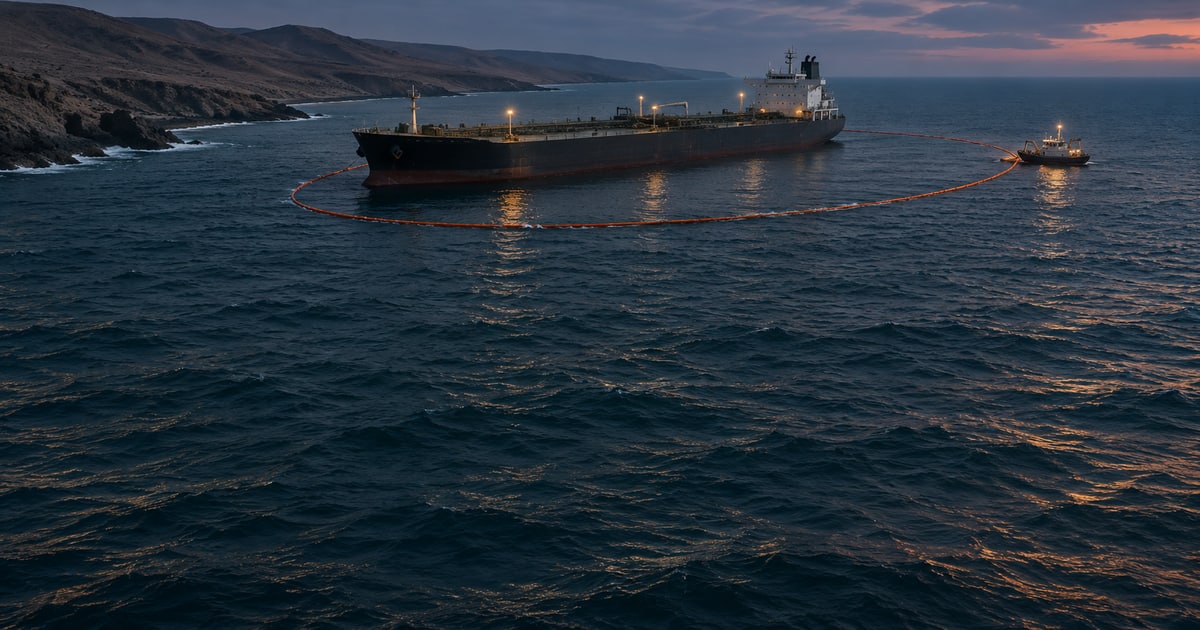
This article uses documents consulted by 20 November 2026. The status of unloading comes from the 17 November report. The individual certificate, policies, payment records and salvage bills for the Caroline Bezengi remain outstanding. The conventions set the limits of separate compensation regimes. We conducted no interviews with the salvors or insurers for this article. The cover image is an AI-generated illustration.
Sources
- Oman: response to the grounded tanker
Passages and scope
Joint release body. Official response announcement; no policy, invoice or indemnity disclosed.
- Oman: the practical constraints of the Caroline Bezengi response
Passages and scope
Statements by Mohammed bin Abdullah Al-Rawahi; list, power supply, rocky seabed and contractors. Coordinating ministry release. Approximately 17-degree list at this stage; no cost breakdown. An earlier ONA dispatch has the same title; publication dates differ.
- Ambrey: engagement in the salvage operation
Passages and scope
Opening paragraphs and photograph caption. First-party statement: mobilisation, specialists aboard and support vessels en route. The 6 August photograph does not date the grounding. No payer identified.
- IOPC Funds: preparatory paper on geopolitical events
Passages and scope
IOPC/OCT26/4/3, PDF pp. 2–3. Secretariat analysis; explosion, grounding and pollution sequence. Distinguishes sanctions-related payment obstacles from war exclusion. Attacker not established.
- IOPC Funds: final record of the October 2026 sessions
Passages and scope
IOPC/OCT26/11/2, PDF pp. 25–28, sections 4.6.3 and 4.6.10–19. Several delegations support the Director’s war-exclusion view for Caroline Bezengi on available evidence, unless new facts emerge. Includes Ghana and International Group interventions. No court judgment or payment established.
- Lloyd’s List: reported financing of the salvage response
Passages and scope
Public summary of 13 August. It attributes a financing role to AlfaStrakhovanie and reports waivers. The summary supplies neither a contract nor the waiver references.
- Offloading reported on 17 November
Passages and scope
First two paragraphs; SS Navigator alongside. Latest operational report located. Specialist-press observation without an official transferred-volume or compensation tally. Speculation about transfer to a third ship is excluded.
- Texts of the liability and Fund conventions
Passages and scope
CLC Articles I–III, V and VII: PDF pp. 4–7; Fund Articles 4 and 9–12: pp. 13–15; Supplementary Protocol Articles 4, 10 and 14: pp. 24–26. Legal texts: security, direct action, limits, exclusions, prevention and contributions. Exact formula retained; institutional 140,000 GT shorthand is not used as an exact arithmetic endpoint.
- IOPC Funds: current explanation of the 1992 CLC
Passages and scope
Liability, limits table, insurance and direct action. Current institutional explanation. Cargo threshold above 2,000 metric tonnes; limits depend on gross tonnage. Liability and defences read with treaty text.
- Oil pollution compensation guide
Passages and scope
Sections on compensation arrangements, liabilities and conventions; PDF pp. 20–21 for Bunkers. Joint institutional and industry guide. Explains separate liabilities and regimes; proves no policy applicable to Caroline Bezengi.
- IOPC Funds: states party to the conventions
Passages and scope
IOPC/2026/Circ.1, PDF pp. 2–3; Oman and France entries. Oman: 1992 Fund; France: 1992 Fund and Supplementary Fund. No global member count used: dynamic list also contains future membership dates.
- IMO: examining insurance certificates and providers
Passages and scope
Annex: provider assessment, financial capacity, reinsurance and periodic review. Implementation guidelines; recommended assessment criteria are distinct from newly created treaty obligations.
- Denmark: issuing insurance certificates
Passages and scope
CLC certificate section: Blue Card and requirements for insurers outside the International Group. Danish administrative practice: insurer’s undertaking followed by a state certificate; authorisation, reinsurance and auditor statements. Does not imply a state budget guarantee.
- IOPC Funds: guidance to Member States on claims handling
Passages and scope
Section 14, Other insurers, paragraphs 14.1–14.3. Post-incident checks of financial standing, solvency and policy scope; cooperation with commercial insurers is contemplated.
- RBNZ: Maritime Mutual’s prudential status
Passages and scope
Paragraphs on licensing, supervision and name exemption. No New Zealand prudential licence; products unavailable to people in New Zealand. Name exemption distinct from prudential authorisation. No finding of insolvency.
- United Kingdom: designations of 24 February 2026
Passages and scope
Caroline Bezengi: PDF pp. 145–146, RUS3341; MM NZ: p. 268, RUS3466; MM Gibraltar: pp. 273–274, RUS3472. Evidence of administrative decisions, with reasons attributed to UK authorities. IMO 9224439 identity; historical flag data. No judicial guilt finding or payment established.
- RBNZ: revocation of Maritime Mutual’s exemption
Passages and scope
PDF p. 1, sections 3–4(b), p. 2 section 4(c); earlier notices appended. Reports confirmation of wind-down, termination of coverage and cessation of insurance offers after sanctions. Concerns the name exemption; no finding that all past liabilities are extinguished.
- Belize: removal of Maritime Mutual from the P&I list
Passages and scope
IMM-045(26), PDF p. 1. Approval withdrawal for Belize-flag ships. Compliance by each operator with the replacement requirement was not checked.
- OFSI: licence for winding down prior Maritime Mutual contracts
Passages and scope
INT/2026/8893924, PDF pp. 1–3: definitions, sections 4.1–4.7, 6 and 9–10. Conditional permission for certain transfers under written contracts before 24 February 2026; includes monthly reporting. Legal permission distinct from observed transfers. Revocable.
- OFSI: notice explaining the 7 October amendment
Passages and scope
PDF pp. 2–3, chronology and Qualifying Overseas Wind-down Payment. Explains qualifying payments under certain contracts outside the UK insurer/broker branch and the 6 October 2027 expiry. Publishes no payment reports.
- IOPC Funds: oil receivers, contributions and payments
Passages and scope
Who pays?; How are contributions calculated?; What are the levies for? Annual threshold above 150,000 tonnes of contributing oil. Supplementary Fund: one-million-tonne minimum per state. No current Caroline Bezengi cost inferred.
- IOPC Funds: limits and conditions of both Funds
Passages and scope
1992 Fund and Supplementary Fund sections; compensation limits. Current cumulative limits of SDR 203m and SDR 750m. Fund may intervene when owner and guarantor cannot satisfy admissible claims. Prior payments are included.
This analysis is not investment advice.
// cite this analysis
l0g, “Russia’s shadow fleet: who pays when a tanker runs aground?”, l0g.fr, published November 20, 2026, updated November 20, 2026, https://l0g.fr/en/analysis/shadow-fleet-tanker-insurance-compensation/
$ cd ../analysis