// analysis
Nvidia: Chinese AI credit meets US export controls
Open the documentsThe source documents
The documents cited in the analysis and, where identified, their associated passages. An automatically detected association is not a verified claim.
- Notification of A100 and H100 licensing requirements ↗Source date not identified
- 10-Q for the quarter ended 26 July 2026 ↗Source date not identified
- Resignation and interim leadership ↗Source date not identified
Sources and reading context
Contents9 sections
In Songyuan, northeastern China, an official investment pitch promises a computing center combining Nvidia chips with Chinese processors. Its developer proposes seeking bank loans for roughly 80% of the cost. Between that pitch and the revenue needed to repay the loans lies a step on which everything else depends: obtaining the equipment and being able to operate it. S01
Nvidia’s crisis gives that question new weight. US export controls shape access to GPUs, the processors powering large AI systems. Jensen Huang’s succession raises a separate question about the commitments the next leader will maintain. On 13 November, the Financial Times reported that Rene Haas, chief executive of Arm and SoftBank Group International, had been approached. S09 S10
This ninth instalment follows our investigation into servers declared as collateral in Shanghai. It examines a different set of Chinese projects identified by Reuters, then considers the authorizations and governance decisions that may shape their financing.
Songyuan seeks financing before the revenue arrives
A project description published by the Jilin government portal on 27 April 2026 sets out planned investment of 2.2589309 billion yuan, or approximately 2.26 billion. Songyuan Guoxin’s proposed center combines H100s with Chinese processors and offers computing and rack-rental services. S01
Its funding section envisages approximately 80% bank borrowing and 20% company or shareholder capital. The developer intends to seek long-term loans on favorable terms from commercial or policy banks. The page still invites partners to negotiate. It presents a proposed financing structure, with lending agreements and disbursements yet to be identified. S01
Turning that proposal into credit requires examining the shareholders’ actual contribution, equipment orders, authorizations and customers expected to pay for the computing service. Cash remaining after operating expenses must cover debt payments. The debt-service coverage ratio, or DSCR, addresses that relationship.
An equipment delay could push revenue further out while some construction or financing expenses continue. Replacing the specified processors would also require reviewing costs, software compatibility and the performance promised to customers. The risk comes from a mismatch between repayment dates and incoming revenue.
Chinese project budgets cover different industrial stages
Reuters examined more than 150 documents and identified over 23 billion yuan in projects and equipment agreements involving Nvidia technology. Its 13 November investigation includes planned investment, contracts and installations described as completed. Buildings, electrical systems and other infrastructure are part of that scope. The figure indicates the scale of the identified projects across different stages of development. S02
Gansu provides an example beyond a search for partners. A tender dated 22 June 2026 envisages company funds and bank borrowing for a computing center specifying equipment described as “H100(200).” The final award notice of 20 July names a construction and engineering consortium with a contract value of 1.1564 billion yuan. An award is an identifiable commercial step. Server acceptance and financing terms require their own records. S03
Reuters expressly separates its identified projects from Megaspeed and the allegations involving Huang. Their relevance here is economic: infrastructure, orders and repayment plans are being designed around access to controlled processors. Nvidia and China’s commerce ministry had not immediately responded to the agency at publication. S02
A computing contract can change operators before it expires
A regulatory response from Damingcheng illustrates a further stage. In a statement published on 27 June 2026, the issuer describes an H800 cluster built using company funds and bank loans. Its associated computing-services contract originally amounted to 759.296 million yuan over 85 months. That figure described a service agreement extending over time, with a different scope from the cost of a data center. S04
As part of an equity sale, the old agreements ended on 31 January 2026. A three-party amendment transferred Mingcheng Digital’s rights and obligations toward Shanghai Unicom to Shida Group, effective 1 February. It describes the transaction as a move toward a lighter operating model. This commercial restructuring predates the current crisis by several months. S04
A lender must keep following the service contract after equipment delivery. When operations change hands, it needs to know who provides the service, who collects customer payments and which company remains liable for the debt. Servers can stay where they are while the legal entity earning the revenue changes.
US authorizations enter the financing timetable
The restrictions predate the present crisis. In a filing published on 31 August 2022, Nvidia reported that it had been notified on 26 August of an immediately effective licensing requirement for future A100 and H100 exports to China, including Hong Kong, and Russia. Systems incorporating those processors were covered as well. S05
The regime subsequently changed. A rule published and effective on 15 January 2026 provides case-by-case review for certain exports from the United States to China and Macau, including qualifying H200 products. It requires checks involving customers, security, US market availability and independent testing in the United States. Eligibility for review precedes an individual licensing decision. Other covered transactions, including certain reexports and in-country transfers, retain a presumption of denial. S06
Chinese decisions matter too. In its 10-Q for the quarter ended 26 July 2026, Nvidia reports H200 licenses obtained from February and a portion of equipment actually shipped. The company also describes Chinese restrictions that constrained purchases. The supplier’s account identifies several steps between US permission and a completed sale. S08
Trump holds commercial leverage whose records are being sought
A separate customs decision sits alongside export licensing. Trump’s 14 January 2026 proclamation imposes a 25% duty on certain covered US chip imports, effective the following day. It provides exemptions according to use, including US data centers, research, repairs and several industrial or public purposes. The duty therefore depends on the scope and conditions of the import. S07
The proclamation also confirms that Commerce transmitted its Section 232 national-security report to the president on 22 December 2025. The public text gives that date and the presidential conclusions adopted. The complete report remains an important record for reconstructing the decisions. S07
On 12 November, Ron Wyden and Richard Neal, the ranking Democrats on the relevant Senate and House committees, requested preservation of records concerning that process, Nvidia licenses and communications. They challenge the arrangement and raise a constitutional objection to a levy they characterize as export-related. Their letter initiates an inquiry and requests records preservation. S13
Our assessment: access to chips gives Washington influence that can reach project financing. Greater uncertainty over authorizations can change schedules and the protections lenders seek. Trump could try to turn that dependence into a political or industrial advantage, a scenario explored in our examination of state leverage.
The Haas report brings SoftBank’s interests into the succession
The Financial Times reported on 13 November that Haas had been sounded out during the search for Huang’s successor. The reported approach moves Haas beyond the names floated by analysts. S09
His background explains the interest. Arm says Haas has been its chief executive and a director since February 2022, after a career that included seven years at Nvidia. He also runs SoftBank Group International and sits on SoftBank Group’s board. SoftBank’s April 2026 announcement describes the expanded role as coordinating its semiconductor and AI holdings. S10
Those roles intersect with significant existing financial relationships. SoftBank is an investor in SB Energy. For the SB Energy/OpenAI project in Ohio, Nvidia agreed guarantees covering defined lease and power payments, subject to a combined $105 billion cap. They generally become effective as each lease begins. This arrangement has its own contractual scope, explored in our seventh instalment on AI guarantees. S08 S12
If Haas joined Nvidia, the board would need to clarify his other positions and how relationships with SoftBank-linked companies would be handled. The practical issue would be freedom to decide on industrial agreements and financial commitments.
Nvidia’s official succession process remains open. The board accepted Huang’s resignation on 11 November, then announced the following day that Colette Kress would serve as interim chief executive while retaining finance responsibilities, with an internal and external search under chairman Harvey C. Jones. S11
Nvidia’s next leader inherits decisions that need financing
An internal candidate could maintain commercial relationships while reviewing the most sensitive commitments. An outsider would need to establish a mandate with the board and partners. The Haas report adds a specific question: how to arrange the responsibilities of an executive already at the center of SoftBank’s industrial interests.
The Chinese projects illustrate a constraint any successor will encounter. An installation financed against future revenue needs equipment, commissioning and creditworthy customers. Governments can influence parts of that chain. Nvidia’s next leader will decide how much risk the company is willing to support, while lenders and investors look for enforceable contracts behind promises of computing power.
Sources
- Songyuan Guoxin computing-center project
Passages and scope
Sections 1.1, 3, 4.1 and 4.2: proposed configuration, investment of 225893.09万元 and sought funding, roughly 80% loans. Investment-promotion document; lenders and disbursements remain unidentified. Conversion: 1万元 = 10000 CNY.
Investigation of Nvidia-dependent Chinese projects, licensed edition · Project factbox from the same Reuters investigation
Passages and scope
Report published 08:29 UTC, updated 08:36; factbox 09:27. More than 150 documents and over 23 billion CNY of projects and agreements. Full indexed text examined in the licensed edition. Different scopes and development stages, explicitly separated from Megaspeed/Huang.
Yunjing project tender · Final contract-award notice
Passages and scope
Proposed company and bank funding, “H100(200)” specifications, then award at 115640万元. Award value differs from the initial budget. Indexed primary texts; delivery, acceptance and associated loans remain to be documented.
Issuer regulatory response, original PDF on CNINFO · Reproduction in Shanghai Securities News
Passages and scope
Announcement 2026-022, pages 3, 5 and 7. Company funds and bank borrowing; 75929.60万元 contract over 85 months. Old agreements ended 31 January; Mingcheng Digital’s rights and obligations toward Shanghai Unicom passed to Shida from 1 February. Issuer PDF examined on CNINFO.
- Notification of A100 and H100 licensing requirements
Passages and scope
Notification dated 26 August, disclosed 31 August. Future exports and covered systems as reported by Nvidia. Historical record to be read alongside subsequent rules.
Revised license-review policy · Official GPO text, 91 FR 1684
Passages and scope
Published and effective 15 January, following a 13 January announcement. Section II and amendments to 742.6: exports from the US, criteria, testing, checks and treatment of other transactions. Case-by-case review requires an individual authorization.
Semiconductor import proclamation · Tariff annex
Passages and scope
Paragraph 1 and operative provisions: Commerce report transmitted 22 December 2025, 25% duty on certain covered goods, use-based exemptions and application from 15 January 00:01 EST. Separate from export licensing.
- 10-Q for the quarter ended 26 July 2026
Passages and scope
MD&A China restrictions: H200 licenses and shipments, US conditions and Chinese restrictions. Note 10: SB Energy guarantees, scope and phased effective dates. Supplier disclosures; risks and commitments belong to the specified arrangement.
Rene Haas approached in Nvidia CEO search · FT public feed with dated headline and deck
Passages and scope
Verified public headline and deck report Haas being sounded out after Huang’s resignation. Full body is subscription-restricted. Contact date and initiator, candidate interest, company responses and publication minute remain unknown in accessible passages.
Rene Haas’s official Arm board biography · Announcement of his expanded SoftBank roles
Passages and scope
Biography: Arm since February 2022, seven Nvidia years and SoftBank roles. April release: coordination of semiconductor and AI holdings while retaining Arm. Terms of any move to Nvidia remain to be established.
Resignation and interim leadership · Attached release on the successor search
Passages and scope
Item 5.02 and Exhibit 99.1: 11 November decision, 12 November publication; Kress interim CEO and CFO, Jones chairman, internal and external search. Official arrangements, distinct from reported recruitment contacts.
- Joint project and SB Energy investors
Passages and scope
Identifies SoftBank and OpenAI as existing SB Energy investors and describes the project. Read alongside the 10-Q guarantee scope. Interested-party source.
- Records-preservation letter on Nvidia, Section232 and licenses
Passages and scope
Three pages. Request by two ranking Democrats. Allegations and constitutional argument are attributed to the signatories; preservation request, without a subpoena or response deadline.
Limits
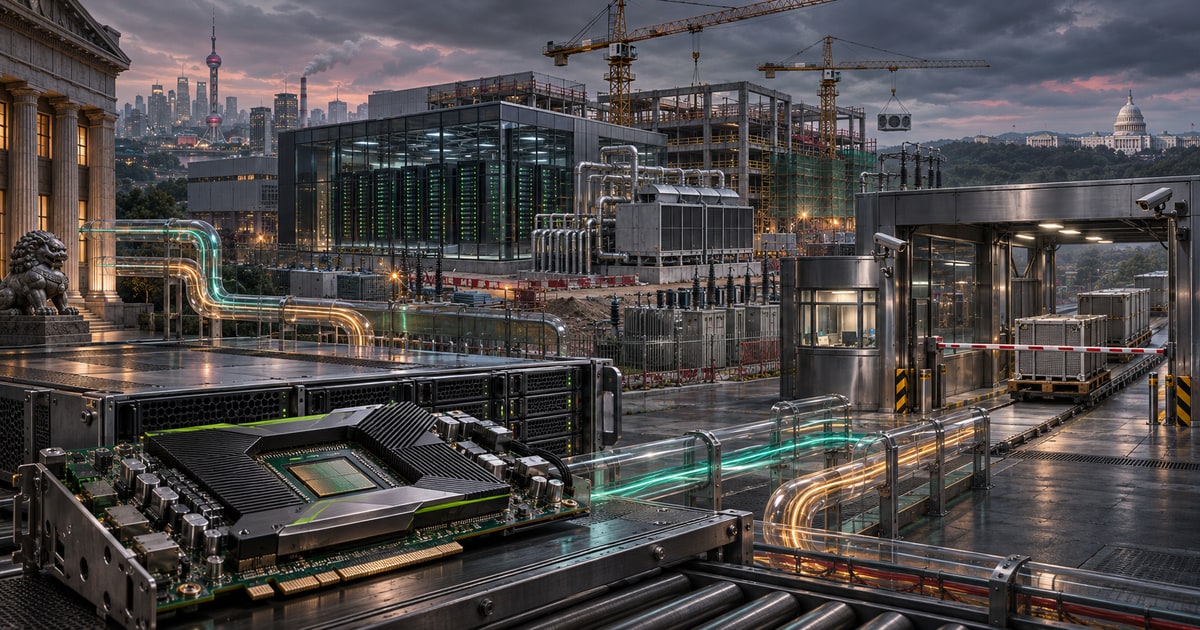
Information as of 13 November 2026. Chinese amounts retain the scopes and development stages specified in the article. Songyuan’s lending target, awarded contracts and Damingcheng’s service agreement have different statuses. Banks, disbursements, security interests and acceptance remain to be established where the records leave them unknown. Institutional and company accounts are attributed. The Haas approach is based on the FT’s public passages; its terms and an appointment remain open. Credit effects and political intervention describe mechanisms or scenarios. The illustration is an AI-generated conceptual composition.
This analysis is not investment advice.
// cite this analysis
l0g, “Nvidia: Chinese AI credit meets US export controls”, l0g.fr, published November 13, 2026, updated November 13, 2026, https://l0g.fr/en/analysis/nvidia-china-ai-credit-us-controls-rene-haas/
$ cd ../analysis