// analysis
Nvidia: Trump backs Tim Cook as Lutnick faces pressure
Open the documentsThe source documents
The documents cited in the analysis and, where identified, their associated passages. An automatically detected association is not a verified claim.
- Manhattan prosecutors’ announcement of the indictments ↗Source date not identified
- Justice Manual: grand-jury powers and subpoenas ↗Source date not identified
- Form 8-K: resignation and appointments ↗Source date not identified
Sources and reading context
Contents9 sections
As Nvidia’s directors begin searching for a chief executive, Donald Trump is publicly promoting Tim Cook for the job. Howard Lutnick faces questions over export enforcement, while Justice Department inquiries reach across the chipmaker’s ecosystem. Washington has several ways to shape the company’s future, and each gives the administration a different kind of power.
On 12 November, Trump proposed that Cook replace Jensen Huang, praising both executives in a Truth Social post. Cook is Apple’s executive chair, having handed the CEO role to John Ternus in September. Reuters reported that Apple and Cook did not immediately respond to requests for comment. His willingness to move, any approach from Nvidia and the board’s interest remain unestablished. S05 S16
Meanwhile, Reuters reports that senior White House officials are discussing whether Commerce Secretary Lutnick should be pushed out, citing two people familiar with the situation. The same report carries a White House official’s assurance of Trump’s confidence in him. Those accounts describe internal discussion and public support; an announced dismissal would be a further event. S01
These events place Nvidia’s succession and Lutnick’s future inside the same political crisis. Nvidia’s directors must choose a chief executive, while the administration must explain its handling of a strategic technology and the warnings surrounding its customers. Our earlier investigations followed the warnings reaching the top, the export-control decisions, the board and the reported NDA and Singapore’s requests for evidence. The next decisions will show how these institutions use the authority they hold.
A presidential preference enters a board decision
Nvidia’s formal position remains clear. Its board accepted Huang’s resignation as President, CEO and director on 11 November, effective immediately, and announced the transition the following day. Colette Kress serves as interim CEO while retaining her CFO responsibilities. The board is searching among internal and external candidates. S04
Trump’s intervention gives Cook a distinct status in the succession debate: a name advanced by the president in public. It may attract attention from customers, directors or investors. Any claim that it reflects a negotiated appointment would require evidence of those discussions. The message itself supplies neither Cook’s agreement nor a board decision.
The company’s bylaws put executive appointments and the filling of vacancies in the board’s hands. They also allow several offices to be held by one person, subject to law. Kress’s combined role therefore creates a practical oversight question: how will directors challenge financial commitments while the interim chief also supervises the accounts? Clear delegation can preserve continuity and make those decisions easier to scrutinise. S08
A prospective CEO must work with US export restrictions, government customers and industrial priorities. That gives the administration influence over the business and makes its preferences consequential for the search. Trump has now made one preference unmistakably public. Evidence of contacts with the board would help establish whether the intervention has gone further.
The Justice Department’s different fronts
Semafor reports three inquiries, citing two administration officials: an antitrust investigation focused on Nvidia, and inquiries concerning Megaspeed and Supermicro that examine Alice Huang’s involvement. It reports no indication of a current intention to charge Nvidia or Jensen Huang criminally. S02
Bloomberg separately reports scrutiny of whether entities linked to Alice Huang helped smuggle Supermicro products to China, citing one informed person. The connection with existing prosecutions remains unclear in the public excerpt. S03
Supermicro’s response now sits alongside Singapore’s account of the investigation. The company tells Semafor that Megaspeed has never been its customer and describes cooperation with US, Taiwanese and Singaporean authorities. Singapore’s Home Affairs Ministry describes limited information or assistance concerning Supermicro after requests to US authorities. The correspondence could clarify the difference through the records sought, the answers supplied and any explanation for the limits on assistance. Tracing the supply chain would also require purchase and delivery records. S02 S18
Some proceedings have a much longer public history. On 19 March, federal prosecutors announced charges against Yih-Shyan “Wally” Liaw, Ruei-Tsang “Steven” Chang and Ting-Wei “Willy” Sun over an alleged server-diversion scheme. The charges included conspiracies to violate the Export Control Reform Act, smuggle goods and defraud the United States. Supermicro itself was not a defendant in that indictment. Its subsequent filing disclosed a grand-jury subpoena, showing that compulsory requests for company records already preceded today’s headlines. S09 S10
There has also been a concrete change in one individual’s case. Reuters reported on 9 October that Sun had pleaded guilty the previous day to four counts covering export-control violations, smuggling, fraud against the United States and obstruction of justice. The plea concerns Sun and those offences. Establishing responsibility elsewhere in the supply chain requires evidence specific to the person or company concerned. S11
Nvidia’s competition exposure also predates Huang’s departure. Reuters reported on 28 October that officials were examining the proposed Hugging Face acquisition within a years-long antitrust investigation. Its account describes questions about acquisitions, investments, sales practices and pressure on customers, alongside scrutiny of transactions involving Groq and Run:ai. That chronology matters: a continuing competition investigation has its own origin and evidentiary record. S12
These cases may eventually connect through customers, transactions or shared intermediaries. Establishing those connections requires the corresponding records. The history already available shows why the latest headlines need to be read alongside earlier proceedings: some describe new scrutiny, while others follow allegations that prosecutors have been pursuing for months.
Investigators obtain evidence before courts decide remedies
In a civil antitrust investigation, the Justice Department can issue a civil investigative demand to obtain documents, written answers or testimony. The demand must identify the conduct being examined and the applicable law. It allows officials to collect evidence before deciding whether to bring a case. S13
A grand-jury subpoena obtains evidence within a criminal investigation. Rule 17 and the Justice Department’s manual describe its use and limits. A company may hold records about employees, customers or intermediaries whose conduct is being examined. The subpoena’s existence alone leaves its own exposure unresolved. S13
If a civil antitrust case follows, the government can ask a federal court to restrain unlawful conduct. A negotiated consent judgment also requires publication and judicial review. A remedy can change the way a business operates, but its terms must emerge from that legal process. The complaint, proposed agreement and court decisions would identify the obligations imposed. S14
Producing records, defending an acquisition and negotiating a remedy can put considerable pressure on management. That helps explain the interest in a possible bargain between Washington and Nvidia. To establish that officials were using an inquiry to obtain ownership, however, the investigation would need evidence of the exchange: a demand, negotiating instructions, a draft agreement or testimony describing its purpose.
At MP Materials, public money buys specific rights
The Pentagon’s July 2025 agreement with MP Materials offers a concrete example of public industrial intervention. The initial package set out $400 million in convertible preferred stock, a warrant, a $150 million loan commitment for heavy rare-earth separation at Mountain Pass, price protection and a ten-year magnet-purchase agreement for the planned 10X facility. The instruments address different needs and carry different rights. S06
The preferred stock gives the Pentagon an economic claim that can convert into common shares, while the warrant allows it to acquire further shares under agreed terms. The loan must be repaid. Alongside those financial claims, the purchase and price-protection agreements help support the business expected to supply the material. S06
Scope of the mechanism
The holding condition applies the contractual threshold to securities defined at closing. The clauses cover specified assets, control transactions and other defined restrictions. The loan commitment concerns Mountain Pass; offtake concerns 10X.
The financing also follows an industrial perimeter. Mountain Pass separation and the new magnet facility are different parts of the production chain. The contractual purpose of each commitment helps explain the capacity the government wants delivered and the risks taxpayers accept. Our examination of Intel and MP Materials follows the agreements in greater detail.
Applied to Nvidia, the precedent points towards several possible bargains. Washington could help finance a defined project in exchange for delivery commitments, or seek securities carrying rights across the company. A guarantee would put public money at risk if the borrower failed, while a capacity purchase would make the government a customer. Each arrangement would connect the public interest to a different part of the business.
Those differences determine the extent of influence. A supply agreement might let the government monitor delivery and recover payments if conditions fail. Shares could carry voting or other rights. A power to choose the CEO would require its own basis. Reading the agreements, including their exit provisions, would reveal far more about control than an ownership percentage alone.
A Pentagon project would need a defined purpose
Nvidia’s latest available quarterly report describes two operating segments: Compute & Networking and Graphics. It supplies a broad commercial picture, without establishing a standalone military division ready for a separate transaction. A defence-related proposal would need to identify the particular assets, technologies, projects or supply commitments being financed. S07
This is an analytical possibility. A public financing proposal could concern secure deployment, resilient supply or a defined computing-capacity commitment. Each would require a description of the public need, the beneficiary and the performance expected in return. Protecting access to strategic computing is a plausible industrial objective. Demonstrating that an actual Nvidia transaction pursues it would require the corresponding documents.
Federal programmes also operate within statutory boundaries. The Industrial Base Fund under 10 USC §4817 addresses industrial capacity and supply-chain vulnerabilities, with expenditure subject to available appropriations. The Office of Strategic Capital under §149 supports eligible investments in critical technologies and assets with potential defence benefits. Programme authority, eligibility and funding all matter to a proposed commitment. S19
The terms would need to turn that national-security objective into something the recipient must deliver. Funding could be linked to construction milestones, available capacity or continued access to technology. The budget and legal authority would define how much the government could promise, while the agreement would determine how it could enforce delivery or recover its money.
The scenario becomes politically consequential because Nvidia’s leadership is unsettled while its access to important markets depends on government decisions. That creates scope for bargaining. Its content remains to be demonstrated: protecting continuity, obtaining industrial commitments and acquiring corporate rights are distinct objectives that could produce very different agreements.
Two successions under different rules
Nvidia’s directors can allow the Kress interim to continue while completing their search. An internal appointment could preserve technical relationships and organisational knowledge. Reuters interviews identify Ian Buck as a suggestion advanced by analysts. His case rests on his product and computing background; those views supply an argument for consideration, rather than evidence of a board decision. S04 S17
An external search would bring questions about availability, incentives and the distribution of authority. Semafor reports Apple hardware chief Johny Srouji being considered, citing one person familiar with the matter. Reuters records observers suggesting Arm CEO Rene Haas. Cook now has Trump’s public endorsement. The sourcing gives these names different standing, and any eventual appointment would require the board’s own process and the candidate’s agreement. S17 S05
Commerce has a different succession mechanism. Lutnick could remain in office while facing scrutiny and demands for a change in enforcement. If a vacancy occurred, the department’s succession order places the Deputy Secretary first, subject to the governing law and the president’s lawful alternatives. Paul M. Dabbar is the deputy identified by recent sources. A permanent Commerce secretary is appointed by the president with Senate confirmation. S01 S15
An acting official would keep the department functioning during a vacancy while the president pursued a permanent nominee through confirmation. For now, the debate concerns Lutnick’s position and the policy he oversees. The absence of an announced departure or documented shortlist leaves continuity in office and an interim transition as scenarios to consider.
At both institutions, the immediate test concerns decisions that remain to be made. Nvidia must distribute authority over technology, customers and financial commitments. Commerce must account for export enforcement and cooperation with other jurisdictions. A personnel change can alter the people responsible while leaving the need for records and explanations intact.
Nvidia’s financial reach brings Congress into the argument
According to Reuters’ public preview, Senator Jack Reed wants Congress to examine whether Nvidia is too important to fail and the implications for the banking system. The available passage supports a request for assessment; it supplies no decision to grant the company systemic status or public support. S20
An operator preparing a new AI site has to spend before it can sell computing services. It needs a building and power, then equipment that must arrive, be installed and work together. A lender assessing the project has to connect that construction schedule with customer demand and the money expected to come in. An order for chips helps explain the plan; financing still depends on the operator’s ability to turn those chips into a functioning service.
Consider a project supported by a large customer’s purchase commitment or a guarantee. The lender would examine when equipment can be delivered, how firm the demand is and precisely when the guarantor must pay. A cancellation right or an unmet delivery condition could change the cash available to service the loan. These are different forms of support, with different failure points. Our previous instalment examines Nvidia’s CoreWeave capacity agreement and SB Energy guarantees, including the conditions attached to those obligations. S21
Existing agreements remain governed by their terms as leadership changes. The next management team inherits responsibility for supervising them, while decisions about new commitments offer more room to change course. If Nvidia became more cautious about supporting future projects, some operators might need more equity from their owners or longer to raise financing. That is a possible transmission mechanism through the industry, whose scale would depend on the projects affected and the alternatives available.
A public customer could make part of a project’s expected revenue easier for lenders to assess. Its contract would still have to be read for delivery requirements, termination rights and any dependence on future budget appropriations. Those provisions help determine how much financing the commitment can support. The same reasoning applies whether the promise comes from a major technology company or the government: the wording decides when money must change hands. Our AI financing atlas follows these links between industrial plans and the balance sheets backing them.
Washington now faces a test of its own decisions as well as Nvidia’s governance. A public investment proposal would make the intended bargain visible through the capacity sought, the money committed and the rights received. Congress could then examine the benefit to taxpayers and the influence acquired. Any evidence that officials had traded an investigation or an export decision for those rights would warrant scrutiny of that conduct too.
Trump has made his preferred name public. Nvidia’s directors retain the formal task of choosing a permanent chief executive. The inquiries, export decisions and any future financing agreement will show whether political preference develops into a more durable form of influence. Following the rights obtained and the obligations accepted will reveal more than treating every development as proof of a single plan.
Reporting and sources
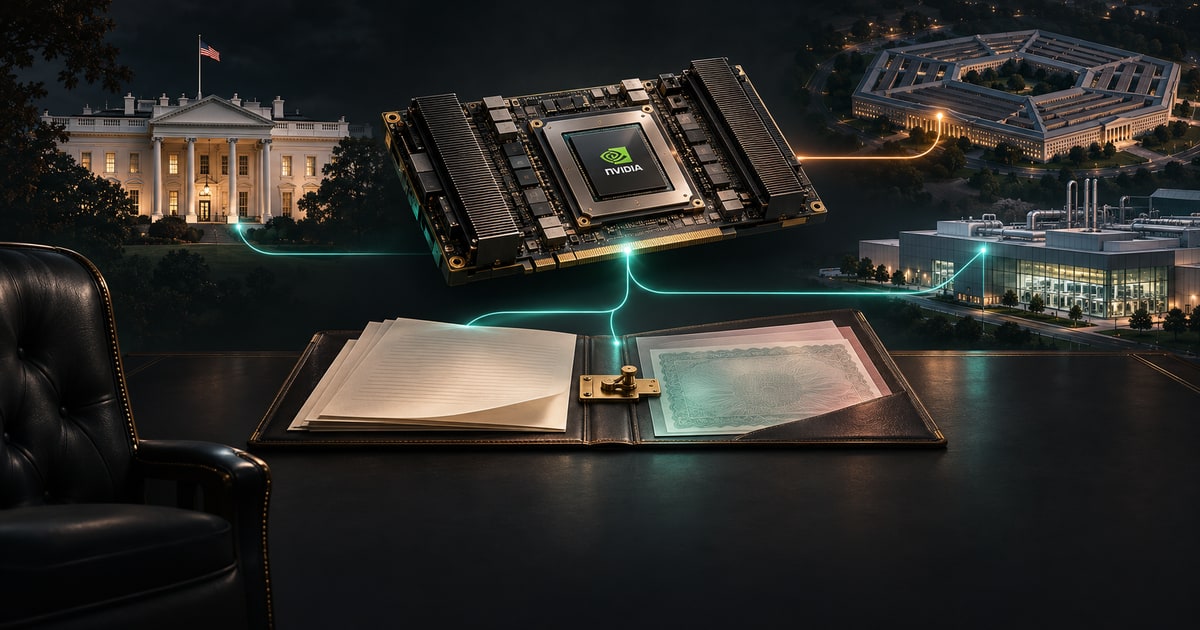
This analysis incorporates material available on 12 November 2026, including Semafor’s updated Supermicro response. It draws on public records and published reporting; no interviews or direct requests for comment were conducted for this article. Anonymous-source reporting is attributed to the originating outlet, and the Bloomberg and Reed items are limited to their accessible public excerpts. Financial amounts refer to disclosed contractual terms, with no current market quotations used. The public-investment routes discussed are scenarios. The cover image is conceptual artwork generated with AI, depicting an imagined scene without reconstructing a documented transaction.
Continue the investigation: our sixth instalment on Congress’s requests to Huang, Teter and Kessler follows the testimony requests and the exchanges between Nvidia and export-control officials.
Sources
- White House discussions about Lutnick’s future at Commerce
Passages and scope
Two sources and an official response. Dispatch timestamp: 18:18 UTC.
- DOJ inquiries and Supermicro’s response
Passages and scope
19:12:54 UTC update, including Supermicro’s response.
- Reported inquiry into Alice Huang and Supermicro products
Passages and scope
Public excerpt of Chris Strohm’s report: one person familiar with the matter describes scrutiny by Manhattan prosecutors. Connections to previously reported smuggling cases remain unclear. The full article was unavailable.
- Official announcement of the leadership transitionForm 8-K: resignation and appointments
Passages and scope
November 12 announcement and Item 5.02 of the 8-K: the decision accepted on November 11, Huang’s departure, Kress’s interim appointment and board succession. Company disclosures; the decision date differs from the publication date.
- Trump’s post proposing Tim CookArchived copy at Trump’s TruthReuters report on the president’s proposal
Passages and scope
The president’s post and Reuters coverage establish Trump’s public suggestion. An appointment requires the company’s own process and acceptance; these sources publish no hiring agreement.
- Form 8-K: partnership with the Department of DefenseTransaction agreement: financing and governanceAgreement to purchase 10X magnet productionForm of promissory note for the samarium loanPreferred stock: ranking and conversionPrice-protection agreement
Passages and scope
Form 8-K, Item 1.01; agreement dated July 9, Articles 7 and 8 on information and governance; purchase agreement, Articles 2 and 3; promissory note and lending terms. Specific contractual rights, subject to stated qualifications and funding conditions.
- Fiscal 2027 second-quarter Form 10-QSEC-filed version
Passages and scope
Quarter ended July 26, 2026; filed August 26. Note 13, pages 21–22: Compute & Networking and Graphics segments, with a unified architecture. Note 10 describes conditional commitments. The published segment presentation identifies no separate military business.
- Amended and restated bylaws dated March 12, 2024
Passages and scope
Sections 28–33, covering appointment, delegation and removal of officers. The document is dated March 12, 2024; its online publication date is unspecified. Executive office and a board seat are governed by distinct provisions.
- Manhattan prosecutors’ announcement of the indictmentsSupermicro’s SEC-filed statement
Passages and scope
Prosecutors’ release and the company’s statement: three individuals charged, with Supermicro absent from the defendants named in that indictment. The release sets out allegations; Sun’s later plea is covered in S11.
- Form 10-K: subpoenas, compliance and investigations
Passages and scope
Risk factors and legal proceedings: grand-jury subpoena, DOJ/BIS and foreign-authority requests, and findings of the board-commissioned inquiry. The reported status and company statements are dated to this filing.
- Willy Sun’s guilty pleaReuters syndication consulted
Passages and scope
Karen Freifeld and Jaspreet Singh’s court report: October 8 hearing, four counts and Supermicro’s response. Sun’s individual plea does not establish the responsibility of the other individuals or the company.
- Long-running antitrust scrutiny and questions about Hugging FaceFull Reuters syndication consulted
Passages and scope
Two people familiar with the matter describe a years-long inquiry into acquisitions, investments and business practices, including Hugging Face, Groq and Run:ai. Reported investigative questions are distinct from judicial findings.
- 15 USC §1312: civil antitrust investigative demandsJustice Manual: grand-jury powers and subpoenas
Passages and scope
Consolidated statute and Justice Manual §§9-11.101 and 9-11.140: obtaining documents and testimony, and grand-jury functions and limits. General legal framework; these texts do not establish that a new demand has been issued in the Nvidia matter.
- 15 USC §4: judicial proceedings and injunctions15 USC §25: proceedings to restrain violations15 USC §16: review of antitrust consent judgments
Passages and scope
Legal bases for judicial relief and public-interest review of settlements, including publication and comments under the Tunney Act. These provisions govern competition remedies; an equity transaction would require its own authority and documentation.
- 5 USC §3345: acting officersExecutive Order 13613: succession at Commerce15 USC §1501: appointment of the Commerce secretarySenate confirmation of Paul DabbarNovember 10, 2026 AI+Quantum programme
Passages and scope
Order signed May 21, 2012 and published May 24; succession remains subject to its exceptions and acting-service law. June 25, 2025 vote confirms Dabbar. The SCSP programme identifies him as deputy secretary; any future succession remains conditional.
- Tim Cook’s current role at AppleAnnouncement of the Cook–Ternus succession
Passages and scope
April 20 announcement, effective September 1, 2026: Cook becomes executive chairman and Ternus CEO. The current biography confirms Cook’s role; it establishes no candidacy at Nvidia.
- Names discussed before Nvidia’s leadership transitionBoard discussions and reported interest in Srouji
Passages and scope
Reuters/RTÉ predates the transition announcement. Semafor, published November 11 and updated November 12, reports board members’ interest in Srouji. Names raised by sources or observers do not constitute an official shortlist.
- Statement on Alice Huang, Megaspeed and US assistance
Passages and scope
Paragraphs 2–9, especially 6: the ministry’s account of local investigations and cooperation received.
- 10 USC §4817: Industrial Base Fund10 USC §149: Office of Strategic Capital
Passages and scope
Permitted fund uses, available appropriations, eligible technologies and investments, and loans and guarantees under the Office of Strategic Capital programme. Statutory conditions are distinct from a general authority to acquire Nvidia.
- Reed calls for an assessment of Nvidia’s systemic importance
Passages and scope
Report preview timestamped 19:33 UTC: Senator Jack Reed’s call for an assessment. The full report and underlying request were unavailable. This source establishes a call to examine risk, with no rescue decision announced.
- CoreWeave: capacity agreement with NvidiaNvidia: guarantees for the SB Energy project
Passages and scope
Item 1.01 of both filings. CoreWeave: agreement dated September 9, 2025, filed September 15; conditional purchases of residual capacity. SB Energy: guarantees announced August 17, 2026, with an OpenAI affiliate as tenant. Two distinct contractual arrangements.
This analysis is not investment advice.
// cite this analysis
l0g, “Nvidia: Trump backs Tim Cook as Lutnick faces pressure”, l0g.fr, published November 12, 2026, updated November 12, 2026, https://l0g.fr/en/analysis/nvidia-trump-tim-cook-lutnick-state-leverage/
$ cd ../analysis