// analysis
Housing in Europe: the cost of waiting for a building permit
Open the documentsThe source documents
The documents cited in the analysis and, where identified, their associated passages. An automatically detected association is not a verified claim.
- Study announcement and plans for the simplification package ↗2026
- Economic Bulletin 7/2026, residential investment ↗Source date not identified
Sources and reading context
Topics
Contents6 sections
In Madrid, a developer can start certain works while the city is still examining the technical file. An initial permit settles the key planning requirements. The review continues alongside the work and, if the final permit is refused, the developer may have to reverse work already done. The arrangement raises a practical question. How much does an extra month cost when the land is already financed and the project is waiting to break ground? S09
On 16 November 2026, the European Commission presented a study it commissioned from Intellera Consulting and Finland’s VTT research centre. It plans to use the findings in a housing simplification package due in the second quarter of 2027. Planning decisions remain largely in the hands of national and local authorities. The study identifies ways to coordinate approvals and give applicants a more predictable timetable. S01 · S02
The formal review starts with a complete file
Under the standard French rules, the review period is two months for a permit to build a single-family home and its ancillary structures and three months for other building permit applications. The period starts when the administration receives a complete application. Preparing the file, some exchanges with the planning authority and steps after the decision sit outside that period. Different deadlines can apply depending on the project and its location. S06
Applicants in the Commission’s study reported a median of about 13 weeks for formal review of a new building. For new buildings, the median for the full administrative process was about 43 weeks, including steps after the decision. Work can already be under way at that stage. The two medians cover different parts of a process that varies from one project to the next. S01
Survey coverage is uneven. Portugal provided 137 of the 226 responses from authorities, while Italy accounted for 88 of the 204 applicant responses. The surveys give an insight into the participants’ experience. Ranking national performance would require comparable projects and a more balanced sample. For developers, uncertainty also matters. A late request for documents can disrupt a financing schedule or a booking with a contractor. S01
Interest keeps accruing while a project waits
Property carrying costs start once capital is committed. Take a project that has already drawn €1 million at a hypothetical annual rate of 5%. If the balance stays constant, six months cost €25,000 in simple interest and a year costs €50,000. This illustration leaves out fees, repayments and compounding.
Land, studies and deposits may all be financed long before a sale. Calculating the actual interest bill requires knowing how much the developer borrowed at each stage. Some of the Commission study’s simulations estimate the time saving using the eventual value of the project. Those estimates are a model of opportunity cost under assumed financing conditions. S01
For a project with little margin for error, a few more months of expenses can force a change in the financing plan. For lower costs to show up in home prices, developments still need to start, builders need to compete and homes need to reach the places where people want them. Where buildable land is scarce, some of the gain can end up in the land price. S01 · S12
Madrid lets part of the work start earlier
Madrid’s licencia básica has a statutory decision period of one month. Once granted, it allows the specified work to proceed while the city reviews the rest of the project. The developer bears the risk that the final licence will be refused. The reform lets work and assessment run in parallel while retaining checks before the building can be used. S09
For cases processed without a collaborating body, the city’s evaluation shows average processing time falling from 177 to 139 days between the two cohorts it examined. The city attributes most of the fall to adding faster initial licences to the average. In the route involving a collaborating body, processing time rose from 40 to 49 days. Following comparable projects through to completion would show how much time residents actually gained. S10
The Commission study also looks at how information moves between departments. A PDF can be filed remotely. A digital building model, known as BIM, makes the information reusable. Staff can check floor area and levels against one version of the project, provided that the model, applicable rules and public databases can work together. The study’s scenarios illustrate how much that might help under those conditions. S01 · S02
French permits and starts follow different timetables
From October 2025 to September 2026, France’s statistical service for sustainable development estimates that 377,834 dwellings were authorised and 318,419 were started, excluding Mayotte. The totals use monthly series adjusted for seasonal and working-day effects. A start may follow a permit issued before the period. Counting the projects still waiting would require tracking each permit through to the start of work or cancellation. S04 · S05 · S13
In October, developers surveyed by Insee were more pessimistic about buyers’ access to finance and the outlook for housing starts. Across the euro area, the ECB reports that residential investment fell 1.3% in the second quarter of 2026 from the previous quarter. Permits continued to recover, partly because permits had been registered early in the Netherlands ahead of a change in legislation. Buyer financing still matters after a project has permission to proceed. Our investigation into how French mortgages are funded follows that side of the market. S07 · S11
Completion is the test that matters
In Auckland, Ryan Greenaway-McGrevy and Yun So estimate that, in 2024, rents on new private tenancies were 23% below the level they would have reached without the reform in the authors’ preferred model. Observed rents rose over the period, and the result depends on the choice of comparison cities. Auckland had broadened building rights across large areas, changing the scope for new housing on a different scale. S08
Europe could measure the benefits of reform more directly by tracking each project from the complete application to completion. An initial licence shows when certain work can begin. The time to the start of construction, and then to occupancy, would show whether simpler procedures change the date a home becomes available. S01 · S13
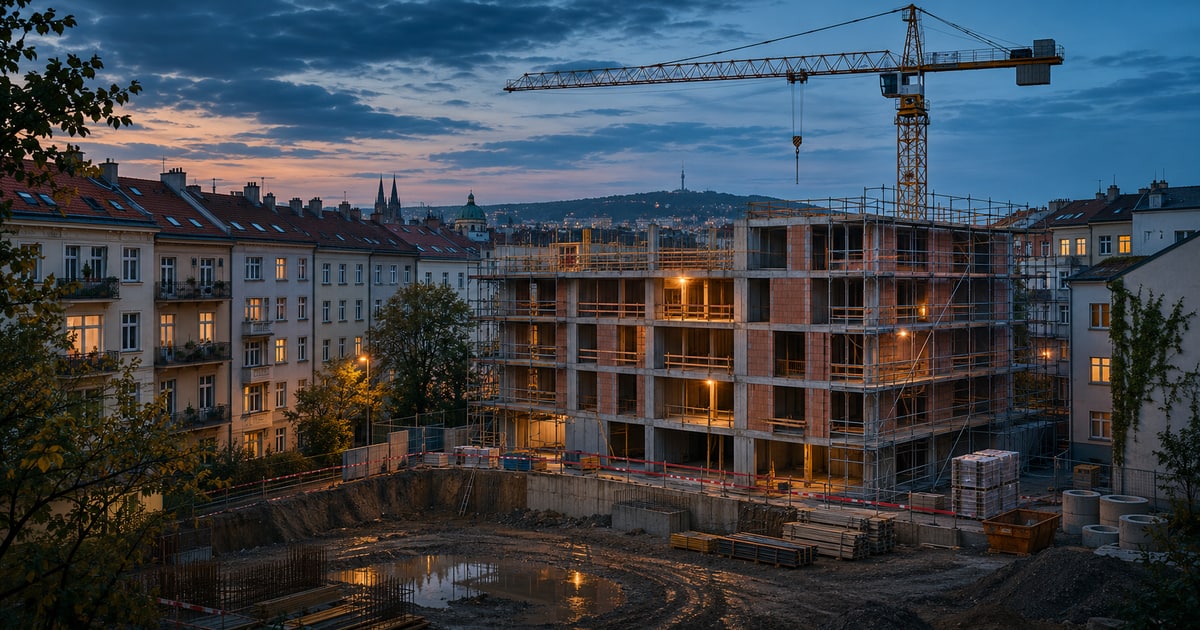
Sources were consulted on 20 November 2026. SDES’s September release page is dated 28 October. Its next release, covering construction through October, is scheduled for 27 November. The cover is an AI-generated editorial illustration. S04 · S15
Sources
- Study of residential building permits in the EU
Passages and scope
Table 3-8 on p. 28 for medians, pp. 134–140 for survey coverage and pp. 176–182 for costing methods. The Commission gives 5 November as the publication date. The Publications Office record is dated 26 October. Download the official PDF.
- Study announcement and plans for the simplification package
Passages and scope
Coordination and digitalisation proposals, with the package planned for the second quarter of 2027.
- Housing construction through September 2026
Passages and scope
Release page for France excluding Mayotte. Estimates by date of event and notes on the Sitadel methodology.
- Statinfo 864, tables and methodology
Passages and scope
Monthly authorisations and starts adjusted for seasonal and working-day effects. l0g calculates the rolling totals. Published estimates do not track outstanding permits, cancellations or time to start.
- Building permits and standard French review periods
Passages and scope
Guide checked by DILA on 13 February. Standard periods from receipt of a complete application, with exceptions.
- Economic Bulletin 7/2026, residential investment
Passages and scope
Section 2. Real residential investment in the second quarter, developments in permits and early registrations in the Netherlands.
- Rents for new tenancies after Auckland’s zoning reform
Passages and scope
Sections 4.3 and 4.4. The estimate is relative to a modelled scenario without reform and depends on the choice of comparator areas.
- Basic and final licences, Articles 44–47
Passages and scope
Version dated 10 November. Decision period, permitted works, liability, consequences of final refusal and first occupancy requirements.
- Final evaluation of the 2022 ordinance
Passages and scope
Report dated 17 October 2025. Printed pages 11–12. A city evaluation of its own reform. 2021 and 2023 cohorts, with decisions through May 2022 and May 2024 respectively.
- October survey of property developers
Passages and scope
Views on housing start prospects and buyers’ access to finance. These balances are survey responses.
- Housing governance and land-use planning
Passages and scope
Chapter 8 of Brick by Brick. How land restrictions and local governance shape the supply response.
- Sitadel methodology
Passages and scope
Definitions of authorisations and declared starts, and distinctions between reporting dates.
- Calendar of statistical releases
Passages and scope
Construction results through October are scheduled for 27 November 2026.
This analysis is not investment advice.
// cite this analysis
l0g, “Housing in Europe: the cost of waiting for a building permit”, l0g.fr, published November 20, 2026, updated November 20, 2026, https://l0g.fr/en/analysis/housing-permits-cost-of-waiting-europe-2026/
$ cd ../analysis