// analysis
Who guarantees the carbon in Google and McKinsey’s pasture deal?
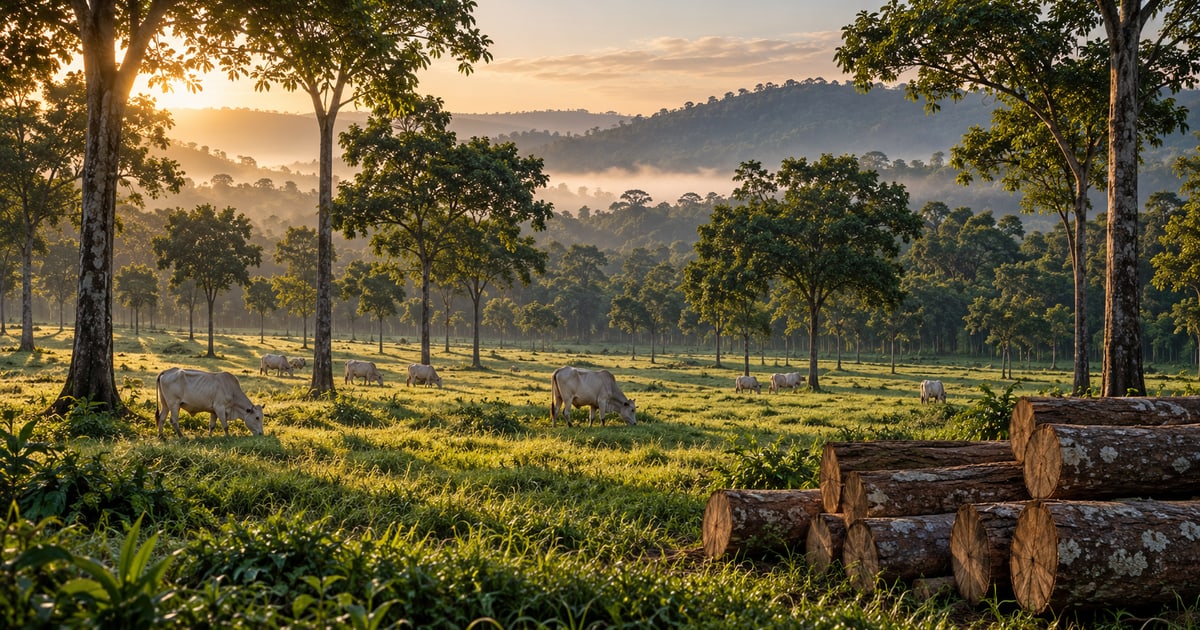
A 320,000-tonne future purchase in Brazil raises questions about finance, farm output and the carbon that remains after the timber is harvested.
A tree on a cattle farm can earn its keep several times, on different schedules. It provides shade, stores carbon as it grows and may eventually become timber that the farmer can sell. The agreement announced on 19 October by Google, McKinsey and the Symbiosis Coalition brings these activities together. Understanding its climate value requires following the carbon beyond planting, and the money beyond the purchase announcement. [1][2]
Symbiosis says Google and McKinsey have contracted the removal of 320,000 tonnes of CO₂ over ten years from Working Trees. Google confirms a purchase of 270,000 tonnes, leaving 50,000 attributable to McKinsey by subtraction. Symbiosis associates the agreements with 8,700 hectares of degraded or semi-degraded pasture, within a broader 50,000-hectare programme in the southeastern Amazon and central Cerrado. Reuters corroborates the announcement, rather than independently verifying the biological outcomes still to come. [1][2][3]
This is silvopasture: trees, forage and grazing livestock sharing the same land. There is a practical appeal to paying farmers to introduce trees without requiring them to leave cattle production immediately. There is also a financing problem. Establishment costs arrive before tradable carbon credits exist. Timber follows a different revenue schedule. The continued carbon storage underpinning the climate claim must remain credible beyond the final commercial delivery. Public documents help explain how these pieces might fit, while leaving the undisclosed contract terms unresolved.
Data and limits of this figure
{
  "announced": "2026-10-19",
  "total_tonnes_CO2": 320000,
  "google_tonnes_CO2": 270000,
  "mckinsey_residual_tonnes_CO2": 50000,
  "residual_method": "320000 - 270000; not a disclosed bilateral contract",
  "purchase_duration_years": 10,
  "associated_hectares": 8700,
  "broader_programme_hectares": 50000,
  "area_share_pct": 17.4,
  "delivery_schedule": null,
  "price": null,
  "prepayment": null,
  "source_ids": [
    "S01",
    "S02",
    "S03"
  ]
}
A future customer can help finance today’s planting
An offtake is an agreement to buy future output. For a developer seeking finance, having a committed customer can be much more useful than relying on a future market price and an unidentified buyer. Yet someone still has to fund planting and maintenance before the project produces credits it can deliver. The public summary of Symbiosis and CrossBoundary’s June guide makes this distinction between demand certainty and delivery risk explicit. [7]
Google’s presence helps answer a commercial question: will there be a customer? It cannot, on its own, settle the production questions. How many trees will survive? When will verification permit credit issuance? Who supplies more capital if maintenance costs rise or a monitoring cycle is delayed? A financially strong buyer can still become a creditor of a seller that fails to deliver.
The public announcements do not disclose prices, payment milestones or the detailed security arrangements for the two agreements. Applying a generic carbon-market price to 320,000 tonnes would therefore manufacture an investment value. Describing the purchase as money already paid to farmers would be equally unwarranted. Payment on delivery leaves an upstream funding gap; an advance narrows that gap but increases the buyer’s exposure. The contract determines how the gap is funded and who bears it. [1][2][7]
Working Trees says it covers most initial establishment costs. The Arbor Day Impact Fund had already announced a capital partnership with the developer on 11 May. Another financier, Enduring Planet, describes a bridge facility that helped the business cover operations during fundraising. These are interested sources, but they show that the financing effort and the programme’s development preceded the October announcement. They do not provide a complete allocation of funding to particular hectares. [4][5][6]
That earlier activity needs a fair reading. A pilot can demonstrate that an approach works operationally, then enable an expansion that requires new customers. Its existence does not automatically defeat additionality: the extra climate benefit attributable to the project. It does make it important to separate already committed land from land dependent on the new agreements. A programme’s target area, the area associated with an offtake and the area actually planted measure different stages of development.
For investors, this distinction affects both collateral and forecasts. Land mentioned in a development programme is not necessarily an operating asset with a predictable stream of credits. Nor does a volume contracted over ten years imply equal deliveries each year. The timing of establishment, growth and verification can concentrate the cash requirement well before the income. An annual average would conceal precisely the financing problem the offtake is intended to help solve.
Data and limits of this figure
{
  "type": "General financing mechanism",
  "documented_milestones": [
    "2025-08-25 Verra consultation",
    "2026-05-11 Arbor Day partnership",
    "2026-10-19 offtake announcement"
  ],
  "payment_schedule": "not public",
  "source_ids": [
    "S05",
    "S07",
    "S09"
  ]
}
Tree measurement and the carbon baseline
Working Trees uses a phone application to reduce the burden of field measurement. There is identifiable research behind the technology. A 2023 paper in Forests compared app-based tree diameters with manual measurements in trials in Virginia, reporting a root mean square error of 2.71 centimetres and a strong statistical relationship between the series. The experiment tested diameter measurement. Its results cannot be translated into a claim of “95% accuracy” for carbon credits. [14][21]
The authors report a downward measurement bias and disclose that several have employment or advisory relationships with Working Trees. Those declared interests do not make the research worthless. They do distinguish a published measurement comparison from an independent audit of the Brazilian project’s carbon accounting. The paper does not verify its parcels, baseline or future credits. [14]
A simple thought experiment explains the gap. A photograph can help identify a tree, locate it and document its growth. It cannot establish how much carbon the same land would have stored without the programme. To claim an attributable benefit, a project needs that alternative trajectory, along with an assessment of implementation emissions, uncertainty and any activity shifted elsewhere.
Verra’s VM0047 methodology provides one reference framework. Its area-based approach uses a dynamic performance benchmark and comparison areas to assess outcomes through successive verifications. Symbiosis’s criteria likewise require a robust reference and field evidence. These are requirements against which an assessment can be made. The accessible documentation did not allow us to check their complete application to every parcel associated with these agreements. [11][8]
There is a relevant public registry trail. In August 2025, Verra listed “Working Trees – Scaling Brazilian Silvopasture” for public comment, linking to VCS project 5184. The current contents of that project record were not readable in this research. It would be wrong to turn that access limitation into a claim that no credits exist, that registration is complete or that the project currently has a particular validation status. The consultation is evidence of a documented project process; the project description and subsequent verification reports are needed to establish more. [9][10]
The following illustration uses deliberately hypothetical quantities. It is not a reconstruction of Working Trees’ methodology or credit forecast. It shows why the amount of carbon observed in vegetation and the number of units available for delivery can be different, even when all the underlying measurements are sound.
Data and limits of this figure
{
  "status": "Hypothetical illustration, not Working Trees data or VM0047 implementation",
  "unit": "tCO2e of illustrative net climate accounting",
  "gross_growth": 100,
  "counterfactual": 20,
  "project_emissions": 5,
  "leakage": 5,
  "uncertainty_deduction": 10,
  "net_before_buffer": 60,
  "illustrative_buffer_fraction": 0.2,
  "buffer": 12,
  "available": 48,
  "reservation_is_not_an_emission": true,
  "source_ids": [
    "S11",
    "S12",
    "S13"
  ]
}
Cattle output determines the leakage risk
Retaining grazing has a plausible advantage over replacing a livestock operation entirely with trees: it may avoid pushing the whole activity elsewhere. Yet cattle can remain on a plot while output per hectare falls. If that output is replaced outside the project, some of the land-use pressure has moved rather than disappeared. Carbon accounting calls this leakage. It needs to be assessed through production and land-use changes, not simply by observing that animals still graze between the rows. Crediting principles and Symbiosis’s criteria both address this risk. [13][8]
A Brazilian meta-analysis published on 28 July 2026 supplies a useful counterweight to automatic productivity claims. It reports 45 included articles from a literature search ending on 10 February 2024. Relative to open pasture, its published average effects are a 30% lower forage accumulation rate, a 12% lower stocking rate and 14% lower liveweight gain per hectare. Forage crude protein concentration was 17% higher, while the difference in individual average daily gain was not statistically significant. [15]
Those results are not a forecast for Working Trees. The underlying systems vary substantially. Many experiments used eucalyptus and comparably managed open-pasture controls, rather than the rehabilitation of degraded pasture targeted by this programme. Species, tree density, rainfall and canopy management matter. Timber income can also offset a reduction in cattle output economically. A farmer can earn more from the combined system while producing less liveweight per hectare. [15]
This changes the relevant diligence question. Animal comfort and total farm income are important, but neither is a complete measure of displacement. Output per hectare, purchased feed and production on other land also need to be followed. A local benefit should be examined alongside the changes it causes beyond the project boundary.
The strongest case for the project deserves equal attention. Improving a badly degraded pasture could increase usable production and reduce pressure to open more land. Keeping cattle revenue can also make adoption more realistic for the farmer. These possibilities have to be tested against appropriate comparison farms and observed over time. An average from the agronomic literature cannot substitute for that work. It does, however, show why retaining livestock cannot by itself settle the leakage question.
There is a broader lesson for buyers. A business model may deliberately trade some livestock output for timber and carbon income. That can be a rational and worthwhile transition. The accounting must simply capture the trade rather than assume that every output rises together. Otherwise an economically successful farm could be used to support a climate calculation built on the wrong production baseline.
Data and limits of this figure
{
  "paper_date": "2026-07-28",
  "search_cutoff": "2024-02-10",
  "articles_reported": 45,
  "control": "Open pasture; same metric normalised to 100",
  "not_project_forecast": true,
  "confidence_intervals": "Not transcribed; visual shows published rounded point estimates only",
  "high_heterogeneity": true,
  "observations": [
    {
      "metric": "forage_accumulation_rate",
      "published_percent_change": -30,
      "index": 70,
      "unit_original": "kg dry matter/ha/day"
    },
    {
      "metric": "stocking_rate",
      "published_percent_change": -12,
      "index": 88,
      "unit_original": "animal units/ha; 1 AU = 450 kg liveweight"
    },
    {
      "metric": "liveweight_gain_per_hectare",
      "published_percent_change": -14,
      "index": 86,
      "unit_original": "kg liveweight/ha"
    },
    {
      "metric": "crude_protein_concentration",
      "published_percent_change": 17,
      "index": 117,
      "unit_original": "% dry matter; relative difference, not percentage points"
    }
  ],
  "individual_daily_gain": "No statistically significant difference reported; not assigned zero effect",
  "source_ids": [
    "S15"
  ]
}
Timber provides an incentive to keep the system, and eventually to harvest
Timber revenue is among the design’s most important features. Farmers need a reason to keep managing the system when carbon income slows or ends. Symbiosis explicitly presents commercial timber as a long-term incentive and says harvesting cycles are included in the project’s carbon quantification. Harvesting is therefore part of the disclosed design, not an inconsistency uncovered behind the announcement. [1]
It still creates a demanding link between the commercial asset and the climate claim. The trees should eventually be worth selling, while carbon stocks remain consistent with the credits already issued. The outcome depends on rotations, remaining growth, replanting and the destination of harvested wood. Careful design can support continuity. Counting the trees initially planted cannot demonstrate it.
Harvest transfers some carbon into other pools. Certain products can retain it for decades; processing losses, residues and end-of-life treatment follow different paths. IPCC inventory defaults distinguish half-lives of two years for paper, twenty-five for wood-based panels and thirty-five for sawnwood. These are modelling parameters for product categories, not predictions of Working Trees’ sales or the accounting provisions in its contracts. [16][17]
Our illustration starts with carbon already in a product-in-use pool and adds no new material. With a thirty-five-year half-life, half remains in that pool after thirty-five years and a quarter after seventy. Leaving the pool does not necessarily mean immediate atmospheric release: recycling or storage at the end of a product’s life requires further accounting. This is why the destination of harvested material matters as much as the carbon initially present in the tree. [16][17]
The key project evidence would be a complete, conservative stock trajectory, with harvest assumptions and continuing monitoring commitments. It should connect credited quantities with standing biomass, the material actually entering products and expected losses. Commercial timber strengthens the reason to maintain a managed plantation; it also makes transparency about transfers between carbon pools essential.
Rotation introduces a further timing issue. A system can maintain an average stock across areas harvested at different times even though individual plots experience large changes. Buyers need to understand which aggregation is being used and whether the areas and obligations remain in place. A smooth programme-level curve would be misleading if it depended on expansion that has not been financed or on replanting that nobody is contractually required to undertake. This is a question for the project documentation, not an allegation about its design.
Data and limits of this figure
{
  "status": "IPCC default-based teaching cohort, not Working Trees projection",
  "initial_in_use_pool_index": 100,
  "additional_inflows": 0,
  "formula": "C(t)=100*2**(-t/half_life)",
  "half_lives_years": {
    "paper": 2,
    "panels": 25,
    "sawnwood": 35
  },
  "pool_outflow_not_necessarily_immediate_emission": true,
  "source_ids": [
    "S16",
    "S17"
  ]
}
Delivery failure and storage loss require different protections
Two distinct failures can affect a carbon purchase. Before issuance, growth may fall short or the project may fail to pass verification on schedule. The buyer receives fewer credits, receives them late or must source replacements. After issuance, a fire or an unanticipated stock loss may undermine a benefit already counted. Financial security and mechanisms addressing biological reversals therefore cover different events. [7][12][13]
A buffer mechanism can withhold units to address losses under a programme’s rules. Insurance or contractual guarantees may cover defined replacement or compensation costs. Conditions, exclusions and the ability to honour commitments matter. None of the announcements examined establishes a project-specific buffer percentage or an unlimited guarantee covering every source of loss.
There is also a tension between buyer protection and project funding. Cash immobilised as collateral cannot simultaneously pay for planting. A developer facing heavy security requirements needs more capital, has to scale back or seeks a higher credit price. Symbiosis and CrossBoundary explicitly identify this financing cost. An apparently safer purchase can make the underlying removal more expensive to produce. [7]
The mechanism can work constructively too. Credible milestones, independent checks and clearly allocated consequences for delays can help avoid a blunt and costly collateral requirement. Better-designed terms could direct more capital towards establishment without pretending that the risk has vanished. That is a contractual design argument, however, rather than a provision we can attribute to either Google or McKinsey without seeing their agreements.
Nor are financial recovery and atmospheric recovery interchangeable. Compensation may enable the purchase of another credit. It does not immediately regrow a lost tree stock. The quality and timing of any replacement therefore remain relevant after a commercial claim has been settled. A statement that a buyer is financially protected would leave this second question open.
One pasture, several climate accounts
Trees create a CO₂ removal flow while the herd has its own emissions, including methane from digestion. FAO’s documentation explains that enteric methane varies with factors including feed and animal characteristics. Monitoring tree carbon does not provide a complete climate account for the beef produced on the land. [23]
Improvement per unit of output also differs from change in the total. In a purely arithmetic example, a 20% reduction in emissions intensity combined with a 25% increase in production leaves total emissions unchanged. This is not a projection for the programme. It illustrates why a productivity indicator cannot simply be relabelled as an absolute reduction in greenhouse gases.
A separate issue arises when different businesses discuss the same trees. The farmer can report physical carbon on the property; a beef buyer can track its supply-chain emissions; Google or McKinsey can acquire credits associated with additional removal. Those observations can coexist. Using them to claim compensation or progress towards targets requires a consistent assignment of the benefit.
Version 1.1 of the GHG Protocol’s Land Sector and Removals Standard, published in June 2026 and effective from January 2027, makes this distinction explicit. It separates the physical inventory from values adjusted for issued credits, and requires adjustments where benefits transferred for external compensation would otherwise also count towards targets within the originating value chain. This is an accounting framework, not evidence of double counting in this deal. [19][20]
Data and limits of this figure
{
  "accounting": "physical inventory, credit issuance and use are distinct",
  "effective_date": "2027-01-01",
  "example": {
    "status": "Arithmetic example only; no farm forecast",
    "baseline_output": 100,
    "baseline_intensity": 100,
    "scenario_output": 125,
    "scenario_intensity": 80,
    "total_emissions_index": 100,
    "formula": "125 * 80 / 100"
  }
}
Ecological claims also depend on the correct boundary. Rehabilitating a degraded pasture and increasing tree cover in native savanna are different interventions. A 2017 Science Advances study in the Cerrado found that carbon accumulation through woody expansion could come with biodiversity losses. It did not study Working Trees. Its relevance is that the history and ecology of a parcel must be established before more trees can be equated with restoration. [18]
Symbiosis’s public criteria call for secure land and carbon rights, social safeguards and ecologically appropriate design. That provides a useful benchmark. The farmer agreements would show how it is implemented: revenue shares, maintenance, harvesting rights, the duration of obligations and what happens when land changes hands. Initial consent matters, but continuity over decades also requires arrangements that survive changes in ownership. [8]
The benefits need not all belong to the carbon buyer for the project to work. Farmers can gain shade, timber income and a more diversified business while buyers acquire a properly defined carbon claim. Clear separation makes those benefits more credible. Ambiguous ownership of the same climate outcome would weaken an otherwise sensible partnership.
The purchase starts the verification work
The deal brings identifiable demand to a farming model designed around several sources of income. Public records also show prior development and financial partnerships. That is more substantial than a planting promise without a customer, and it supports a plausible role for the new agreements in financing expansion. [2][4][5]
A verified climate conclusion requires further evidence. Parcel histories establish the reference; agricultural monitoring helps assess displaced output; harvest trajectories explain storage over time. Independent reports and registry transactions should then connect those outcomes to credits delivered and used. The essential contract provisions would reveal who finances a delay or pays for a loss.
This can be useful transition finance without making the announced 320,000 tonnes an already verified climate result. Its strength will depend on aligning the interests of credit buyers, the people maintaining the trees and the farmers who eventually sell the timber. The signature brings them together. Delivery will show whether their different schedules can hold together.
The distinction between carbon credits and a product’s footprint extends this examination of climate claims. The TFFF’s proposed bond portfolio offers a different route from capital markets to forest protection, with its own payment priorities and risk allocation.
Method and limits
Documentary research as of 20 October 2026, following the 19 October announcement. Contracted quantities are separated from physical outcomes, standards from their project-specific application, and external research from Working Trees results. No interviews or field audit were conducted. The full contracts and current registry contents could not be examined. Teaching examples are explicitly hypothetical; wood-product curves use generic IPCC parameters. Original sources are linked, not archived in full.
Sources and documents reviewed
- Symbiosis Announces New Carbon Offtake Agreements with Working Trees
Aggregate future offtakes, associated area and disclosed timber-harvest design; commercial announcement, not an outcome audit.
- Working Trees to remove 270,000 tons of CO2 in Brazil
Google confirms 270,000 tonnes contracted. McKinsey’s 50,000-tonne residual is calculated against the coalition total, not independently disclosed contract text.
- Google, McKinsey strike Brazil carbon removal deal with silvopasture project
Independent reporting corroborates the announcement, not future removal performance.
- Working Trees : présentation du modèle
Developer description of establishment support and pilot activity; self-reported, not a parcel-level audit.
- Arbor Day Impact Fund, Working Trees Partner to Unlock Catalytic Finance for Reforestation
Capital partnership predates the October offtake. Amount and allocation are undisclosed.
- Working Trees partners with Enduring Planet to scale silvopasture deployment
Lender case study on operating bridge finance during fundraising; not evidence of this offtake’s loan structure.
- Symbiosis Coalition and CrossBoundary Group Release the Carbon Offtake Guide
Published guide summary explains delivery-risk allocation and the funding cost of collateral; not deal-specific contract evidence.
- Quality Criteria
Buyer quality criteria provide a benchmark; they do not constitute a public independent audit of this project.
- Projects Open for Public Comment: August 25, 2025
Historical consultation and project identifier, not proof of current issuance or registration status.
- VCS 5184: registry record linked by Verra
Current registry content was not readable. No current status or issuance total inferred from the access failure.
- VM0047 Afforestation, Reforestation, and Revegetation, v1.1
General reference for dynamic benchmarking; project-specific methodology version and implementation were not verified.
- ABACUS Label Guidance, v1.0
Reference framework for durable storage and reversal treatment; no ABACUS label is asserted for this project.
- Core Carbon Principles
Quality principles, not an assessment or label for the project.
- Measuring Tree Diameter with Photogrammetry Using Mobile Phone Cameras
Instrument-validation research with disclosed employment/advisory interests. Not project carbon verification; R² is not a carbon-accuracy percentage.
- Forage Responses and Beef Cattle Performance in Silvopasture Systems: A Meta-Analysis of Tropical and Subtropical Regions of Brazil
Published rounded average effects, with substantial heterogeneity. Not Working Trees measurements or forecasts; underlying search ends in February 2024.
- 2019 Refinement to the 2006 IPCC Guidelines, Volume 4, Chapter 12: Harvested Wood Products
IPCC default product-pool half-lives. Teaching cohort only; pool outflow is not necessarily immediate atmospheric release.
- Wood products and carbon storage
Institutional explanation of wood-product carbon storage; not a project-specific timber forecast.
- The biodiversity cost of carbon sequestration in tropical savanna
Original Cerrado study illustrates a carbon–biodiversity trade-off; it is not evidence of harm by Working Trees.
- Land Sector and Removals Standard v1.1
Inventory and credit-adjusted target accounting requirements, effective January 2027; not evidence of double claiming in the deal.
- Land Sector and Removals Standard: publication and effective date
Version and effective-date information; not a universal legal prohibition.
- Measuring Tree Diameter with Photogrammetry Using Mobile Phone Cameras: institutional repository
Institutional repository for the same measurement paper, not a separate replication.
- The Carbon Offtake Guide: overview
Guide landing page; the full guide was not retrieved. Analysis uses the detailed public summary.
- Enteric methane
Livestock methane mechanism; no project herd emission factor or methane conversion is assumed.
This analysis is not investment advice.
// cite this analysis
l0g, “Who guarantees the carbon in Google and McKinsey’s pasture deal?”, l0g.fr, published October 20, 2026, updated October 20, 2026, https://l0g.fr/en/analysis/google-mckinsey-pasture-carbon-timber/
$ cd ../analysis