// analysis
When credit starts sorting AI
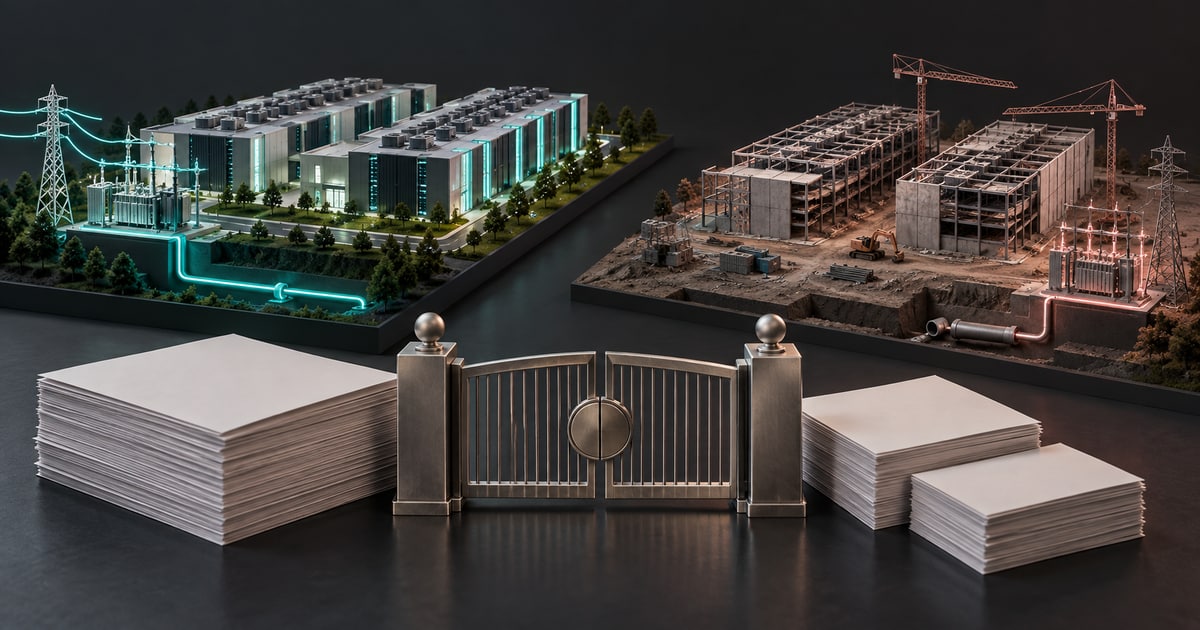
Discounted Jupiter loans, Oracle customer advances and Meta guarantees: a sourced analysis of AI data center financing and contractual risk.
A huge order book can coexist with a construction project that is hard to finance. In New Mexico, loans tied to Oracle are being offered below par. In Louisiana, Hyperion relies on Meta’s leases and guarantees. The two structures show how the cost of capital can shape which AI projects reach operation.
On September 18, 2026, Reuters, citing the Financial Times [3], reported that $18 billion of loans tied to Project Jupiter, an Oracle-leased campus, were quoted by syndicate banks at 89–91 cents per dollar of face value. Distribution to other investors had slowed, leaving banks with more Oracle-linked debt than planned.
These were loan quotes reported by the press, rather than a comprehensive record of executed trades. A discount does not directly quantify either the probability of default or lenders’ eventual loss.
Hyperion, Meta’s Louisiana campus, offers a different perspective. Public documents describe its funding structure and contractual protections. The comparison here concerns financing arrangements and risk allocation. We do not have a verified price series for comparing the projects’ market performance in September.
Jupiter’s loan distribution becomes a constraint
According to the same Reuters report [3], Project Jupiter spans about 1,400 acres in Doña Ana County, New Mexico, and is intended to deliver computing capacity to OpenAI under Oracle’s agreements. Santander and Jefferies were among the banks cited for September’s quotes.
Syndication spreads a financing across several lenders. Arranging banks may subsequently seek to sell part of their exposure. Difficult distribution ties up their resources for longer and may restrict their ability to back new projects, depending on their balance sheets and exposure limits.
Reuters attributes concerns about Oracle’s borrowing, creditworthiness and the campus’s permits to the Financial Times. The account identifies pressure on this transaction. It does not establish that AI financing has closed across the sector.
Electricity becomes a contractual issue
The project initially envisaged 2.2 GW of gas turbines. Reuters reported on September 18 that the state land office had blocked a request for a pipeline right of way. Water supply and air quality also feature in local opposition. That capacity describes the initial plan as reported then, without assuming it remains the final energy configuration. Reuters / FT [3]
On September 24, Reuters reported a force majeure notice [4] sent by Oracle to a Blue Owl unit developing the campus. Oracle cited possible delays in securing electricity. An unnamed source attributed that responsibility to Oracle and said the company remained responsible for debt costs and could not terminate the lease.
The notice’s legal effect depends on the contract and the parties’ agreement. The report says Oracle is seeking to defer some payments if the campus misses its planned 2028 opening. Oracle says Project Jupiter remains on schedule; Blue Owl says the notice does not alter the financial commitments.
A delay may extend financing costs or shift rental receipts. Who bears those costs depends on construction, payment and guarantee clauses. We therefore do not infer a numerical decline in the loan’s value from electricity problems: market yields also reflect rates, liquidity and counterparty risk.
The ghost kilowatt examines the financial role of electricity commitments. Connection becomes a financing issue when a payment timetable depends on physical capacity still to be delivered.
Oracle must build before recognising future revenue
Oracle’s official fiscal Q1 2027 results [1], published on September 10, show strong growth: $19.3 billion in revenue, up 30% year on year, including $7.4 billion in cloud infrastructure, or IaaS, up 121%. Oracle also says it delivered more than 300,000 GPUs since the previous quarter ended.
The company reports $664 billion in RPO, remaining performance obligations under customer contracts that have yet to be recognised as revenue. Its August 31 Form 10-Q [2] expects roughly 13% to become revenue over the next twelve months. Recognition depends on contract execution. RPO describes services still to be delivered; it is neither available cash nor an earned profit margin.
For the quarter ended August 31, 2026, Oracle reported $23.103 billion of operating cash flow and $28.499 billion of capital expenditure. The difference is −$5.396 billion of free cash flow, under Oracle’s published non-GAAP definition. Oracle, Form 10-Q [2]
One detail changes how that cash generation should be read. Oracle received around $11.4 billion of customer prepayments with a significant financing component during the quarter. Those payments contribute to operating cash flow before the corresponding services are delivered. Strong cash collection cannot therefore be equated entirely with revenue already earned or a recurring collection rate. Oracle, Note 1 and cash-flow statement [2]
Oracle also issued approximately 141 million shares through its at-the-market programme, raising $19.9 billion net. Customer advances and shareholder capital help fund construction. They complement borrowing while creating different obligations for the company. Oracle, Note 7 [2]
The gap between construction, funding and receipts runs through AI debt runs on a different clock.
Hyperion’s tenant supports its financing
Meta and funds managed by Blue Owl [5] announced their joint venture on October 21, 2025: 80% owned by the Blue Owl funds and 20% by Meta. The announcement referred to approximately $27 billion in development costs for buildings and long-lived power, cooling and connectivity infrastructure.
S&P’s October 16, 2025 preliminary rating report [6] describes a more detailed funding perimeter: $28.79 billion committed to the campus, with $23.03 billion to come from Blue Owl-affiliated funds and $5.76 billion from Meta. Beignet Investor, the vehicle holding the Blue Owl stake, planned $27.30 billion of amortising debt maturing in May 2049. Proceeds would also fund reserves, construction-period debt service and transaction costs.
These figures measure different things. Meta’s announced development cost and S&P’s financing plan have distinct scopes. Debt at a holding company can finance its project contribution and other requirements without equalling its share of construction costs.
S&P assigned a preliminary A+ rating at that point. A subsequent agency webinar about the issuance [7] confirms the $27.3 billion transaction and its A+ analysis at the time. Those 2025 documents are not treated as verification of a current rating on September 29, 2026.
S&P explained that the contracts transferred or mitigated much of the construction risk through Meta’s support. It also identified a weakness: no direct pledge of the assets, despite the senior secured designation. Security arrangements deserve close reading. Collateral that cannot leave the building explores the same issue.
Coverage of 1.12 times still requires scrutiny
S&P projected a DSCR of 1.12 times over the debt’s life. The debt-service coverage ratio divides cash available to pay lenders by interest and principal due over the same period. Here it is an assumption in the initial rating model, rather than realised operating coverage at a campus still under construction. S&P [6]
Holding debt service constant, cash equal to 1.12 times that service reaches the coverage threshold after a decline of approximately 10.7%: 1 − 1 / 1.12. This sensitivity isolates an arithmetic relationship. Contractual protections, reserves or additional contributions may also apply; the calculation neither reproduces S&P’s full model nor estimates a default probability.
Tenant quality, minimum rent, guarantees and their triggers can support a rating even when the cash-flow margin appears limited. Their interaction matters before turning a ratio into a verdict.
Meta retains leases and a residual value guarantee
Meta’s June 30, 2026 Form 10-Q [9] says the joint venture is not consolidated in its accounts, based on its assessment of control and primary-beneficiary status. A 20% ownership stake alone does not determine that accounting treatment.
The Hyperion leases are due to commence in 2029, with an aggregate initial commitment of approximately $12.31 billion. Each property has a four-year initial lease, with options that can extend the total term to twenty years.
Meta also provides residual value guarantees, with an initial aggregate threshold of approximately $28 billion, declining over time. On non-renewal or termination and subject to other conditions, the maximum payment depends on the shortfall between a property’s value and its contractual threshold. The threshold is not $28 billion of immediately payable debt. Meta judged payments not probable as of June 30 and had recorded no corresponding liability. Meta, Note 5 [9]
Several entities are involved. The vehicle issues debt; Meta contributes to the project, leases the facilities and supplies contractual protection. Non-consolidation leaves that economic exposure in place.
Future commitments have different scopes
At June 30, Meta disclosed $278.99 billion of signed leases that had not yet commenced, for data centers, colocations and some network infrastructure. The filing also mentions approximately $68 billion of additional leases signed in July, expected to start in 2027 and 2028. Meta, Note 9 [9]
Separately, it reported $349.31 billion of non-cancellable contractual commitments, mostly for third-party cloud capacity, servers, networks, data centers and Reality Labs products. The categories differ in nature and timing. Adding them together does not produce a reliable measure of “hidden debt” without examining scope and accounting treatment.
The Q2 2026 results [8] show the intensity of investment: $60.801 billion in revenue, up 28%, and $31.862 billion of operating cash flow. Property and equipment purchases of $30.116 billion, plus $0.962 billion of finance-lease principal payments, leave $0.784 billion of free cash flow under Meta’s non-GAAP definition. The two expenditure components sum to exactly $31.078 billion.
Meta continues to collect substantial cash. Much of it now finances physical capacity and long-term commitments.
The cost of capital can determine which projects proceed
A project becomes harder to finance when investors require a return its expected receipts cannot support. Sponsors may contribute more equity, negotiate stronger protections or revise the timetable. Outcomes depend on the transaction; higher financing costs do not automatically produce bankruptcy.
Interest rates form part of the calculation. The official DGS10 series [10], consulted on September 29, showed 5.17% for the ten-year Treasury on September 25, its latest displayed observation, compared with 4.96% on September 21. This is market context rather than a benchmark suitable on its own for every cash flow of debt amortising through 2049.
Monitoring a potential financing contraction requires comparable credit premiums, loan-sale prices, bank-retained exposures and protections demanded on new transactions. An accumulation of difficulties would be more informative than a single quote.
Jupiter illustrates strained loan distribution, according to the available reporting. Hyperion illustrates how a contract with a strong tenant can support large-scale funding. Capital, construction schedules and contractual risk allocation can determine which AI projects move ahead. These cases identify specific mechanisms to monitor, without supplying an exhaustive measure of financing across the sector.
Sources and documents
- Oracle, fiscal Q1 2027 results, September 10, 2026.
- Oracle, August 31, 2026 Form 10-Q: Notes 1 and 7, cash-flow statement.
- Reuters / FT, Jupiter loan quotes, September 18, 2026, republished by StreetInsider.
- Reuters, force majeure notice, September 24, 2026, republished by Euronext.
- Meta, Hyperion joint venture, October 21, 2025.
- S&P, Beignet Investor, preliminary A+ rating and analysis, October 16, 2025.
- S&P, webinar on the Beignet issuance and A+ rating, October 2025.
- Meta, Q2 2026 results, July 29, 2026.
- Meta, June 30, 2026 Form 10-Q: Notes 5 and 9.
- Federal Reserve / FRED, DGS10: observations through September 25, consulted September 29, 2026.
Method and limitations
Oracle’s accounts cover the quarter ended August 31, 2026; Meta’s cover the quarter ended June 30, 2026. The periods differ and their cash flows are not compared as simultaneous quarterly performance. Amounts are nominal US dollars. Free cash flow follows each issuer’s non-GAAP definition.
Jupiter’s quotes are dated September 18 and come from Reuters citing the Financial Times, consulted through an identified republication of the wire report. The private force majeure clauses are described by an unnamed Reuters source; the full contract was not reviewed. Oracle’s and Blue Owl’s statements are attributed to the companies.
S&P’s 2025 analysis is an initial model. The DSCR graphic is a normalised arithmetic sensitivity, without an estimate of actual cash flows or default risk. No contemporary Hyperion price, yield or spread is published because the proposed source could not be verified.
This analysis is not investment advice.
// cite this analysis
l0g, “When credit starts sorting AI”, l0g.fr, published September 29, 2026, updated September 29, 2026, https://l0g.fr/en/analysis/when-credit-starts-sorting-ai/
$ cd ../analysis