// analysis
AI debt runs on a different clock
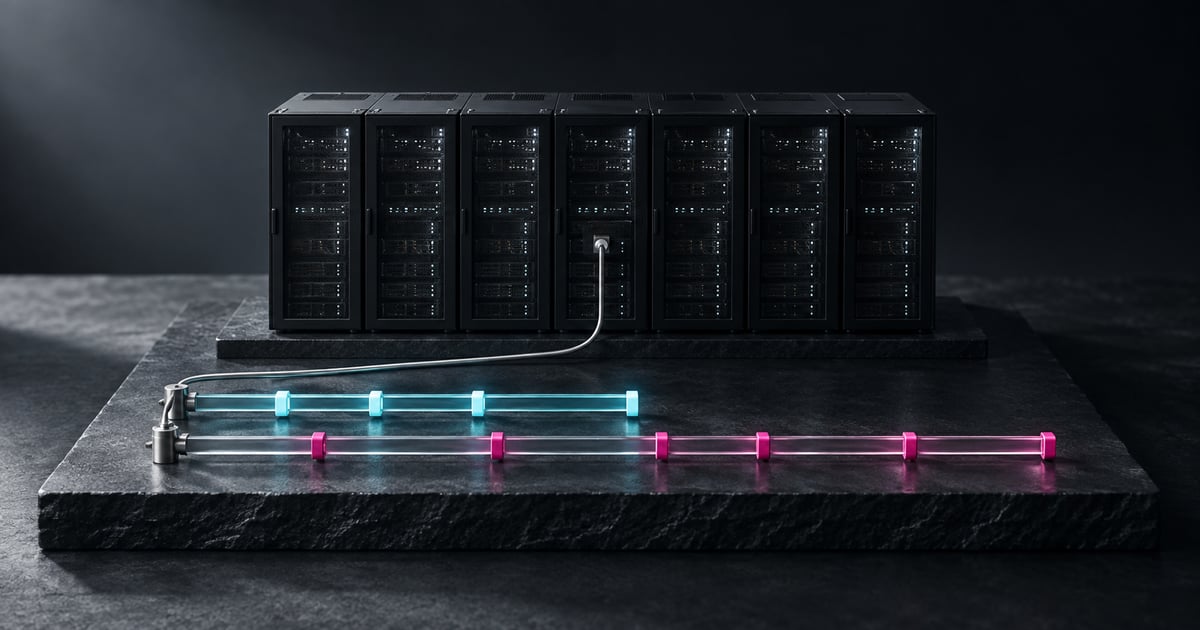
CoreWeave, Meta and private credit: customer renewals, repayment dates and guarantees explain who bears the financial cost of slowing AI.
The price of slowing down · Part 6
After Japan’s rates and the cost of waiting, part six follows obligations already signed: customer contracts, loan repayments and guarantees.
Customer contracts averaging roughly three years. A loan lasting about five. Somewhere between those two timeframes, the business may need to renew a lease on its computing capacity, find another customer or reduce its borrowings. The argument about slowing artificial intelligence becomes rather more tangible at this point: who makes the payments if the next customer takes longer to arrive?
The mismatch appears in CoreWeave’s $2.6 billion financing announced on August 10, 2026. CoreWeave rents out computing capacity, including for AI. It presents the structure as an additional source of flexibility: financing can extend beyond the original customer contracts. Putting the equipment to work again is part of the business proposition.
The question arises at the outset: how much of the repayment depends on business already contracted, and how much requires another successful sale? Part of the risk lies in the moment when someone has to agree to rent the machines again.
Public documents allow us to follow that distinction through several transactions. They reveal meaningful safeguards, very different rights of recourse and obligations that outlast the latest product announcement. They do not establish that calls to slow AI are all financially motivated. They do explain why the same pause could give one company breathing room while putting another under pressure.
Three-year contracts, five-year credit
A conventional borrower expects its business to generate enough cash to repay a loan. A project lender can go further, underwriting identified contracts, the equipment needed to fulfil them and the receipts they are meant to produce. That is a more concrete proposition than a general promise of growth. It still contains assumptions.
The August facility, identified in the documents as DDTL 5.5, matures on September 1, 2031 and carries a guarantee from the CoreWeave parent company. Funds can be drawn over time, with a commitment fee on the unused portion. Calculating interest as though all $2.6 billion necessarily entered the borrower’s bank account on day one would be wrong. The August 10 regulatory filing describes maturity and the guarantee; section 2.10(c) of the agreement sets out the undrawn fee.
A parent guarantee gives lenders recourse beyond the subsidiary that raised the debt. It does not establish that the wider group will always have the resources to pay. It changes whose obligations and resources the creditor can turn to.
Two qualifications matter when comparing the durations. Three years is an average: the customers do not all leave on the same morning. Nor does a five-year maturity mean that every dollar of principal waits until the final day. The facility includes monthly amortisation, meaning scheduled reductions in principal after the commitment period ends.
The more revealing provision concerns replacement business. A failure to renew or replace an expiring or terminated customer agreement on the required terms can trigger a mandatory prepayment to restore contractual ratios. This is set out in section 2.09(b)(iii) of the credit agreement. It is not an automatic demand for the whole loan whenever a customer leaves. No activation of the provision is established here.
The bargain is intelligible. The operator can finance equipment beyond its first booking. In return, the lender does not simply agree to wait until every commercial arrangement has run its course. If the expected replacement revenues cannot support the same amount of borrowing within the agreed framework, debt may have to come down.
For the shareholder, the lender’s protection can become a funding requirement. An equity contribution, another source of cash or an eligible replacement contract may be needed. That pressure can arrive well before the equipment fails or the loan reaches final maturity.
From booking to the first cash receipt
At June 30, 2026, CoreWeave reported a $104 billion revenue backlog. The company’s definition includes remaining performance obligations and estimates relating to other agreements. It also makes delivery and service availability relevant to realisation. The number is neither a bank balance nor revenue already earned. That distinction is explicit in the second-quarter results release.
An order can provide commercial visibility while leaving a timing problem. Equipment must arrive, be installed, connected and accepted. The payment obligation starts according to the agreement, not when the total contract value appears in a press release.
Research labs’ caution is only one possible source of delay. The International Energy Agency’s September 21 report describes constraints on building and modernising electricity networks. A late connection is a plausible physical reason for later receipts. It does not establish a concealed change of strategy or a fall in end demand.
Consider a wholly hypothetical project. It has drawn a $100 million loan in full, at a fixed annual rate of 10%. Interest must be paid in cash and there is no grace period. A six-month delay adds $5 million of interest, using simple interest. That is not the full cost of the delay: rent, construction, insurance and any compensation are excluded.
An agreement to defer interest would change the immediate funding need. A customer advance would change it again. If the loan had not been drawn, the calculation would not apply. The useful question is which agreement absorbs those six months. A research team cannot unilaterally move its lender’s payment date.
Another contractual feature can offer the operator substantial protection. Under a take-or-pay agreement, a customer pays for reserved capacity even if it does not use all of it, provided the supplier meets its obligations. CoreWeave says committed take-or-pay contracts accounted for 98% of second-quarter 2026 revenue. Its quarterly filing also describes commencement at a specified date or when capacity is made available.
Pausing a training run does not necessarily cancel the associated payment. The financial burden can stay with the lab that booked the machines. It moves back towards the hosting company if the customer cannot pay, has an applicable termination right or does not renew. Those are different events. None follows automatically from the word “pause”.
Receipts follow an order of priority
It is easy to imagine an operator receiving a customer payment and then deciding what to do with it. Project financing can settle that decision in advance. Receipts enter dedicated accounts and follow an agreed order of priority.
In DDTL 5.5, section 2.20 directs payments towards expenses, debt service and reserves before permitted distributions. It records the rule governing the money, not a statement of payments already made.
The purpose becomes clearer with a practical question. Should an owner be able to withdraw all the cash from a functioning installation shortly before it needs to replace customer contracts? The lender wants resources retained before a problem emerges. The shareholder may find that the business is collecting revenue without being free to use those receipts on the next development.
Expansion can slow without an immediate default. The equipment keeps running and employees keep getting paid, but part of the cash remains committed to a particular purpose. A consolidated cash figure alone cannot tell us how much money is available to which entity, or when.
Safeguards are not themselves an admission of exceptional weakness. Organising repayment is what lenders are meant to do. The analytical question is whether the buffers remain adequate when several assumptions deteriorate together: a renewal at a lower price, higher electricity costs and a more difficult equity raise.
The public exhibits do not disclose everything needed to calculate that combined shock. Some commercial information is redacted, and the detailed amortisation schedule is not reproduced. We cannot reconstruct a precise debt balance remaining after three years. That calculation would require the full schedule and commercial agreements.
Another CoreWeave facility makes a different bet
It would be tempting to apply that narrative to every borrowing in the group. The facility announced on March 31, with initial capacity of up to $7.5 billion, expandable to $8.5 billion as assets stabilise, has a different timetable. It brings together banks, investment managers and institutional investors, including Blackstone Credit & Insurance. An alternative asset manager’s involvement does not make the whole transaction an opaque bilateral loan. Participants are identified in the financing announcement.
The borrowing vehicle, CoreWeave Compute Acquisition Co. VIII, holds the equipment. According to Morningstar DBRS’s April 3 analysis, its customer is Meta. A roughly 15-month drawing phase is followed by about five years of amortisation, with the debt fully repaid by maturity. On that basis, the agency identifies no refinancing or re-contracting requirement for the scheduled debt repayment. It nevertheless flags deployment, availability and energy-cost risks.
This is an important counterexample. The lender need not wait for the GPUs to be sold to recover its money. Contract payments can return the principal while the equipment is still delivering the agreed service. A disappointing resale value then bears first on the economic interest left after repayment, rather than automatically damaging principal already collected.
The protection remains conditional. Unavailable capacity does not create the same entitlement to payment as a delivered, functioning service. Construction must reach the point at which the customer contract can do its job. A credit rating is an assessment of those risks, not insurance against them. The DBRS rating was solicited and benefited from issuer information; it does not give readers access to the full underlying commercial contracts.
Parent recourse also differs. For this transaction, the March 31 Form 8-K describes a guarantee limited to specified misconduct or breaches, rather than a general repayment guarantee. The August facility has the broader parent support described earlier.
Two borrowings by the same group, both associated with graphics processors, can therefore offer quite different protections. “GPU-backed debt” does not tell us whether repayment rests principally on the customer, the parent or the equipment’s value. We have to read what happens when things go wrong, not merely identify what was pledged at closing.
Meta’s flexibility comes with a potential exit bill
Another structure shifts the focus from chips to buildings. On October 21, 2025, Meta announced a venture with Blue Owl-managed funds to develop Hyperion in Louisiana. The funds hold 80% and Meta 20%. The estimated $27 billion development concerns buildings and long-lived power, cooling and connectivity infrastructure. That is the scope of the original announcement, not a general warranty on the accelerators placed inside.
Why bring an outside investor into this property? The user can retain some flexibility over future capacity, while the investor acquires exposure to infrastructure and contractual payments. Ownership percentages do not, however, reveal where either party’s risk ends.
At June 30, 2026, Meta described leases due to commence in 2029, with initial four-year terms and renewal options. It also provided residual value guarantees with an aggregate threshold of approximately $28 billion, declining over time. Termination or non-renewal, together with other conditions, can require a payment for the shortfall between property value and the applicable threshold. Meta had recognised no liability because payment was not considered probable. The details appear in Note 5 of its quarterly filing.
The mechanism matters more than the headline number. Take a fictional guarantee, assuming all its triggering conditions have been met. Its threshold is 80 units. If the property is worth 50 when the tenant leaves, compensation is 30. If it is worth 90, compensation is zero. The guarantee does not automatically pay 80, and the owner does not receive both the property value and the entire threshold.
The tenant has an exit option that can become expensive precisely when replacement users are harder to find. The risk has not vanished because an investment fund owns most of the vehicle. Part of it can return to the user just as the user wishes to reduce its exposure.
That does not make every guarantee a debt immediately due. Development costs, future rents and the guarantee threshold are not three independent loans to be added together for a dramatic total. They describe different, sometimes conditional, obligations within the same transaction.
Nor is a building with an electricity connection the same asset as a generation of chips. The former may accommodate other equipment, subject to modifications and demand. The latter may lose its commercial advantage while remaining capable of computation. Both can be exposed to obsolescence, but on different timescales and through different contracts.
More time can mean more debt
When revenue comes later, a creditor may agree to revised terms. The decision depends on the value the lender expects to preserve. Immediate liquidation is not always preferable to giving a promising project time. But an extension has a price and cannot be assumed in advance.
The Financial Stability Board’s May 2026 publication on private credit identifies vulnerabilities involving payment-in-kind interest, valuations and financial interconnections. Its assessment covers a much broader market than AI infrastructure. It is not a default-rate estimate for data centres.
Payment in kind, usually shortened to PIK, means adding interest to the debt instead of settling it immediately in cash. The borrower preserves liquidity and the lender owns a larger claim. Such terms can be agreed at origination. Their use should be assessed against the original agreement and changes in the borrower’s repayment capacity.
Take 100 fictional units at 10% a year, with no principal repayment for two years. Paying interest annually costs the borrower 20 in cash and leaves principal of 100. Capitalising all interest annually requires no cash interest payments during the period, but leaves 121 owed. Second-year interest is charged on first-year interest as well.
The arrangement can give a project time to win customers. It also raises the amount that future success must support. If it merely postpones an increasingly likely loss, the absence of an immediate cash payment is not an economic recovery.
Accounting terminology creates another trap. Interest can be included in the recorded cost of construction and still have been paid in cash. CoreWeave reports $176 million of capitalised interest within interest paid during the first half of 2026. That disclosure in its Form 10-Q does not describe PIK added to loan principal. “Capitalised” is not a synonym for “unpaid”.
What matters is the actual payment schedule, available receipts and the terms on which the creditor will wait. An accounting presentation does not replenish a bank account. A negotiated maturity extension can change the real timetable.
Private credit remains connected to banks
The BIS bulletin published in January 2026 describes a shift from expansion supported heavily by large technology groups’ internal cash flows towards more debt financing. It also identifies a stabiliser: closed-end funds commit their investors’ capital for years. Those investors cannot all demand immediate repayment in the way bank depositors can.
The distinction matters. A lender with stable funding can hold a long-lived asset without being forced to sell after the first difficult week. But the actual investment vehicle must be examined. A closed-end fund, a fund offering periodic withdrawals and an insurer do not face identical obligations.
The FSB documents connections among banks, funds and insurers. Credit can change intermediary without leaving traditional institutions entirely. A bank may lend to a fund that finances a project; an insurer may buy an exposure; a fund may manage its own liquidity with a credit line. Information quality and valuation practices then matter even when assets do not trade frequently. The FSB describes these transmission channels and highlights gaps in the data needed to monitor them.
Double-counting is a separate danger. A project loan and the credit line helping finance it do not necessarily represent twice the same ultimate economic exposure. They do create two contractual relationships with different protections and maturities. Trouble can travel from one to the other.
“Private credit” also needs unpacking. A lender to a software company whose business might be disrupted by AI is not necessarily financing the data centres that make AI possible. A dataset covering artificial intelligence, big data and cloud technology does not exclusively measure borrowing by model developers. The BIS bulletin states its broader coverage; we do not turn that into a total for generative-AI financing.
When the supplier helps fund the buyer
There is a more direct connection. A lab’s investors may also sell it the computing services it consumes. In January 2025, the FTC documented partnerships combining investments with cloud-spending commitments and potential switching barriers. That study used earlier information; it is not a complete account of the contracts in force today.
On February 27, 2026, Amazon and OpenAI announced a $50 billion Amazon investment, starting with $15 billion and followed by $35 billion subject to conditions. Amazon’s quarterly filing of July 31 updates that announcement: $28.7 billion had been invested by June 30, followed by the remaining $21.3 billion after that date. According to the filing, the full $50 billion has therefore been invested. Separately, the February agreement announced a $100 billion, eight-year expansion of the AWS commitment. That service contract runs over time.
Money can flow from a supplier to a lab as financing, then back to the supplier as payment for a service. That circuit does not automatically make the service fictitious. Equipment operates, electricity is consumed and a product reaches users. The existence of the service must be separated from the source of the money paying for it.
Financing buys time. Sustainable economics ultimately depend on what external customers will pay, at what margins and with what persistence. A funding round is not a second independent validation of demand when the investor also benefits from the purchases the funding will enable.
Adding the investment, the cloud commitment and the loans used to build the equipment could again count successive stages of one chain several times. The useful exercise follows the payments to the party funding them from its own revenue, or accepting the associated risk for the long term.
The bill depends on when the pause begins
Recent disclosures do not show that financing has closed across the board. On September 22, CoreWeave completed a $4.2 billion convertible-note offering, with a 2.875% coupon and an April 2033 maturity. The Form 8-K confirms the completed transaction, including the additional option. The coupon alone is not the full economic price of this funding: investors also receive a conversion right linked to the shares.
The transaction shows that, on that date, investors would fund this issuer on those terms. It does not assure the same access for the next borrower or construction project. It does prevent an inference from a few exposed structures that nobody is still financing AI.
What, then, would a slowdown change? If it reduces expenditure that can still be avoided, it can lower funding needs. If it arrives after equipment has been ordered and loans drawn, it can extend the period of payments before receipts begin. If a customer has firmly reserved capacity, the bill may stay with that customer. At renewal, the question moves back towards the operator and its lenders.
Slower technical progress might also extend the commercial life of some equipment. Conversely, cheaper models could bring in more users and support total demand for computation. Either effect can coexist with downward pressure on prices. Distinguishing them requires usage data and contracts, not an extrapolation from the number of model launches.
The useful dividing line is between spending that can still be cancelled, payments already committed and capacity that must be sold again. It does not always coincide with the line between incumbents and entrants, although their available resources may differ substantially.
This gives a financial meaning to the wider inquiry into slowing AI. A fully funded company may absorb a delay that a rival still has to persuade its creditors to support. An additional evaluation requirement could lengthen that delay. Connecting that financial effect to the actors’ intentions would require separate evidence about their decisions and motivations.
The documents establish obligations, safeguards and dependencies. They do not support a prediction of general collapse or a single motive shared by labs, property owners and lenders. The next instalment will examine what changes when the money being sought is equity from new investors rather than a loan.
For now, the immediate test is simpler: when a customer does not renew, who has to produce the cash? The answers are written into agreements already signed. They do not change at the same speed as the debate about AI’s future.
Sources and method
Documentary research as of September 27, 2026. SEC filings contain issuers’ disclosures; filing does not mean that the regulator endorses their forecasts. DBRS, BIS, FSB and IEA publications address their respective scopes. The cited DBRS rating was solicited. No interviews seeking comment or audit of lenders’ positions were conducted.
Unpublished commercial terms, omitted schedules and redacted parameters prevent reconstruction of a complete repayment schedule or a quantified stress loss. This article does not assert a default or guarantee activation in the transactions examined. Property guarantees are not treated as guarantees of GPU resale values. Numerical examples are hypothetical, exclude taxes and unspecified fees, and isolate a mechanism rather than reproduce a contract or forecast.
- CoreWeave, CoreWeave Closes $2.6 Billion Loan Facility, Expanding Financing Flexibility for AI Infrastructure (2026-08-10).
- CoreWeave / SEC, Form 8-K, event dated August 7, 2026 (2026-08-10).
- CoreWeave / SEC, DDTL 5.5 Credit Agreement (2026-08-07).
- CoreWeave, CoreWeave Reports Strong Second Quarter 2026 Results (2026-08-11).
- CoreWeave / SEC, Form 10-Q, June 30, 2026 (2026-08-12).
- CoreWeave, CoreWeave Closes Landmark $8.5 Billion Financing Facility (2026-03-31).
- CoreWeave / SEC, Form 8-K, event dated March 30, 2026 (2026-03-31).
- Morningstar DBRS, Rating of A (low), Stable, for CoreWeave Compute Acquisition Co. VIII, LLC (2026-04-03).
- Meta, Joint Venture with Funds Managed by Blue Owl Capital to Develop Hyperion Data Center (2025-10-21).
- Meta / SEC, Form 10-Q, June 30, 2026 (2026-07-30).
- Banque des règlements internationaux / BIS, Financing the AI boom: from cash flows to debt, BIS Bulletin No 120 (2026-01-07).
- Financial Stability Board, FSB warns on private credit vulnerabilities (2026-05-06).
- Agence internationale de l’énergie / IEA, Modernising Grids in the Age of Electricity (2026-09-21).
- Federal Trade Commission, FTC Issues Staff Report on AI Partnerships & Investments Study (2025-01-17).
- Amazon / OpenAI, OpenAI and Amazon Announce Strategic Partnership (2026-02-27).
- CoreWeave / SEC, Form 8-K, event dated September 17, 2026 (2026-09-22).
- Amazon / SEC, Form 10-Q, June 30, 2026, Note 2: OpenAI (2026-07-31).
This analysis is not investment advice.
// cite this analysis
l0g, “AI debt runs on a different clock”, l0g.fr, published September 27, 2026, updated September 27, 2026, https://l0g.fr/en/analysis/ai-slowdown-6-debt-contracts-guarantees/
$ cd ../analysis