// analysis
SK hynix and the cost of industrial proof
Open the documentsThe source documents
The documents cited in the analysis and, where identified, their associated passages. An automatically detected association is not a verified claim.
Consult the references in the article below. No document has been identified for this shortcut.
Sources and reading context
Contents9 sections
A supplier can have a promising technology and still lack the means to sell it: evidence obtained under factory conditions. Through Trinity Fab, SK hynix and Korea’s public authorities are funding that missing step. The facility’s budget, equipment catalogue and credit terms also reveal the anchor customer’s influence over its partners’ route to market.
Evidence reviewed as of 16 November 2026. Programme amounts are in nominal Korean won.
A machine can pass its laboratory tests and spend months waiting for a place in a chip factory. Its prospective customer needs consistent results, compatibility with other processes and confidence in the impact on production. Throughout validation, the supplier keeps paying engineers and buying components. Industrial evidence consumes cash well before the first order arrives.
Trinity Fab is designed for this transition. The validation facility is planned inside SK hynix’s first fabrication plant in Yongin, South Korea. On 16 November, Reuters highlighted the group’s support for suppliers of materials, components and equipment: 1.4 trillion won over five years. That envelope already appeared in an SK hynix statement dated 2 July 2026. November’s coverage therefore sheds light on the industrial rollout of a policy announced months earlier. S01 S02
Reading that policy alongside Trinity Fab’s budget and the guaranteed financing available to partners reveals several kinds of support. Access to testing helps suppliers produce evidence. Credit funds the time spent developing their products. In both cases, selection rules will determine which businesses can make the transition.
A prototype has to prove itself within the production process
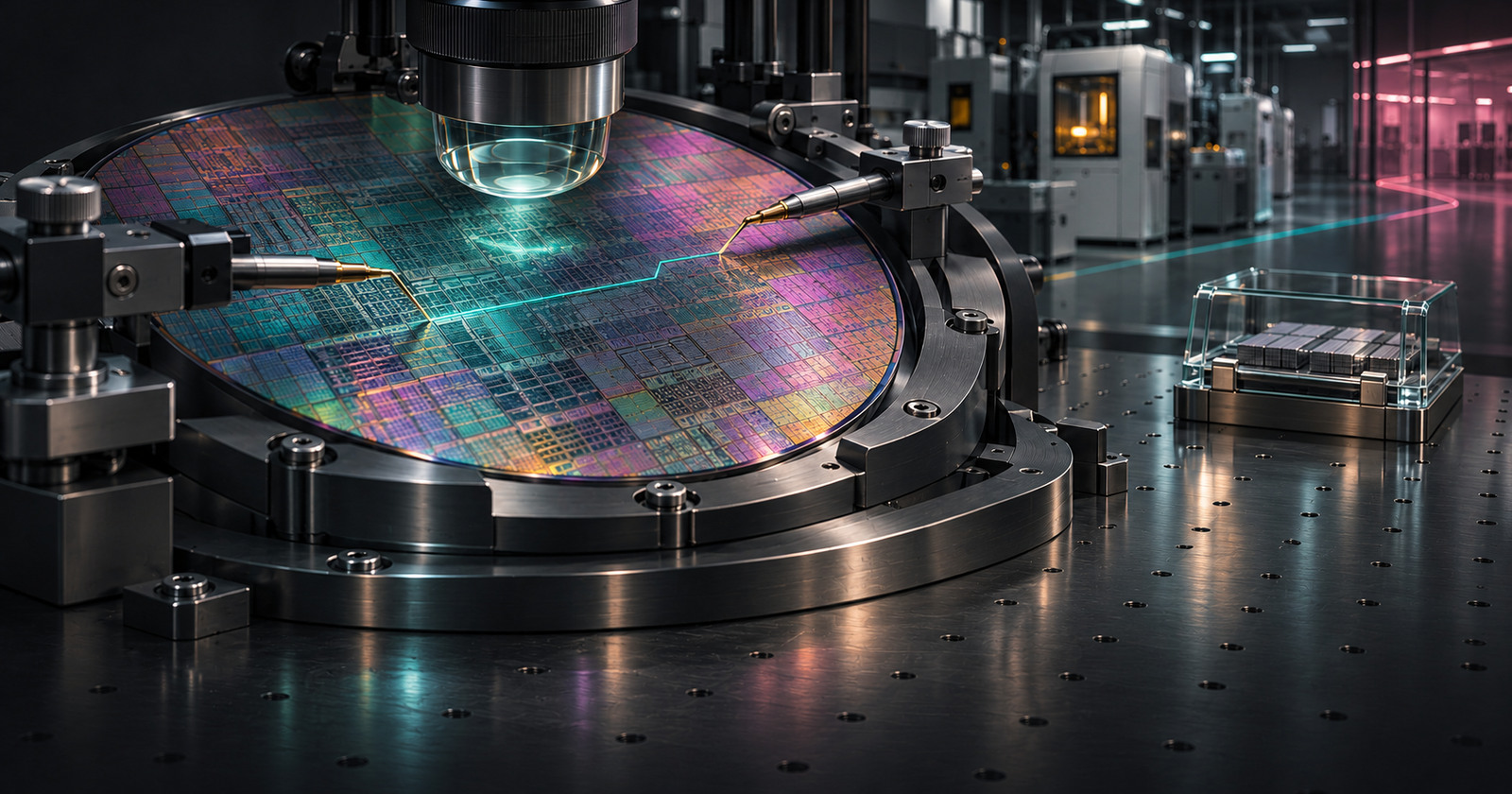
A fab is a semiconductor fabrication plant. A wafer is the disc on which circuits are made. Trinity Fab plans to offer processing, measurement and inspection services using 300-millimetre wafers. Its role is to bring product evaluation closer to the industrial conditions in which those products will operate. S06
The US National Institute of Standards and Technology, or NIST, describes the difficulty of moving from an experimental device to system-level evaluation in its work on emerging memory technologies. That evaluation requires infrastructure and specialist expertise. Industrial qualification brings together tests and evidence for assessing a technology in a specified application. The customer then makes a purchasing decision against its own requirements. S10 S13
Consider a teaching example: a tool deposits a layer on a wafer. Engineers need to examine uniformity, repeatability and compatibility with subsequent steps. Trinity Fab’s DI-01 catalogue entry identifies a polysilicon deposition tool, an equipment category relevant to that work. Manufacturing yield is the share of products that meet quality requirements. An attractive result at one step can lose its economic appeal if it damages yield further along the process. S15
A shared facility spreads the cost of testing infrastructure across users. Suppliers gain access to resources they would struggle to finance alone, while the chipmaker assesses new alternatives before introducing them into commercial production. This adds a qualification layer to the equipment, materials and integration constraints examined in our analysis of the semiconductor production stack.
Opening the facility and supplying its services follow different schedules
The project predates November’s announcements. On 28 November 2024, Korea’s industry ministry announced that it had cleared its preliminary feasibility review. The proposed testing infrastructure was linked to a chipmaker and intended to help suppliers validate their products. Reports published on 16 November 2026 describe a facility still being prepared within the Yongin site. S03 S08 S09
Reuters reports an opening target of May 2027. ChosunBiz gives a more detailed schedule: a cleanroom in May, followed by equipment installation, with evaluation services expected in the fourth quarter of 2027. The operator’s catalogue schedules some tools as late as 2031. Services would therefore begin before the full toolset is installed. For a supplier, the relevant date is when the required process and measurements become available for its project. S01 S07 S17
Trinity Fab states a target of cutting domestic companies’ lead time for adoption in production by 30%. Evaluating that ambition requires a defined starting point and comparable projects, including those eventually abandoned. Available bookings, skilled staff and usable access to data will matter alongside the installed equipment. S06
The facility budget and lending capacity serve different purposes
The 1.4 trillion won over five years describes SK hynix’s support programme presented in July. For Trinity Fab, the ministry published a different breakdown on 19 October: 874.6 billion won for 2025–2031, comprising 373.6 billion from central government, 57.7 billion from local authorities and 443.3 billion in private contributions. Planned public funding thus totals 431.3 billion won, or approximately 49.3% of the announced budget. The calculation is (373.6 + 57.7) / 874.6 × 100. S02 S04
The form of the contributions matters too. ChosunBiz describes cleanroom space and expertise provided by SK hynix as part of its valued contribution. Making facilities and specialist services available commits resources on a different schedule from an immediate cash transfer. The breakdown sets out planned contributions whose annual delivery remains to be tracked. S17
The lending arrangement addresses another need. The ministry announced 100 billion won in contributions from SK hynix and four banks, intended to support 2 trillion won of potential financing with backing from K-SURE, Korea’s trade-insurance agency. The twentyfold relationship between intended lending capacity and contributions describes the structure of the arrangement. K-SURE confirmed that the agreement was signed on 19 October in a notice published on 21 October. S04 S05
These figures belong to a multi-year programme, an infrastructure project and a lending capacity. Their detailed relationship with July’s envelope remains to be clarified. Tracking contributions, commitments and drawings separately will show which resources have been mobilised and the obligations attached to them.
The catalogue schedules a rollout through 2031
Trinity Fab’s public unit-process catalogue contains 26 distinct entries. Their planned installation years break down as 15 in 2027, three in 2028, three in 2029, one in 2030 and four in 2031. The counting unit is the catalogue entry. This inventory describes the schedule of one part of the service offering, across tools with different prices, throughput and technical importance. S07
Named entries include Korean manufacturers alongside ASML, Tokyo Electron, Lam Research and Applied Materials. For several future entries, the manufacturer or model remains planned or to be determined. Developing local suppliers will therefore draw on an international toolset whose configuration is still being completed. This interdependence connects with ASML’s installed-base economics, where services and integration also determine a machine’s value. S07
A tool planned for 2027 may depend on a processing or measurement step available later. Following the requirements of individual experiments will therefore be more informative than calculating an overall readiness rate from entry counts. Mapping those dependencies would identify the real waiting points and show whether the first tools meet the most urgent needs.
Entries included in the count
2027 : PH-01, PH-02, ET-01, ET-03, DI-01, DI-02, DI-03, DI-04, TF-01, TF-05, TF-06, CC-01, CC-02, CC-04, CM-01.2028 : TF-02, TF-04, CC-05.2029 : ET-04, CC-03, CC-06.2030 : ET-02.2031 : DI-05, TF-03, TF-07, CC-07.
Waiting consumes cash before a purchase order arrives
SK hynix’s July programme announces upfront payment of up to 50% of initial development costs, alongside compensation based on technical contributions when development fails. The group’s policy aims to share some risk earlier in the relationship. Each supplier’s rights will depend on the agreements, eligibility criteria and settlement provisions. S02
The timing effect is clear in an entirely hypothetical example. A business consumes €100,000 of cash each month during validation. Shortening that period from twelve months to nine reduces consumption by €300,000: €100,000 × (12 − 9). The monthly rate is assumed constant. This illustration uses a 25% reduction in time, independently of Trinity Fab’s stated 30% target.
Funding helps sustain testing during that wait. After a favourable technical result, the supplier must still negotiate sales terms, prepare its production and receive payment. Its economic return depends on the whole sequence, just as SK hynix’s investments depend on the permits, operations and funding examined in our investigation of Dalian and the financing of a US factory.
The customer’s recommendation starts the credit process
The ministry’s 19 October release directs this financing towards suppliers recommended by SK hynix, subject to K-SURE’s assessment and then financed through the four participating banks. The government’s policy portal describes a three-year guarantee with stated 100% coverage within the scheme. The borrower retains its repayment obligation. Contracts will specify covered events and recourse conditions. S04 S16
The anchor customer can give lenders useful information. It knows the technologies sought, the developments under way and the vulnerabilities in its supply chain. Its recommendation can help a bank examine a project that would otherwise be difficult to assess. The same role increases its influence over a supplier’s financial prospects. Losing SK hynix’s interest could weigh on both anticipated sales and access to this credit channel.
For testing at Trinity Fab, detailed admission and priority rules remain to be obtained. MoneyToday describes a separate nonprofit foundation intended to operate the facility and protect sensitive information. Its statutes and user agreements will allow its practical autonomy to be examined. The documented credit recommendation is therefore a procedure that must be distinguished from access to the infrastructure. S08
Intellectual-property questions begin with the results. Parameters, failures and corrections create valuable knowledge. Being able to show a report to other customers would help a supplier expand its market. Confidentiality rules and ownership of jointly developed improvements will determine how that evidence can travel.
NanoIC connects validation with customer requirements
On 9 February 2026, imec inaugurated a cleanroom extension as part of the rollout of Europe’s NanoIC pilot line. Its offering includes evaluating processes and equipment before definitive industrial investments. The technologies and governance differ from Trinity Fab’s, but this validation role provides a practical point of comparison. S12 S13
On 1 October, AlixLabs announced a six-month evaluation of its etching technology within NanoIC. The company’s release, hosted by imec, says several prospective customers had requested this additional level of validation. The project seeks data that could support later qualification. Its outcome will emerge from the tests and subsequent customer decisions. S14
The economics of providing access continue after construction. The research paper published by NIST on shared nanofabrication facilities examines start-up costs, operations, equipment replacement and tool time. Fees, operating support and the allocation of bookings will shape access for smaller suppliers. S11
Trinity Fab will be useful if businesses previously too small to produce persuasive evidence can finally convince buyers. Assessing that outcome requires applications, refusals, repeated trials and purchase orders to be tracked, followed by sales to additional customers. Credit needs its own record of drawings, repayments and defaults. The funding creates an opportunity to produce industrial evidence. Its value will depend on the markets that evidence can open.
Sources
Documents consulted on 16 November 2026. Statements from the group and operator describe their policies and objectives. Ministry releases establish the announced amounts and terms. November’s reporting adds detail on their implementation.
- SK hynix to spend $1 billion over five years to support chip suppliers
Passages and scope
16 November dispatch: 1.4 trillion KRW over five years and an expected May 2027 opening. Full Reuters text read in the Investing.com republication. The dispatch attributes 443.2 billion KRW to SK hynix for Trinity Fab, versus the ministry’s 443.3 billion private contribution in S04. The article uses the primary breakdown and leaves the 0.1 billion discrepancy unexplained. The policy was already presented in July in S02.
- SK hynix explains its supplier-cooperation policy
Passages and scope
2 July statement: five-year supplier support, upfront payment of up to 50% of initial development costs, and compensation based on technical contribution if development fails. Full indexed text consulted; direct access was denied. SK hynix’s stated policy, with implementation governed by individual agreements.
- Trinity Fab clears its preliminary feasibility review
Passages and scope
28 November 2024 ministry release: completion of the preliminary feasibility review and plans for a testbed linked to a chipmaker. Full text consulted. Estimates from 2024 belong to that project stage, separate from the 2026 breakdown.
- Trinity Fab budget and launch of guaranteed trade financing
Passages and scope
19 October release: 2025–2031 budget of 874.6 billion KRW, comprising 373.6 billion from central government, 57.7 billion from local authorities and 443.3 billion in private contributions. Potential financing of 2 trillion KRW supported by 100 billion in contributions. SK hynix-recommended suppliers undergo K-SURE assessment before financing through four banks. Full text consulted. Announced figures, separate from actual drawings.
- K-SURE, SK hynix and four banks sign the 19 October agreement
Passages and scope
Notice published on 21 October about the agreement signed on 19 October by K-SURE, SK hynix and four banks. Full text consulted. It confirms the institutional agreement; contracts govern individual transactions.
- Trinity Fab: foundation and infrastructure overview
Passages and scope
Operator overview: 300 mm wafers, processing, measurement and inspection services, with a target to reduce domestic companies’ lead time for adoption in production by 30%. Full indexed text consulted. Publication date unestablished. Animated counters indexed at zero are excluded from calculations. The reduction remains a stated objective.
- Trinity Fab: public unit-process catalogue
Passages and scope
Full catalogue consulted on 16 November: 26 unit-process identifiers, with planned installation years of 2027: 15, 2028: 3, 2029: 3, 2030: 1, 2031: 4. Some future entries leave the manufacturer or model to be determined. Named entries support the examples in the article. The counting unit is the entry, independent of equipment price, throughput and capacity.
- MoneyToday: Trinity Fab’s operator and organisation
Passages and scope
16 November report describing a separate nonprofit operator and protection of sensitive information. Full indexed text consulted; direct access unavailable. The English edition identifies the use of automated translation. Statutes, user agreements and appeal provisions remain to be examined.
- Newsis: Trinity Fab construction visit and service timetable
Passages and scope
16 November report on the construction visit and opening schedule. Full indexed text consulted. It distinguishes the cleanroom expected in May 2027 from evaluation services targeted for the fourth quarter. The equipment scope reported in the press is broader than S07’s 26 catalogue entries.
- Prototyping Platforms for Emerging Technologies
Passages and scope
NIST programme overview on prototyping platforms, including emerging memory technologies: moving from experimental devices towards system-level evaluation. Full text consulted. Created on 19 March 2025 and updated on 5 October 2026. General technical context, separate from an evaluation of Trinity Fab.
- So, You Want to Have a Nanofab? Shared-Use Nanofabrication and Characterization Facilities
Passages and scope
Research article published on 21 February 2020: start-up costs, operations, equipment replacement and allocation of tool time. Publication notice and opening PDF pages consulted. Used to identify economic costs to monitor, without extrapolating cost estimates to Korea.
- imec inaugurates NanoIC pilot line, accelerating innovation in sub-2nm systems-on-chip
Passages and scope
9 February 2026 release: inauguration of a cleanroom extension within the NanoIC rollout. Full text consulted. This infrastructure milestone forms part of the pilot line’s progressive deployment.
- NanoIC pilot line: accelerating beyond-2nm innovation across Europe
Passages and scope
NanoIC service overview: evaluation of processes and equipment before definitive industrial investments and commercial production. Full text consulted; publication date unspecified. The operator’s presentation is used to describe its validation role.
- AlixLabs begins APS technology evaluation within the NanoIC pilot line
Passages and scope
1 October AlixLabs release hosted by imec: a six-month evaluation project and prospective customers’ request for further validation. Full text consulted. The company’s objectives and explanations, with test outcomes still to be assessed.
- Trinity Fab: DI-01 polysilicon deposition catalogue entry
Passages and scope
DI-01 entry: Eugene Tech BJM3000 polysilicon deposition tool. Full page consulted. Several detailed specification fields remain empty. The article’s uniformity and repeatability example is educational, with no measured performance attributed to this tool.
- Korea.kr: supplier recommendation and guarantee terms
Passages and scope
19 October government article: SK hynix-recommended suppliers, K-SURE assessment and a three-year guarantee with stated 100% coverage. Full text consulted. Institutional account of the S04 scheme, with individual transactions governed by contractual terms.
- ChosunBiz: SK hynix contributions and the Trinity Fab service timetable
Passages and scope
16 November report: SK hynix’s contribution of cleanroom space and specialist staff valued at 443.3 billion KRW. Cleanroom expected in May 2027, followed by equipment installation and evaluation services targeted for the fourth quarter. Full text consulted through the site’s native version. A description of contributions and plans, separate from an audit of delivery.
Limits
This investigation uses public documents and reporting, with access methods specified for each source. Announcements describe programmes and prospective schedules. The inventory of 26 entries covers unit processes in the consulted catalogue, leaving other equipment scopes separate. Individual contracts, detailed testing-access rules, credit drawings and project outcomes remain to be documented. Reports arising from the same company presentation share that origin. The euro example is entirely hypothetical, assumes constant cash consumption and provides neither a profit calculation nor an estimate of Trinity Fab’s impact.
This analysis is not investment advice.
// cite this analysis
l0g, “SK hynix and the cost of industrial proof”, l0g.fr, published November 16, 2026, updated November 16, 2026, https://l0g.fr/en/analysis/sk-hynix-preuve-industrielle/
$ cd ../analysis