// analysis
GPU resale and the value left on the books
Open the documentsThe source documents
The documents cited in the analysis and, where identified, their associated passages. An automatically detected association is not a verified claim.
- Form 10-Q, Q1 2026 ↗Source date not identified
- Form 10-Q, Q3 2026 ↗Source date not identified
- Investor presentation ↗Source date not identified
Sources and reading context
Topics
Contents5 sections
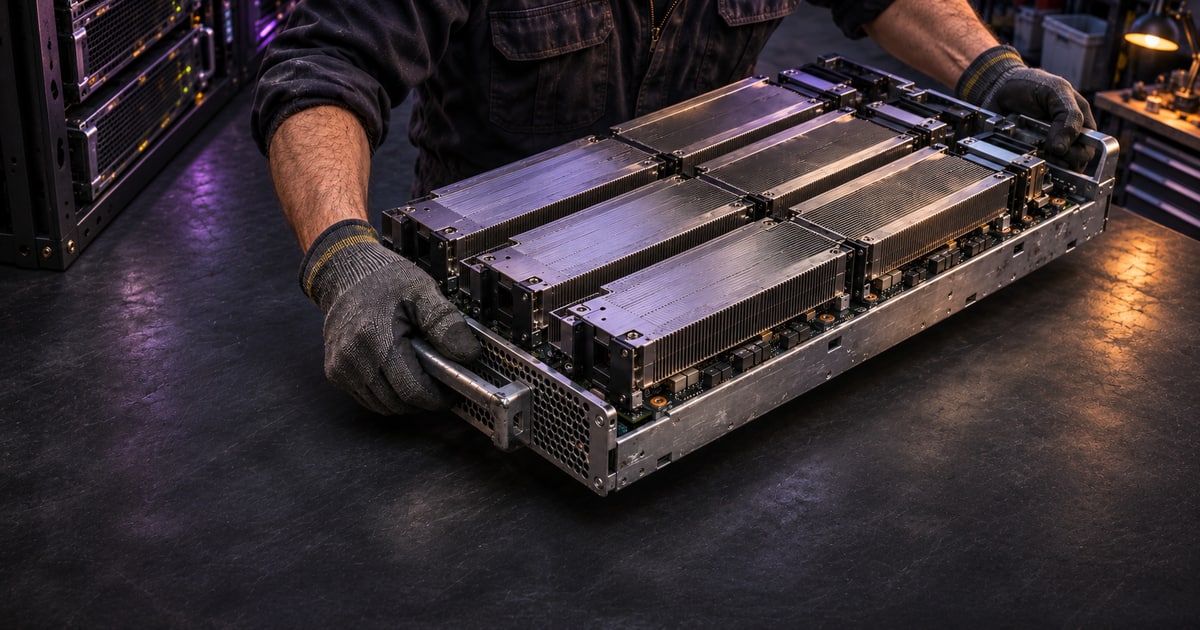
In the first quarter of 2026, WhiteFiber sold a batch of servers fitted with Nvidia H200 GPUs. The disposal note put their carrying amount at $24.3 million on the sale date. WhiteFiber fetched $26.1 million and had collected the full sum by the time it filed on May 14. Its November filing repeats the transaction. S01 S02
The previous year, WhiteFiber had changed its estimate. From January 1, 2025, it expected to use its cloud service equipment for five years instead of three. Slower depreciation cut 2025 expense by $10 million and narrowed the net loss by $7.9 million. Spreading the charge over more years leaves more of the purchase price on the balance sheet. Earnings in use or the price at sale give an indication of whether the estimate holds up. S20
The disposal yielded a $1.8 million gain, about 7.4% of carrying value on the rounded figures. Working out the return from purchase would require the original cost of this particular lot, the revenue it earned in service and its operating costs. The gain measures the difference on the day of the sale. S01 S02
Finding another job for the same chips
WhiteFiber kept another part of its fleet and sold time on it. In May 2026, Hyperbolic Labs signed up for two years of service using 512 H200s that WhiteFiber already owned, according to its quarterly filings. The company reports recognising revenue from the contract in the second quarter. For those machines, the evidence of value is a customer agreeing to pay for their work. S02 S23
CoreWeave describes a different job for an older chip. A scientific research company rents A100s to generate and refine datasets and fine-tune models. In September, the cloud operator disclosed a three-year renewal running into 2029. It said the terms were in line with a typical one-year deal and kept the rate private. Nvidia launched the A100 in 2020. The installation dates of these particular machines remain unknown. If the contract runs its course, it will show how long the design can still attract paying customers. S03 S22
The job can change the case for replacing a chip. In a trial by the Hasso Plattner Institute, a system equipped with a B200 delivered roughly 82% more throughput in a matrix multiplication test than a system with an H100. Its lead fell to 19% on the combined score for three TPCx-AI use cases. The second test also reflects work on the host processor. The machines hosting the chips differed. An operator weighing purchase price and power bills first needs to know which jobs the machines will run. S21
At the Oak Ridge National Laboratory, each compute node of the Summit supercomputer held six V100s. Summit entered full production on January 1, 2019, and received an extra year of service after the five originally planned. Its extension awarded time to 108 projects and delivered 21.4 million node-hours, each representing one compute node in use for one hour. Summit ran its last jobs on November 15, 2024. That is observed service. A public research lab and a commercial cloud operator attach different economics to an hour of computing time. S05 S06
One year on Amazon’s books
Amazon’s filings offer a rare chance to see the earnings effect in both directions. On January 1, 2024, the company extended its estimate for servers from five years to six. For the full year the change took $3.2 billion out of depreciation expense and added $2.5 billion to net income. The earnings lift came from spreading the cost of servers over more years. S07
A year later Amazon shortened the estimate from six years to five for a portion of its servers and networking equipment. It cited faster technological change, particularly in AI and machine learning. On the 2025 accounts, that meant $1.4 billion of extra depreciation and $1 billion less net income. A separate decision to retire certain equipment early had already produced roughly $920 million in charges in the fourth quarter of 2024, including accelerated depreciation. The 2025 revision covered a narrower set of equipment. Each annual effect belongs to its own pool of assets and accounting period. S07 S08
Dividing each disclosed after-tax boost by reported net income for the same fiscal year gives 4.1% for Microsoft in the year to June 2023, 4.1% for Alphabet in calendar 2023 and 4.3% for Meta in 2025. The revised schedules cover categories of servers or network equipment that extend well beyond AI chips. S09 S10 S11 S12
Meta shows how a growing fleet changes the totals. Extending useful lives to five and a half years reduced 2025 depreciation by $2.92 billion for the affected equipment already in service at the end of 2024. Third-quarter server and network depreciation still rose to $5.34 billion in 2026 from $3.60 billion a year earlier. A new estimate changes the schedule for existing machines. The quarterly results also include equipment that entered service in the meantime. S11 S12 S13
One sale, two answers on the books
Suppose an operator pays $120 million for a fleet when it enters service. It expects to use the equipment for six years and assumes zero residual value at the end. Straight-line depreciation allocates an equal $20 million to each year. After two full years, $40 million has gone through the income statement and $80 million remains on the balance sheet. Now suppose management cuts the total useful life to four years. The first two years stand. The remaining $80 million has to be written off over two years, at $40 million a year. That is what it means to change an estimate prospectively. S14
At the end of year four, a buyer offers $12 million, unexpected under either schedule. Under the original six-year estimate, the fleet still carries a value of $40 million. The sale produces a $28 million loss. Under the revised four-year schedule, the fleet is fully depreciated. The same $12 million wire transfer produces a $12 million gain. Over the holding period, the purchase price less sale proceeds comes to $108 million either way. Accumulated depreciation and the gain or loss on disposal reconcile to that amount before operating costs, financing and taxes. The path of reported earnings is different. S14
Model the equipment sale
Change the useful lives and sale price to compare the two depreciation schedules.
| Original schedule | Revised schedule | |
|---|---|---|
| Book value at revision | 80 | 80 |
| Annual expense just after revision | 20 | 40 |
| Book value at sale | 40 | 0 |
| Gain or loss on sale | -28 | +12 |
| Purchase cost less sale proceeds | 108 | 108 |
The model uses straight-line depreciation and a zero estimated residual value. The price becomes known at sale. Operating costs and revenue, financing, taxes and discounting sit outside the model.
Sometimes an event also casts doubt on whether equipment can earn back the amount on the balance sheet. For long-lived assets held for use, US accounting rules call for a recoverability test when such indicators arise. The company compares the carrying amount of the relevant asset group with the undiscounted cash flows it expects the group to generate. If it fails that test, the loss is measured against fair value. The SEC staff illustrates the distinction with an older generation of computers, mainframes due for replacement. As the replacement plans take shape, management needs to reconsider the remaining useful life even while the asset group still passes the recoverability test. S14 S20
The next test comes at renewal
In April 2026, IMF staff compared property, plant and equipment with depreciation at ten large cloud operators. Their proxy suggested a useful life of roughly seven years across those assets. The authors discussed the possibility that advanced chips could become obsolete in two years. They separately modelled a three-year capital life, which reduced aggregate operating margin by more than nine percentage points in their simulation. The IMF subsequently highlighted the risk of debt outliving the equipment it finances. The ECB discussed obsolescence risk in its November review. S15 S16 S24
In June 2025, AWS cut the on-demand price for its H100-equipped P5 instances by 44%. In the third quarter of 2026, CoreWeave said it obtained 30% to 50% higher prices on its Ampere and Hopper generations than a quarter earlier. One is a posted price change. The other comes from a different operator fifteen months later. To decide whether to keep a machine, the operator needs the actual rate it collects, the hours it sells and the cost of keeping it running. At a site with no spare power, a newer machine might earn more in the same slot. S04 S17
The most telling dates are in CoreWeave’s November 10 earnings call. The company said more than 130,000 GPUs would come off contract in 2027, followed by about 170,000 in 2028. It depreciates technology equipment over six years. Renewal rates, new contract prices and the time machines spend waiting for another customer would give readers a way to test that schedule against revenue. A quick return to paying work at prices that cover operating costs would support a longer economic life. Racks standing idle or repeated sales below book value would weigh against it. WhiteFiber’s sale gives us one firm observation. We know the carrying value of that batch of H200 equipment and can compare it with the cash that came in. S01 S02 S04 S18
This investigation follows our reporting on the useful lives of AI servers. Sources checked as of 25 November 2026. All amounts are in US dollars.
Sources and reading notes
- Form 10-Q, Q1 2026
Passages and scope
Quarter ended March 31. Filed May 14, 2026. Notes 2 and 7, especially “Disposals of Property, Plant and Equipment,” p. 21. Management’s discussion describes the equipment sold as H200 servers.
- Form 10-Q, Q3 2026
Passages and scope
Nine months ended September 30. Filed November 10, 2026. Note 7 and management’s discussion of customer agreements, including Hyperbolic Labs. Note 7 gives a carrying amount at disposal of $24.3m. The cloud segment reconciliation in management’s discussion cites $23.8m. The article uses the disposal note. Q3 management’s discussion places the start of Hyperbolic revenue in May. The Q2 report places it in June.
- Investor presentation
Passages and scope
Filed with the SEC on September 17, 2026. Slide 10, A100 and H200 renewals, workloads and commercial terms as described by management.
- Q3 2026 earnings call
Passages and scope
November 10, 2026 call, transcript p. 3. Third-quarter pricing and GPUs due to come off contract in 2027 and 2028. Management statements.
- 2024 Operational Assessment
Passages and scope
Appendix C, “IBM AC922 (Summit) Resource Summary.” Full production on January 1, 2019, a one-year extension and final operation on November 15, 2024. The SummitPLUS section distinguishes 19.04 million node-hours awarded from 21.4 million delivered.
- Summit User Guide
Passages and scope
System overview and node description. Identifies the NVIDIA Tesla V100 GPUs.
- Form 10-K, FY 2024
Passages and scope
Note 1, “Use of Estimates.” Annual effect of moving from five to six years and separate Q4 early-retirement decisions.
- Form 10-K, FY 2025
Passages and scope
Year ended December 31, 2025. Note 1. Realized effect of the shorter schedule, assets covered and earnings impact.
- Annual Report 2023
Passages and scope
Year ended June 30, 2023. Note 1, “Change in Accounting Estimate,” and consolidated income statements.
- Form 10-K, FY 2023
Passages and scope
Year ended December 31, 2023. Note 1, “Change in Accounting Estimate,” and consolidated statements of income.
- Form 10-K, FY 2024
Passages and scope
Note 1, property and equipment table at December 31, 2024. Previous range and footnote on the change.
- Form 10-K, FY 2025
Passages and scope
Year ended December 31, 2025. Note 1, change in accounting estimate, and consolidated statements of income. Actual effects.
- Form 10-Q, Q3 2026
Passages and scope
Property and equipment note. Depreciation expense for servers and network assets in the quarters ended September 30, 2025 and 2026.
- Staff Accounting Bulletin, Topic 5.CC
Passages and scope
SEC staff interpretation, “Impairments,” questions 1 and 2. Mainframe replacement and prospective revision to the remaining useful life.
- Global Financial Stability Report, April 2026
Passages and scope
Chapter 1, box 1.4, p. 40 and figure 1.4.1. Proxy for ten firms, technology risk and operating margin scenarios.
- The debt financing of AI and its implications for financial stability
Passages and scope
November 2026 Financial Stability Review. Box on debt financing and obsolescence risk, citing the IMF estimates.
- EC2 GPU instance price reductions
Passages and scope
Compares prices on May 31 and June 1, 2025. P5 row, on-demand rate.
- Form 10-K, FY 2025
Passages and scope
Note 2, “Property and Equipment, Net.” Six-year technology equipment life and effective date of the change from five to six.
- Useful lives of AI servers
Passages and scope
Earlier l0g investigation, published September 1, 2026. Useful lives disclosed by major operators.
- Form 10-K, FY 2025
Passages and scope
Note 2, “Use of Estimates” and “Impairment of long-lived assets.” Actual FY 2025 effect of the change effective January 1.
- Green or Greedy? An Ecological Analysis of Data Center GPU Replacements
Passages and scope
2026 experimental study, table III and figures 5 and 9. H100 and B200 in two benchmarks, including three TPCx-AI use cases at scale factor 10. Host configurations differ.
- A100 release
Passages and scope
Nvidia announces production and shipments of the A100, the first Ampere GPU.
- Form 10-Q, Q2 2026
Passages and scope
Management’s discussion of the Hyperbolic contract: term, equipment already owned and revenue beginning in June according to this filing.
- Technical Note on Emerging AI-Related Financial Stability Risks
Passages and scope
Discussion of possible mismatches between equipment’s economic life and debt maturities.
This analysis is not investment advice.
// cite this analysis
l0g, “GPU resale and the value left on the books”, l0g.fr, published November 25, 2026, updated November 25, 2026, https://l0g.fr/en/analysis/gpu-resale-value-depreciation-whitefiber-coreweave/
$ cd ../analysis