// analysis
Yanbu: why France wants to protect Saudi Arabia’s oil route
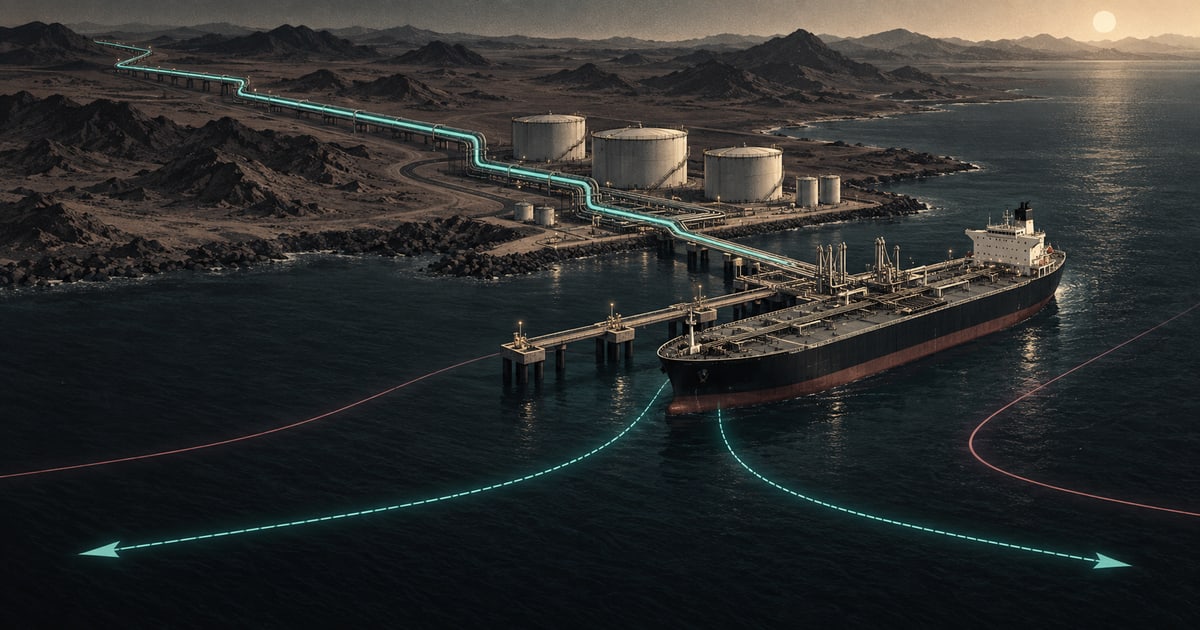
France has announced military protection for Yanbu. The routes to Europe, exposure to fuel supplies, Houthi threats and conditional economic scenarios.
French personnel, radars and defence systems to protect a Saudi energy site. On 24 September 2026, Emmanuel Macron announced on TF1 and France 2 that France would send military resources to Yanbu, on the Red Sea. He described the mission as protecting the site rather than joining the conflict. The operational timetable remains to be established. Reuters
The port also matters to drivers filling up in France. The connection runs through cargo routes, refineries and competition between buyers. The economic reach of a local protection mission depends on the entire delivery chain, through to refined-product prices.
The restart preceded the French announcement
On the evening of 21 September, a French diplomatic source had already said France was ready to help secure Yanbu and the East-West corridor through a defensive approach. AFP published the offer on 22 September. AFP
On 22 September, Reuters reported a low-rate restart of the East-West pipeline, citing informed sources. Its updated report dates the shutdown to 11 September, following attacks that Saudi Arabia attributed to Iraqi militias. Reuters
The initial restart therefore preceded Macron’s announcement by two days. Saudi Arabia’s attribution of the pipeline attacks also needs to remain distinct from operations claimed by the Houthis in Yemen.
On 24 September, Reuters added a crucial operational detail: crude was flowing towards coastal refineries again, but tanker loadings at Yanbu had yet to resume, according to industry sources and shipping data. Aramco was rebuilding the volumes needed to restart deliveries. The report separates the pipeline’s restart from the recovery of exports. Reuters, via Baird Maritime
The official Élysée page confirms the television interview’s date. Personnel numbers, specific systems, operational readiness and the mission’s cost remain to be documented. Its effectiveness will depend on those resources and the interruptions they actually prevent.
Routes to Europe and Asia
Yanbu lies on Saudi Arabia’s western coast. The East-West pipeline allows oil from the east of the kingdom to reach that coast without passing through the Strait of Hormuz. From Yanbu, one route heads north towards Suez and the Mediterranean; another runs south towards Bab el-Mandeb and the Indian Ocean. EIA mapping distinguishes these directions.
A cargo leaving Yanbu for Europe does not have to cross Bab el-Mandeb. It can travel north to the Suez Canal. Crude can also use SUMED, crossing Egypt by pipeline after being unloaded on the Red Sea side and reloaded on the Mediterranean side. The canal carries ships; SUMED carries oil. They are separate pieces of infrastructure. EIA
The direct route to Asia instead runs south through Bab el-Mandeb. A threat there does not have exactly the same effect on every customer of Yanbu. It can disrupt the Asian route without physically closing the northern route to Europe. That does not make the latter immune: it still requires a working terminal, willing vessels and usable transit facilities.
Getting oil to the port, loading it and delivering it each impose their own constraints. An upstream outage deprives the terminal of crude; interrupted loading holds oil in storage; a delayed vessel postpones arrival at the customer.
This bypass concerns oil. Liquefied natural gas requires specialised liquefaction facilities, carriers and receiving terminals; it cannot use this oil pipeline. EIA, Hormuz and pipeline sections
France also buys oil that has already been refined
French customs data available on 25 September cover January to July 2026. Over those seven months, France imported approximately 810,166 tonnes of Saudi crude, compared with 725,400 tonnes in the same period of 2025, an increase of 11.7%. Imports of a major category of ultra-low-sulphur gasoil moved in the opposite direction, falling 36.0% to 1,829,749 tonnes. These changes describe two specific trade flows; they do not measure Saudi Arabia’s share of total French consumption. French Customs, country data by CN8 product code
| Million tonnes | Jan–Jul 2025 | Jan–Jul 2026 |
|---|---|---|
| Crude oil | 0.725 | 0.810 |
| Selected gasoil | 2.858 | 1.830 |
Source and calculation: French Customs file PAYS_SA_IMP.CSV, data through July 2026, using the January–July cumulative mass columns, dividing kilograms by 1,000 and rounding to whole tonnes. Crude is code 27090090, excluding natural gas condensates. Gasoil is code 27101944, with sulphur content no higher than 0.001% by mass; its definition is unchanged between 2025 and 2026. This category covers only part of refined-product imports. Percentage changes use unrounded figures for matching months and product codes. Customs, Saudi Arabia download, Eurostat, crude definition, Idescat, gasoil code correspondence
The monthly breakdown adds another detail: this extract records no mass for that crude category in June or July 2026, and none for that gasoil category in July. These monthly observations are subject to revision. They do not establish September arrivals or purchases routed through other trading partners. French Customs
For the latest complete calendar year, provisional 2025 data published by Insee put Saudi Arabia’s share at 2.4% of French crude imports. This mass-based series assigns oil to the country where it was extracted. It also includes condensates, other refinery feedstocks and the non-bio share of additives, making its scope broader than the customs crude code above. It does not identify the loading port. Insee, using SDES data
France also imports products that have already been processed. The provisional French energy balance attributes 14% of refined petroleum product imports in 2025 to Saudi Arabia. That is a different category from crude delivered to refineries. SDES, page 2
The two percentages should not be added or divided to manufacture a dependency index. Their denominators are different. The SDES sentence giving country shares of refined-product imports does not specify the weighting unit; the reported share is reproduced here without an additional conversion. Above all, 14% of refined-product imports is not 14% of French fuel consumption.
Refined-product purchases therefore widen France’s exposure. The 2025 shares provide historical annual benchmarks, while customs tonnages update two flows for part of 2026. Measuring the proportion routed through Yanbu in September would require tracking cargoes to their destination.
A central question therefore remains unresolved: how much oil loaded at Yanbu now reaches France, either directly or through another country? The public material assembled here does not support a verified percentage. Treating all Saudi-origin French imports as cargoes shipped through Yanbu would be an unsupported shortcut.
Competition for cargoes spreads the pressure
Consider two refiners that normally buy from different suppliers. The first loses a delivery and looks for a replacement. It may then bid for a cargo the second refiner expected to buy. The second has lost nothing at the affected port, but its acquisition cost can still rise. The EIA describes how trade transmits pressure between regional product markets. EIA
This gives France an economic reason to care about Saudi export continuity beyond its bilateral contracts. Competition for cargoes transmits pressure to other buyers. The analysis describes exposure without presuming any particular government motive.
It does not imply a perfectly uniform market. Within this example, a replacement is useful only if the receiving installation can use it, it is available when required and it can be delivered at an acceptable cost. An advertised quantity on the other side of the world may not meet an immediate need.
A potential shared benefit from protecting a route also has a distributional consequence. If more oil reaches the market, buyers outside France may benefit from the same easing of conditions. That does not eliminate the French benefit, but it prevents treating every euro of military expenditure as savings reserved for French consumers. Without the mission’s cost, a credible estimate of disruption avoided and an observed price effect, a national cost-benefit calculation would be premature.
Houthi threats and their maritime reach
The warning to third countries predates the French announcement. On 20 September, Houthi political bureau member Mohamed al-Bukhaiti told the Associated Press that countries joining Saudi Arabia in the war could face his movement. He said its target was Saudi Arabia rather than all foreign shipping. AP
For shipowners, the stated scope leaves practical questions: which link to a Saudi port exposes a vessel, and what insurance remains available? Uncertainty over those criteria can itself change a transport decision.
As early as 21 July, Reuters had documented a Houthi message telling shipping companies to avoid Saudi ports. Two tankers loaded for China and India reversed course in the Red Sea towards Suez. Their commercial destination and observed course at that date are distinct pieces of information. The Houthis alleged a Saudi blockade of Yemen, an accusation Riyadh rejected. Reuters
Such pressure aims to make selling and delivering oil harder. It could influence the other side’s choices, although the cited sources do not identify concessions secured through this mechanism.
On 24 September, the Saudi-led coalition said it had intercepted six ballistic missiles aimed at Taif and Yanbu. The Houthis claimed attacks on Aramco facilities at Yanbu and a site in Riyadh. Reuters reported these statements without immediate Saudi confirmation of damage or casualties. Reuters
The sources reviewed as of 25 September contain no authenticated new statement naming France in response to Macron’s announcement. The documented warning of 20 September addressed countries that might join Riyadh more broadly.
A defensive mission within a political conflict
France has described the military objective it intends to pursue. Its diplomatic position is also set out in the G7 statement published on 22 September: the signatories condemn Houthi attacks, express solidarity with Saudi Arabia and Yemen’s internationally recognised government, and support a negotiated settlement under UN auspices.
Paris is setting an objective of protecting installations while expressing political solidarity with Riyadh. How other actors interpret the French presence remains a variable for the mission.
Under Article 35 of the French Constitution, the government must inform Parliament within three days of the start of an overseas intervention. Continuing an intervention beyond four months requires parliamentary authorisation. The television announcement alone does not establish the operational start date or which procedures have already taken place.
The human consequences also extend far beyond fuel prices. In its 21 September update, the International Organization for Migration recorded approximately 129,400 people displaced since the June escalation within the area it monitored, using information through 20 September. This is not Yemen’s total displaced population. IOM displacement tracking
Protecting infrastructure and resolving a conflict address different problems. Under some conditions, the first can preserve deliveries without ending the fighting. A durable recovery in commercial confidence could therefore depend on credible political commitments as well as successful interceptions.
From pipeline throughput to deliveries
There is also a 2026 reading for Saudi exports: JODI’s 22 September update covers July. In this series reported by the kingdom, crude exports averaged 4.125 million barrels a day in July, compared with 3.994 million in June and 7.276 million in February, rounded. These monthly averages cover all destinations and export routes; they do not isolate Yanbu or French deliveries. The data are subject to revision, and JODI flags these observations as not assessed for comparability. JODI update, 2026 primary series
For the East-West route, Reuters reported on 22 September that Saudi Arabia had been rerouting approximately 4 million barrels a day towards Yanbu before the shutdown. Aramco was seeking to restore that rate after the low-rate restart. It remained a recovery target, while the 24 September report described tanker loadings as still suspended. Reuters, 22 September, 24 September
Aramco says the East-West pipeline reached its maximum capacity of 7 million barrels a day in the first quarter of 2026, in results published on 10 May. That is the operator’s account of an earlier period, not a September flow reading or additional supply available to importers. Aramco
Capacity describes what an asset can handle under particular conditions. Throughput measures what actually moves through it. Exports are what leaves the country, and deliveries are what reaches customers. Those quantities can differ without any contradiction.
In a simplified supply chain, oil arriving on the coast can feed a refinery, replenish storage or be exported as crude. A recovery in pipeline throughput does not necessarily become an identical increase in exports on the first day. Some of the refinery’s resulting products may also be consumed domestically.
The time ships remain occupied matters too. Consider a wholly fictional example, not an estimate of any actual route. Ten tankers each carry two million barrels per round trip. A complete rotation, including loading, travel, unloading and return, takes sixty days. In a steady operating pattern, average delivery capacity is approximately 333,000 barrels a day, calculated as 10 × 2,000,000 ÷ 60.
If that rotation takes ninety days with the same fleet and cargo size, the average falls to 222,000 barrels a day. Transport capacity has dropped by one-third without a single ship disappearing. The calculation assumes continuous use of the fleet and excludes every other constraint.
It shows why a detour, a wait or an interruption can matter beyond one cargo: the vessel returns later for its next voyage. It does not predict a freight rate, which would also depend on ships available elsewhere and demand for transport. The arithmetic concerns the rotation of a fixed fleet.
An EIA analysis published in February 2024 documented rising Red Sea freight costs and war-risk insurance costs during the earlier disruption in late 2023 and January 2024, without a matching rise in Brent, the international crude benchmark, over the period it discussed. That historical episode does not forecast September 2026. It demonstrates why the commodity price and the cost of transporting it must be examined separately. EIA
Refining and inventories shape diesel supply
Fuel sold at a filling station has already been processed. Assessing an improvement in supply therefore requires looking at the products available after refining, not just the oil extracted or loaded.
The International Energy Agency provides a useful reference in its report published on 11 September. In August 2026, net diesel and gasoil exports from the Gulf and Russia were 1.6 million barrels a day below February’s level. It also estimated an August draw of 95 million barrels from observed global oil inventories. That second figure covers oil overall, not just diesel stocks or French reserves. IEA
These estimates precede the announcement of protection for Yanbu. They describe an already constrained market and do not measure an effect of the French mission. Better crude-loading availability could help, but the transmission would depend on the ability to produce and deliver the products buyers need.
Drawing down stocks can temporarily cushion a shortfall in deliveries. If those inventories then need rebuilding, some additional cargoes will be used to refill them. The recovery of a supply flow and the recovery of a comfortable safety buffer need not occur at the same time.
Finally, retail fuel prices include production and transport costs, distribution costs and taxes, as France’s economy ministry explains. A fall in the purchase price of the product therefore does not automatically produce the same percentage fall in the tax-inclusive pump price. This article estimates neither a future price per litre nor savings attributable to the deployment.
Four situations to watch
The following are conditional scenarios, without assigned probabilities. They may occur in sequence or overlap. Their purpose is to identify what would have to be observed to connect the site’s security with supply and prices.
Deliveries become reliable again
Repairs allow a stable flow, loading facilities work and vessels continue to call. If protection actually reduces interruptions, it contributes to making the route more predictable. The potential benefit is more usable cargoes and less uncertainty about when they arrive.
The relevant evidence would be a sustained sequence of completed loadings and deliveries, not a capacity announcement alone. Lower transport costs would reinforce that assessment. Even then, refining constraints or demand to rebuild inventories could limit the fall in fuel prices.
Logistics remain disrupted
Physical damage is contained while alerts, waiting times or commercial hesitation continue. The port remains usable without normal logistics returning. A mission could then reduce some losses without eliminating the extra costs buyers face.
Unreliable loading windows, cancellations or slower vessel rotations would be relevant signals. Preserving installations and restoring a regular commercial flow are then separate outcomes to assess.
The route suffers another major interruption
An outage affecting the port’s supply or infrastructure required for shipment again reduces accessible volumes. Protecting one perimeter would not be sufficient if the binding constraint lay elsewhere. Buyers would seek replacements and might draw on inventories.
Alternative routes remain available: Reuters documented Saudi Gulf loadings and passages through Hormuz on 21 September. Reuters On 25 September, it reported Kpler estimates putting Saudi crude exports through Hormuz on track for 3.6 million barrels a day in September, compared with approximately 0.9 million in August. With September still incomplete, the estimate remains provisional. Ship-to-ship transfers off Oman were reaching capacity, according to the sources interviewed. Rerouting can offset some lost Red Sea volumes while extending the delivery chain. Reuters, via MarineLink
An incident directly involves French assets
An attack affecting French personnel or equipment would change the mission’s circumstances. Subsequent decisions would depend on the incident, its attribution and the choices of the authorities involved. No particular escalation should be treated as automatic.
The economic effect would depend partly on the duration of interruptions and how carriers interpreted the event. An incident could increase uncertainty, but its occurrence alone would not establish a volume of lost oil or a rise in Brent. Additional operational and commercial evidence would be needed.
The outcome has to be measured beyond the terminal
Preserving an oil-access route matters to France in a market where disruption spreads between buyers. Refined-product imports belong in that assessment alongside crude purchases. The next step is to follow available supplies through to refineries and customers.
The economic case for protection rests on disruption avoided. Its central limitation is that the mission’s cost, operational scope and incremental effect have not yet been measured here. A simultaneous improvement in market conditions would not establish causation: repairs, alternative routes and developments in the conflict could all be working at the same time.
Assessing the French deployment’s effect will require completed cargo deliveries, steadier lead times and observed transport costs, followed through to refined-product markets. The announcement establishes an intention. Subsequent loadings and destinations will help show its economic reach.
Our guide to the oil market connects inventories, transport and price formation. The analysis of Cushing shows how a storage and delivery location shapes an oil benchmark.
Sources and limitations
Documentary analysis updated on 25 September 2026. French customs volumes cover January to July 2026, compared with the same months of 2025. The annual SDES/Insee shares concern provisional 2025 data with a different scope. JODI’s national crude-export series runs through July 2026, in its 22 September update. The IEA estimates concern August, published on 11 September; Kpler’s Hormuz estimate concerns an incomplete September. No complete daily series of Yanbu-to-France cargoes, independent damage audit or operational record of the French force was obtained. Military statements are attributed to their authors. The fleet example is fictional and is not a forecast.
- Élysée, Interview du Président de la République sur TF1 et France 2 (2026-09-24).
- Reuters, via Al-Monitor, France to send military to protect Saudi Arabia on Red Sea oil route, Macron says (2026-09-24).
- AFP, via The Times of Israel, La France prête à aider à sécuriser les infrastructures énergétiques saoudiennes : source diplomatique (2026-09-22).
- Reuters, via MarketScreener, Saudi Arabia restarts East-West oil pipeline, sources say (2026-09-22).
- Aramco, Aramco announces first quarter 2026 results (2026-05-10).
- U.S. Energy Information Administration, World Oil Transit Chokepoints (2026-03-03).
- Insee, SDES data, Provenance du pétrole brut importé en France (2026-05-21).
- SDES, Bilan énergétique de la France en 2025 : données provisoires (2026-04-22).
- U.S. Energy Information Administration, What drives petroleum product prices? Trade.
- Associated Press, Iran-backed Houthi rebels warn against joining Saudi Arabia in Yemen’s growing civil war (2026-09-20).
- Reuters, via Al-Monitor, Houthis warn shipping companies to avoid Saudi ports, email shows (2026-07-21).
- Reuters, via AOL, Houthis say they attacked Riyadh and Aramco facilities in Yanbu (2026-09-24).
- G7 / Foreign, Commonwealth & Development Office, G7 Statement on Bab al-Mandab and Navigational Rights and Freedoms (2026-09-22).
- Légifrance, Constitution du 4 octobre 1958, article 35 (2008-07-25).
- International Energy Agency, Oil Market Report, September 2026 (2026-09-11).
- Ministère de l’Économie, Bercy infos, Où trouver le prix des carburants près de chez soi ? (2026-03-09).
- IOM, Displacement Tracking Matrix, Yemen: Displacement Caused by Escalation in the West Coast, Update #9 (2026-09-21).
- Reuters, via The Economic Times, Saudi Arabia ramps up Gulf oil exports after pipeline attack, shipping data shows (2026-09-21).
- U.S. Energy Information Administration, Red Sea attacks increase shipping times and freight rates (2024-02-01).
- French Customs, country data by CN8 product code, Saudi Arabia file (July 2026 results, accessed 2026-09-25).
- JODI, oil database and September update (2026-09-22); 2026 primary CSV, Saudi Arabia, crude oil, exports, thousand barrels per day.
- Reuters, via Baird Maritime, Yanbu tanker loadings yet to resume despite Saudi pipeline restart (2026-09-24).
- Reuters, via MarineLink, Saudi Oil Surge Pushes Gulf of Oman Transfers to Capacity (2026-09-25).
This analysis is not investment advice.
// cite this analysis
l0g, “Yanbu: why France wants to protect Saudi Arabia’s oil route”, l0g.fr, published September 25, 2026, updated September 25, 2026, https://l0g.fr/en/analysis/yanbu-france-houthis-oil-route/
$ cd ../analysis