// analysis
The Gulf’s broken security bargain and the global cost of Trump’s war
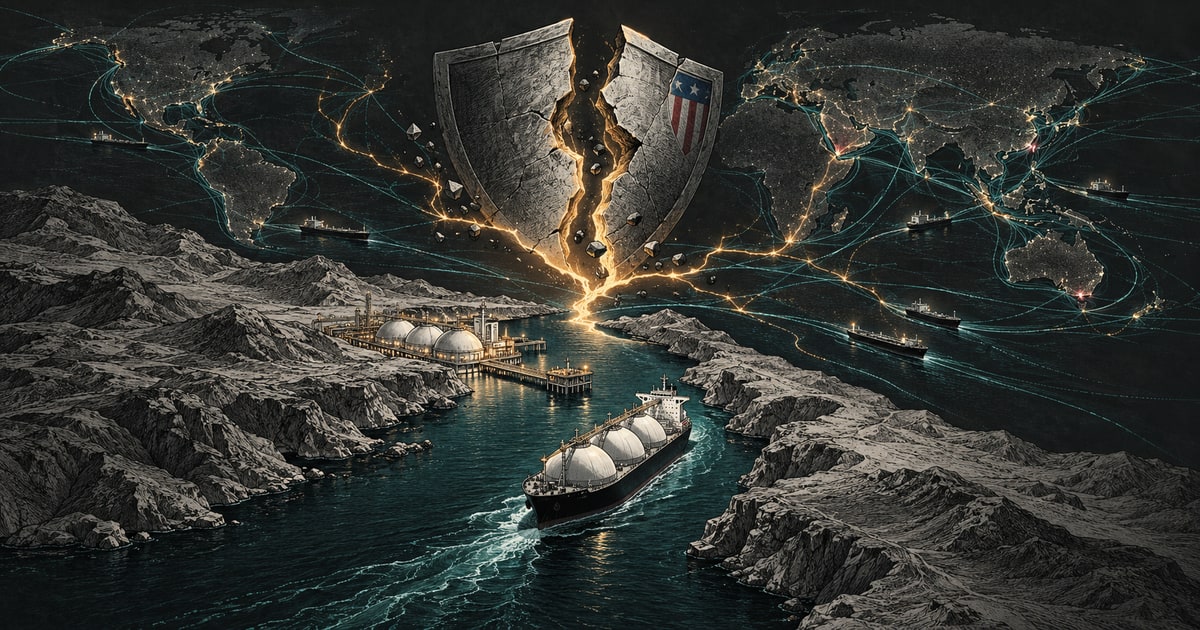
From Trump’s Qatar pledge to the Doha message: an investigation into responsibility, industrial damage and the worldwide costs of the Iran war.
// reading pathAsia in the global financial systemFollow the rates, currencies, credit and capital flows around this analysis.On September 29, 2025, Donald Trump signed a security commitment to Qatar that explicitly covered critical infrastructure. The following March, QatarEnergy’s chief executive described to Reuters the damage inflicted by Iranian strikes and repairs potentially lasting several years. On October 20, in Doha, US envoy Tom Barrack argued that regional states should take greater responsibility for their security. The sequence gives the charge of betrayal a substantive political foundation: a promise, severe damage to an ally, and an insistence that the region carry more of the burden. [1] [2] [3]
That charge needs a firmer basis than a viral claim that America is preparing to abandon the Gulf entirely. Barrack also said, “We’re not leaving.” The accounts reviewed describe a change in the guarantor’s role and in the allocation of responsibility; they provide no general withdrawal order. Washington can retain forces, facilities and formidable striking power while offering its partners less protection than they believed their cooperation would secure. [3] [4]
The practical question is therefore about the security produced by a war the United States chose to enter, and the consequences left for others to absorb. Public documents allow us to trace commitments, damaged industrial capacity, American military costs and economic effects abroad. Together, they support a severe assessment of political failure. A definitive worldwide bill remains beyond the evidence.
A written pledge within a limited security doctrine
The Qatar executive order provides the clearest starting point. It treats an armed attack on Qatar’s territory, sovereignty or critical infrastructure as a threat to US security and envisages appropriate measures, including military action if necessary. This is a commitment specifically to Qatar, with discretion over the response. Assessing the gap between the pledge and an ally’s exposure requires preserving those terms rather than reading an automatic response into them. [1]
A second document explains the wider American position. The official US presentation of the January 2026 defence strategy assigns regional partners primary responsibility for deterring Iran and its proxies, with American support. Washington reserves the capacity to act decisively in pursuit of its own interests. That allocation predates the military campaign. Barrack’s message in Doha continues an announced approach whose consequences have become far more onerous for partners during the war. [5]
According to US Central Command, Operation Epic Fury began on February 28, 2026, at the president’s direction. The White House subsequently described objectives concerning Iranian missiles, naval power and armed proxies, alongside denying Iran a nuclear weapon. These statements establish the administration’s declared ambitions. An assessment of their achievement requires separate evidence. [6] [7]
The political problem lies in how those choices fit together. An administration may consider war necessary while expecting its allies to do more for their own defence. Choosing both makes the preparation of their protection, supply systems and recovery an essential part of its responsibility. Gulf governments have agency and interests of their own. Hosting American forces nevertheless exposes their populations and infrastructure to a confrontation whose initiating decisions are substantially beyond their control. The Qatar pledge itself recognised the importance of that military cooperation. [1]
Ras Laffan tests the promise
The industrial chain gives the security argument a physical form. Liquefied natural gas, or LNG, is cooled for shipment by sea. A liquefaction “train” is a sequence of industrial equipment whose availability determines export capacity. Adding another tanker cannot replace a train that has stopped producing. Our guide to gas and LNG markets explains the infrastructure behind this dependence.
Human Rights Watch’s investigation traces Israeli attacks on Iran’s South Pars gas complex on March 18, followed by Iranian strikes on Qatar’s Ras Laffan complex on March 18 and 19. It documents damage and challenges the legality of the attacks. That legal assessment belongs to the organisation, rather than to a court judgment. Qatar’s government also condemned the escalation and the strikes on its facilities. [8] [9]
On March 19, QatarEnergy’s chief executive told Reuters that the damage removed 12.8 million tonnes a year of export capacity, equivalent to 17% of Qatar’s capacity, with repairs expected to take three to five years. He estimated roughly $20 billion in annual lost revenue. That figure concerns commercial revenue forgone, a different measure from the repair bill. It remains the operator’s March assessment; we found no equivalent public October reassessment. [2]
Industrial recovery has a material sequence: secure the site, replace equipment, restore connections and recommission the system. The operator’s estimate therefore changes the significance of the Doha message. A diplomatic realignment and a damaged gas installation operate under different constraints. Customers dependent on the plant, and the people who operate it, remain tied to the industrial recovery process as the political language changes.
Responsibility must be traced with equal care. Trump owns the American decision to wage war; Israel is responsible for its targeting choices; Iran is responsible for its attacks on Qatar. Holding Washington strategically accountable preserves the responsibility of each attacker. It also sharpens the political criticism: a power that promises protection must incorporate foreseeable retaliation into its assessment of a campaign and account for the protection it actually delivers.
Firepower and the security it delivers
Claims of comprehensive American military collapse obscure the failures that can be documented. Reporting by Stars and Stripes on the first inspector-general report describes damaged bases, struck buildings and redeployments. It does not establish that every US base in the region became unusable. A damaged facility, a relocated asset and a complete loss of operational capability describe materially different situations. [10]
Pressure on ammunition is more firmly documented. The Congressional Budget Office estimates that the United States consumed between half and two-thirds of its defensive interceptor inventory from June 2025, with replenishment potentially taking at least five years. The period extends beyond the 2026 campaign alone. Offensive cruise missiles face a different constraint. [11]
An interceptor protects a target against an incoming weapon. Using one demonstrates both protection delivered and an industrial resource consumed. Even a functioning defence can become harder to sustain through a prolonged campaign. For an ally, the relevant questions concern continuity of protection and the replacement of expended systems. Destroying enemy targets and safeguarding an energy facility over time are different missions, even when entrusted to the same armed forces.
The nuclear file also demands caution. In their September statement to the International Atomic Energy Agency, the United States, France, Germany and the United Kingdom described continuing gaps in access and verification in Iran. This is the position of four governments, including a belligerent, and is attributed accordingly. It identifies an unresolved verification problem against which public confidence about war aims must be tested. It establishes no shortcut to a claim that Iran possesses an available nuclear weapon. [12]
A strategic assessment therefore needs criteria beyond the number of targets struck. Protection of partners, safe commerce and verifiable outcomes are closer to the security that was promised. On those measures, the documented industrial damage and continuing uncertainties warrant a harsh judgment even where particular operations achieved tactical objectives.
Hormuz traffic returns unevenly
The Strait of Hormuz is a chokepoint: trade is concentrated in a passage that is difficult to replace. October evidence nevertheless challenges a picture of complete, uniform closure. The International Energy Agency reports that Gulf crude exports in September had recovered to more than three-quarters of their pre-war level. Refined products and liquefied petroleum gas, or LPG, remained much more impaired. [13]
That distinction matters to a haulier, distributor or manufacturer. Crude must still be processed into products their customers can use. Recovering crude loadings cannot by themselves restore every other part of the chain. LPG is also distinct from LNG, with different uses and infrastructure requirements. The IEA’s figures call for attention to the products available and the customers they can reach; one recovering aggregate cannot establish general normalisation. [13]
Inventories and alternative suppliers cushion disruption according to the spare capacity available. A business may keep producing while paying more for inputs, leaving part of the economic damage hidden behind stable output. An October bulletin by Bank for International Settlements researchers highlights this combination of substitution and inventory use with higher input costs. These are the authors’ findings. [14]
For Asian buyers, prominent among the Gulf’s energy customers, the adjustments involve cargoes, contracts and competing uses of energy. Our analysis of the Hormuz crisis in Asia explores that exposure further. European customers also seek replacement supply. Competition for available resources carries the effects into countries whose ports and power plants have suffered no direct attack. [2] [13]
Costs spread through budgets, factories and farms
American military expenditure provides one relatively bounded measure. The CBO estimates $38.1 billion in additional Defense Department costs through August 1, including replacement equipment and ammunition. Base repairs are excluded because sufficient information could not be verified. This is a cost estimate whose scope extends beyond cash already disbursed. [11]
AP reports CENTCOM’s $43.6 billion estimate through September 3, excluding base damage. This later assessment cannot be added to the CBO figure; its full underlying document was unavailable. [15]
For Gulf states, the economic damage also includes activity that cannot take place. On October 6, the World Bank forecast an average 4.3% contraction in Gulf Cooperation Council economies in 2026. This is a revisable annual forecast for overall economic activity. A higher resource price offers limited relief to an exporter whose production facilities or export routes are impaired. [16]
Costs abroad take other forms. An importer finances replacement supplies; a household changes its spending; a government chooses between fiscal support and allowing the shock to pass through. Additional revenue for a supplier can be the counterpart of additional spending elsewhere. Adding all those changes to lost output would count some effects more than once. A worldwide assessment requires an economic account of destroyed resources, forgone activity and distribution, extending well beyond a sum of transactions.
Farming makes the delay between an immediate shock and later consequences particularly clear. The Food and Agriculture Organization describes the risks that disruptions to energy and fertilisers pose to food systems. For an importing farmer, the constraint may emerge when purchasing inputs for the next harvest. Reduced applications, driven by limited cash or unavailable supplies, can affect production later. The magnitude depends on crops, soils, stocks and available support; a cost increase does not translate into the same yield loss everywhere. [17]
In April, the World Food Programme published a scenario under which a conflict extending through the second quarter could expose 45 million additional people to acute food insecurity. This was a dated, conditional projection for the countries covered by its model. Treating it as an observed October count would manufacture a result. It nevertheless demonstrates the scale of the humanitarian risk the agency was trying to anticipate. [18]
Relief operations provide another view of the pressure. In early October, WFP described worsening constraints in Yemen and said it had brought forward resources intended for November, with assistance gaps ahead unless new funding arrived. Yemen’s crisis has a much longer history than this war. Regional conflict adds obstacles for an already vulnerable population and an already underfunded aid operation. [19]
Human lives exceed a dollar valuation
An investigation of the war’s cost must keep those killed by strikes in view. Amnesty International attributes the February 28 strike on a school in Minab, Iran, to US forces and reports 156 deaths, including 120 children, based on its investigation. The organisation calls for accountability. We attribute both the finding and the toll to Amnesty, including its stated limitations on access to witnesses; these findings are not a final court judgment. [20]
The toll from a documented attack cannot supply a comprehensive casualty count for the war. It does prevent an assessment confined to missile inventories and growth rates. Recovering exports offer a bereaved family no conceptual compensation. Destruction also imposes costs in health, education, displacement and the conditions of daily life. Monetary estimates can inform particular public decisions without exhausting the meaning of those losses.
American political responsibility does not require assigning every economic difficulty worldwide to Trump. The IMF’s October outlook situates the Middle East conflict among several forces shaping the economy. Properly isolating the effect of any decision requires a baseline and explicit assumptions. The investigation is stronger when it follows identifiable damage and transmission channels than when it treats every adverse development as fresh proof. [21]
Betrayal as a political judgment
Washington can point to a doctrine announced before the campaign, an expectation of greater allied contributions and the continuation of its presence. Those points appear in the documents and in Barrack’s remarks. They rule out treating comprehensive withdrawal as an established fact. They leave the United States accountable to allies exposed by a war chosen in Washington. [3] [5] [6]
Betrayal describes the gap between promised protection, the risks imposed on partners and the allocation of consequences. It is a political judgment. Its verifiable foundation is the sequence: a specific commitment to Qatar, an American military campaign, severe Iranian attacks on Qatari installations, and renewed emphasis on regional responsibility. The charge gains particular weight when anticipated repairs extend over years and the consequences reach countries outside the decision to go to war. [1] [2] [3] [6]
An alliance is also tested by the sharing of risk after a disastrous decision. Asking partners to fund more of their defence can be an openly stated policy. Choosing a war that increases their exposure creates an obligation to answer for the consequences: sustained protection, durable commercial access, recovery from damage and verifiable results. The documents assembled here reveal the distance between the military power claimed and the security delivered. That distance is the foundation of the charge that America betrayed its promise.
Scope and limits of the investigation
Documentary research closed on October 21, 2026, using public texts, institutional reports, investigations by identified organisations and press accounts. The headline, author and date of the Wall Street Journal article supplied as a screenshot were located; the full article was not consulted. The Doha intervention is cross-checked through Al-Monitor and Al Jazeera’s account; the full recording was not verified. [22] [3] [4]
The material reviewed does not establish a complete US withdrawal, the loss of every usable American base or general exhaustion of US missile stocks. March industrial estimates, costs assessed through August or September, September trade flows and economic or humanitarian projections retain their dates and scopes. No worldwide total or exhaustive human toll is proposed. The three figures distinguish reported data, an operator’s estimate and a qualitative mechanism. The opening image is a generated conceptual illustration, with no documentary status.
Sources
- [1] White House · Security commitment to Qatar
- [2] Reuters / Business Recorder · Damage to Qatar’s LNG capacity
- [3] Al-Monitor · Rosaleen Carroll · Barrack on the guarantor role
- [4] Al Jazeera · Doha interview
- [5] US policy editorial / VOA · Regional defence doctrine
- [6] CENTCOM · Campaign launch
- [7] White House · Declared military objectives
- [8] Human Rights Watch · Energy infrastructure attacks
- [9] Qatar · Ministry of Foreign Affairs · Qatar government response
- [10] Stars and Stripes · Chad Garland · Bases and military supplies
- [11] Congressional Budget Office · Military costs and defensive inventories
- [12] France · Germany · United Kingdom · United States · Nuclear verification in Iran
- [13] International Energy Agency · September oil exports
- [14] BIS Bulletin 138 · Chokepoints, inventories and substitution
- [15] Associated Press · September military cost estimate
- [16] World Bank · Gulf growth forecasts
- [17] FAO · Agricultural and food-system risks
- [18] World Food Programme · Food insecurity scenario
- [19] World Food Programme · Humanitarian constraints in Yemen
- [20] Amnesty International · Investigation of the Minab strike
- [21] International Monetary Fund · Global economic outlook
- [22] The Wall Street Journal · Feliz Solomon · Limits of the US security guarantee
This analysis is not investment advice.
// cite this analysis
l0g, “The Gulf’s broken security bargain and the global cost of Trump’s war”, l0g.fr, published October 21, 2026, updated October 21, 2026, https://l0g.fr/en/analysis/gulf-trump-security-betrayal-global-cost/
$ cd ../analysis