// analysis
Danfoss and the business drama of cyber defrosting
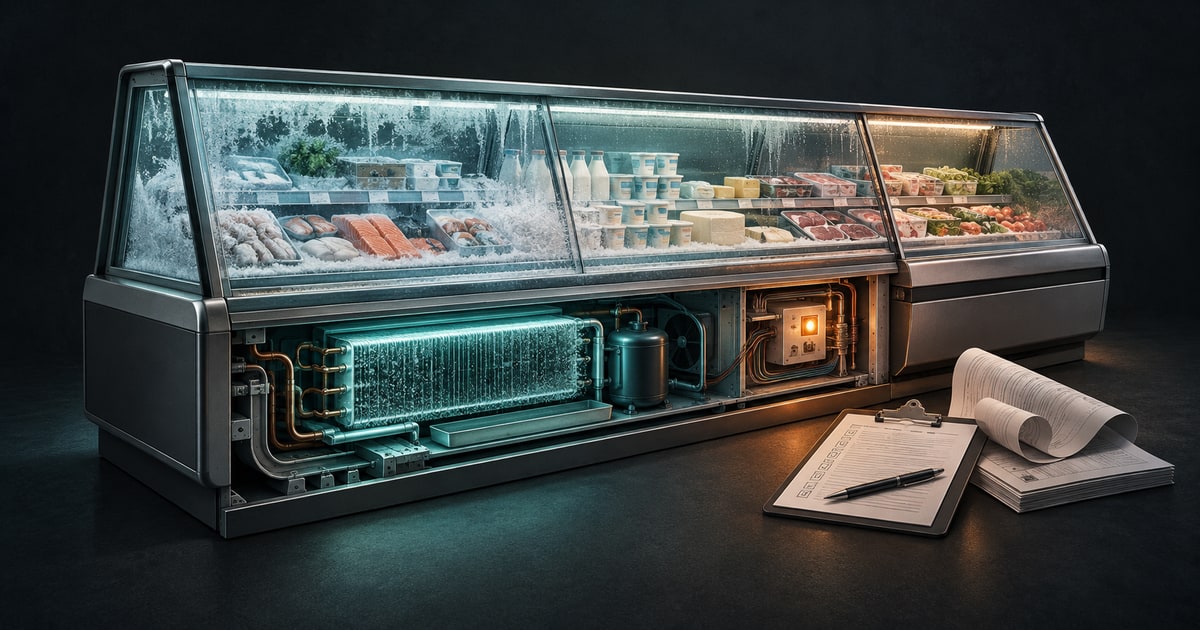
From refrigeration controls to spoiled stock: the Danfoss case exposes the handovers between product security, maintenance, food safety and insurance.
A supermarket can recover control of its refrigeration and still have lost the contents. That asymmetry gives the Danfoss affair its economic force: even where equipment can be restored, food exposed to an unsafe temperature history may already have lost its commercial value.
On 12 October 2026, BleepingComputer reported a cyberattack affecting refrigeration at French supermarkets. Intermarché said the attack may have affected a provider responsible for refrigeration systems, and confirmed the removal of products from sale. The provider’s identity and the entry route remained unresolved in the public account. [1]
France’s CERT-FR confirmed numerous compromises of Danfoss AK-SM and AK-SC controllers on 12 October. Its alert names neither an attacker nor a specific vulnerability from the public CVE catalogue. [22]
AFP reported retailer figures of at least 300 Intermarché and Netto stores, more than 100 Coopérative U stores, and several Leclerc stores on 12 October. These are attributed, provisional scopes. The Paris prosecutor said investigators would identify victims and establish links between the attack and reported damage. [25]
The investigation therefore starts with a narrower, more useful question than the total size of the attack. How does the ability to change a refrigeration setting become a stock loss, an interrupted business and a disputed claim? Following that sequence brings several actors into view, each holding a different piece of the answer.
A command crosses into the physical world
In its statement to Cooling Post, Danfoss identified legacy AK-SM800 and AK-SC355 systems among affected equipment, alongside current AK-SM800A units running outdated firmware. The manufacturer said it was helping customers with updates where available and stronger network protection. These are the supplier’s statements about the incident, rather than an independently published forensic reconstruction. The product suffix matters: evidence about an 800A vulnerability cannot automatically be assigned to an older 800. [3]
Refrigeration management belongs to operational technology: software supervises a physical process. For a reader used to office IT, the important change is the nature of an authorised action. A user may be allowed to alter operating conditions because a technician needs that ability during normal service. An intruder who acquires equivalent authority can misuse the same function.
Turonensis’s initial post reported 50 °C setpoints. The available post supplies a public allegation, without independent thermal measurements. [2] The analytical distinction is between the instruction, the environment and the goods. A temperature setpoint expresses a desired operating condition. An air sensor reports a measurement at a particular place and time. The temperature history of food depends on its exposure and physical characteristics. An alarming screen value cannot, by itself, establish the temperature reached inside every package.
This distinction also changes recovery. Restoring settings addresses the equipment. Establishing whether stock remains saleable requires a separate decision supported by trustworthy records. If the same compromised management system supplies both the commands and the history used to assess them, an investigator should test the reliability of that history. Independent measurements and preserved logs can become economically valuable because they help delimit the stock actually at risk.
A known vulnerability still needs an incident link
Amir Zaltzman’s Team82 research at Claroty, published 9 August 2026, describes an alternative authentication mechanism on the AK-SM800A capable of granting administrative access. Its illustration also shows a Censys census of 2,765 exposed devices. That is an exposure count, with neither a verified store-to-device conversion nor evidence that all those devices were compromised. Claroty is a commercial security company reporting its own technical research. [4]
Danfoss’s advisory for CVE-2025-41450, published 24 March 2025, describes an authentication flaw that can expose sensitive information through a generated web report and identifies a correction in version 4.2. Claroty’s later narrative describes broader administrative access under the same identifier. The difference between those descriptions should remain visible. Neither document identifies the entry route used in October. [5]
A further Danfoss advisory, dated 1 August 2025, covers CVE-2025-41451, a command-injection flaw potentially allowing remote code execution, and CVE-2025-41452, a configuration weakness that can make the web service unavailable. Both require authenticated access and affect AK-SM8xxA versions before 4.3.1, the stated corrective release. These preconditions matter when assessing any proposed attack chain. [23]
Connecting a vulnerability to an incident requires the affected model and software version, then evidence of how access was obtained. A matching product name and a published weakness provide leads for investigators to test. Logs, configuration history and forensic findings must establish the connection. The public documentation supports scrutiny of product security and deployment practices while leaving the attack chain open.
Temperature records and remote authority
An argument circulating around the affair deserves a precise answer: food-safety monitoring can justify collecting temperature data, but it does not prescribe an internet-facing control panel.
Regulation (EC) 37/2005 concerns quick-frozen food in transport and storage. Article 2 requires regular air-temperature recording and refers to EN 12830, EN 13485 and EN 13486. Article 3 provides derogations, including visible thermometers for retail display cabinets and local distribution. The text imposes no requirement for internet connectivity or public access to controls. Its scope also cannot be expanded to every refrigerated retail product. [6]
The architecture remains a design choice. Collecting a reading, acknowledging an alarm and changing an operating parameter involve different powers. A retailer buying remote visibility should be able to ask who also acquires the ability to write settings, and through which route. Commercial convenience can bring these functions into one interface; the security assessment still needs to follow each permission.
ANSSI’s industrial-security guidance recommends preventing direct internet access and controlling remote maintenance through measures including strong authentication, restricted access periods and logging. These are technical recommendations whose application depends on the system and relevant obligations. They provide a reference against which an installed design can be examined. [7]
Danfoss itself recommends network segregation, current software and protection against direct internet exposure. Its guidance also describes an Alsense proxy whose implementation, maintenance and operation are handled by Danfoss. A manufacturer’s advice and a service it undertakes to operate carry different implications for the investigation. Receipt of the advice, acceptance of the service and the actual installation each require evidence. [8]
The contract follows the access path
The words connected refrigeration can cover several arrangements. Danfoss documents StoreView Web as a front end updated independently of controller firmware. A current screen therefore says little about the software inside the equipment. Its documentation also separates direct StoreView access from paid access through Alsense. [9]
Alsense’s product page distinguishes digital services, where the customer monitors operations, from managed services that can include Danfoss monitoring and intervention. It describes an Azure-hosted environment operated by Danfoss. That establishes an advertised service model; public evidence reviewed here does not establish which affected stores subscribed to it or that the cloud service was compromised. [10]
These distinctions suggest a practical method for allocating responsibility. Start at the device and follow the people and organisations able to act on it. The manufacturer controls product design and the fixes it supplies. The installer may have designed the local network and established remote access. A maintainer may hold credentials and perform changes. The operator approves expenditure and runs the business. A managed-service provider may undertake additional duties. Those roles can overlap, and their contractual extent must be established individually.
The central question is a handover: when a security problem became known, who had promised to turn that information into an operational change? Publishing an advisory, forwarding it, approving work and installing a patch are separate events. A useful investigation follows one notice through the relevant organisations until it reaches a verified change on the equipment, or finds the point where action stopped.
Danfoss’s French general sales terms, marked January 2025, illustrate the financial stakes. They describe remedies for qualifying defects and seek to exclude categories including lost profit and downtime, while limiting liability and preserving mandatory legal exceptions. Applicability, interpretation and enforceability depend on the actual agreement and law. These public terms cannot decide a victim’s claim. [11]
The company’s services page directs Climate Solutions customers to the quotation and applicable sales terms. The signed quotation could consequently matter as much as the general conditions when establishing the scope of a maintenance promise. [12]
A retailer might have bought emergency fault repair while assuming that security updates were included. A contractor might have proposed a replacement awaiting approval. Alternatively, a service agreement might explicitly assign continuous monitoring or update management to a provider. These are competing investigative scenarios. In each, the same unpatched controller could sit within a different chain of obligations.
Our investigation into cyber access at wind and solar installations follows a comparable handover. In both settings, a defensible allocation connects a named duty with access, authority, funding and evidence of completion. The organisation that can perform a change and the organisation empowered to approve it both belong in the reconstruction.
A patch has to reach the equipment
Danfoss’s September 2025 instructions make the implementation work tangible. Release 4.3.1 required a compatible Danux operating-system package, a backup and checks after restart; network conditions could favour an on-site intervention. Danfoss also said stocked units would not be recalled or updated. A recently purchased unit could therefore still require that work before use. [24]
The global English-language download page offers 5.3.x, checked on 13 October 2026. Version 4.3.1 is a historical remediation milestone, rather than current deployment advice. [24]
The economic question is who organised and paid for the migration. A downloadable package can be free while preparation, travel, operational interruption and verification consume resources. When procurement and maintenance sit with different companies, commissioning provides an opportunity to verify the installed software and record the handover. The relevant evidence would be the accepted work, the version actually deployed and the subsequent checks. A purchase date alone supplies none of those assurances.
The software lifetime enters the investment decision
Danfoss’s October 2025 technical newsletter says the AK-SM800 reached end of life in May 2021 and announces a firm end to services for legacy products. It also identifies the SC355 among products phased out in 2016. The newsletter is evidence of a public support position; proving an individual customer received adequate notice requires further records. [13]
This raises a capital-allocation problem. A refrigeration installation can remain useful while part of its digital control environment loses support. The owner then has to compare the cost of replacement with the cost and limitations of protective measures, possible downtime and residual exposure. A credible assessment needs the actual architecture and the conditions under which continued operation would be acceptable.
For future procurement, support duration belongs beside installation and servicing costs. Buyers can ask how security notices reach the final operator after a change of maintainer, how replacement will be managed, and how access is closed at the end of a contract. These questions turn a distant support date into a funded operational obligation.
The Cyber Resilience Act adds another reason to keep dates precise. Its reporting obligations began applying on 11 September 2026; its main product requirements apply from 11 December 2027. That timetable does not establish a breach by any actor in this affair. Our analysis of the CRA’s vulnerability-reporting duties examines that distinction. [14]
The loss grows beyond the stock room
Food law makes the first operational decision urgent. Regulation 852/2004 places primary responsibility for food safety with the food business operator and requires protection of the cold chain. Regulation 178/2002, Article 19, provides for withdrawal and notification when its conditions are met, with consumer information and recall where necessary. A temperature deviation needs a product-specific safety assessment; the law cannot be reduced to an automatic order to destroy every item. [15] [16]
Le Monde reported one Gradignan Intermarché owner’s €21,000 stock-loss estimate at purchase cost. The local account supplies no national estimate. [17]
For analysis, the business loss should be reconstructed from distinct records. Purchase cost describes capital tied up in goods. Lost sales describe revenue that might otherwise have been earned. Adding both without accounting for the cost of those sales can double-count the damage. The appropriate measure of lost trading contribution depends on the revenues foregone, costs avoided and the accounting or insurance definition being applied.
Other costs follow a different path. Staff may need to identify and segregate stock, arrange disposal, clean equipment and restock. An emergency intervention can restore refrigeration before normal deliveries restore the assortment. Forensic work may continue after the shop resumes trading. Each item needs an invoice, a labour record or another defensible basis; none is quantified nationally here.
Timing changes the burden even when a later recovery is possible. In an illustrative case, a store pays for replacement goods and urgent service while an insurer examines causation and coverage. The cash requirement arrives before the final allocation of responsibility. A sound assessment therefore follows both the ultimate loss and the financing needed to keep operating during the claim.
The familiar retail sign above the door also tells us less than it appears to. Les Mousquetaires describes its model around independent business owners; Coopérative U likewise presents a cooperative of independent retailers. These structures make the identity of the operating company and contracting parties relevant. They establish neither the insurance arrangements nor the security duties of the stores affected here. [18] [19]
Common equipment creates another analytical risk: several businesses may require assistance at once. A shared weakness could correlate losses across otherwise separate operators, placing pressure on maintenance capacity and replacement logistics. The strength of that connection remains a matter for investigation. Similar symptoms alone cannot demonstrate one central platform breach or a single contractual counterparty.
Insurance must recognise the route to damage
A cyber event with spoiled food at the end of it sits across several possible insurance questions. A policy may address damaged stock, machinery, business interruption or cyber response. Its definition of the insured event, exclusions, limits and any requirement for prior physical damage determine how those categories interact. The label on the policy supplies a starting point; the actual wording and facts determine the analysis.
This matters where machinery continues to function after a malicious command. A repair invoice may be small while lost inventory is substantial. The claim then needs to explain how the unauthorised action affected the goods and interrupted trade. Identifying the damaged interest helps prevent a technical restoration report from becoming a misleading proxy for the commercial loss.
French law also supplies a concrete procedural condition. Article L12-10-1 of the Insurance Code, in force since 24 April 2023, makes payment under relevant professional cyber-loss cover conditional on the victim filing a complaint within 72 hours of becoming aware of the attack. It does not create cover absent from the contract. [20]
France Num’s guidance describes the complaint process and the value of retaining evidence. For this kind of loss, preserving the incident chronology alongside temperature records, stock records and intervention documents would help connect the cyber event to the claimed consequences. That evidential chain serves several purposes: investigation, food-safety decisions and financial recovery. [21]
From network traces to a documented loss
A forensic reconstruction needs to follow the event across organisational boundaries. The device inventory establishes the equipment and software present at the time. Controller logs may record a session or setting change. Network records and remote-maintenance logs may help explain where that activity came from. Monitoring records and received alarms can then be compared with temperature readings and observations of the goods.
This is a proposed investigative sequence, rather than a description of traces already recovered. Each connection needs scrutiny. The appearance of an account in a log leaves open who was using it. A change of setting requires comparison with the previous state and the equipment’s response. Investigators must also retain differences in time zones, clock accuracy and retention periods when correlating records. Apparent simultaneity can otherwise create a causal story the evidence cannot sustain.
For suspected compromise, CERT-FR recommends access filtering, factory reset, security updates, secret rotation, account checks and reconfiguration. [22] That response creates an operational tension: urgent restoration can alter material useful to the investigation. Coordinating containment and recovery with evidence preservation helps address both demands, subject to the safety needs of the site.
The resulting chronology should connect access, authority to change a parameter, the action taken, its physical consequences and the documented commercial loss. Maintenance records can then establish who was responsible for the protections and decisions relevant to that sequence. This is the point at which a technical hypothesis becomes useful to a liability assessment.
Accountability survives the restart
The business lesson follows the division of operational authority. Security obligations become effective when someone can carry them through to the installed equipment. Food-safety obligations become effective when reliable information supports a timely decision. Insurance becomes useful when the contract covers the actual route from the digital action to the physical and commercial damage.
For the Danfoss affair, the documents still needed are specific: a defensible incident reconstruction, the versions and access arrangements in use, the notices exchanged, the accepted maintenance scope and the affected businesses’ loss records. Together they would allow responsibility to be assessed without treating a manufacturer’s advisory, a contractor’s credentials or a retailer’s empty cabinet as a complete explanation.
Refrigeration can restart before those questions are settled. The goods already withdrawn, the cash needed to replace them and the obligations passed between organisations remain. That is where the business drama of cyber defrosting continues.
Method and limits
Transparency. Bluetouff participated in the early public discussion. Posts checked directly on X show a relay of Turonensis at 09:35 on 12 October, followed by a link to Claroty’s refrigeration research at 10:04, in the browser’s Europe/Paris context. Those timestamps document participation, without establishing who first discovered the incident. A separate post about Danfoss iC7 vulnerabilities explicitly cautioned against assuming a connection; those products fall outside the refrigeration-controller evidence examined here. This article draws on public documents and attributed reporting. We have reviewed no affected store’s contract, insurance policy or forensic image. [2]
The figures explain general mechanisms and do not reconstruct a victim’s installation. The opening image is a generated conceptual illustration.
Sources and documentary scope
Sources checked on 13 October 2026. Manufacturer and researcher publications are attributed to their authors. The economic sequences above are analytical frameworks, not estimates of this incident’s aggregate losses.
- BleepingComputer, refrigeration cyberattack at French supermarkets, 12 October 2026. Reporting and Intermarché response.
- Bluetouff’s X posts of 12 October 2026: 09:35 relay, quoting Turonensis; 10:04 Claroty link; qualified iC7 reference. Author participation, not independent incident confirmation.
- Cooling Post, Danfoss moves to mitigate cyberattack, 12 October 2026. Manufacturer’s statement to specialist press.
- Claroty Team82, research on Danfoss refrigeration controllers, 9 August 2026. Primary technical research; commercial security vendor.
- Danfoss, DSA-2025-03-01, 24 March 2025, classification updated 1 September 2025.
- Commission Regulation (EC) 37/2005, 12 January 2005, Articles 1–3.
- ANSSI, industrial-system security: detailed measures, version 2, 27 November 2025, recommendations R122–R130.
- Danfoss, cybersecurity best practices. Current guidance; individual customer receipt unverified.
- Danfoss, StoreView Web product documentation and FAQ. Front end, firmware and access arrangements.
- Danfoss, Alsense Food Retail services and FAQ. Advertised service scope, not a victim’s contract.
- Danfoss, French general sales terms, January 2025, especially Articles 11–14. Applicability to affected stores unestablished.
- Danfoss, general terms for services, Climate Solutions entry.
- Danfoss, Tech Insider October 2025, 31 October 2025, end-of-service section.
- European Commission services, summary of the Cyber Resilience Act, application timetable and reporting provisions.
- Regulation (EC) 852/2004 on food hygiene, Article 1 and Annex II, Chapter IX.
- Regulation (EC) 178/2002, Articles 17 and 19.
- Le Monde, supermarket losses, 13 October 2026.
- Les Mousquetaires, retail brands and independent-owner model. Organisation’s own description.
- Coopérative U, cooperative model. Organisation’s own description.
- French Insurance Code, Article L12-10-1, effective 24 April 2023.
- France Num, filing a complaint following a cyberattack, updated 6 October 2023.
- CERT-FR, CERTFR-2026-ALE-012, 12 October 2026.
- Danfoss, DSA-2025-08-01, 1 August 2025.
- Danfoss, Tech Insider September 2025, 23 September 2025; current AK-SM800A downloads, checked 13 October 2026.
- AFP, French supermarkets suffer refrigerator shutdown, 12 October 2026. Retailer and prosecutor statements.
This analysis is not investment advice.
// cite this analysis
l0g, “Danfoss and the business drama of cyber defrosting”, l0g.fr, published October 13, 2026, updated October 13, 2026, https://l0g.fr/en/analysis/danfoss-cyber-defrosting-business-drama/
$ cd ../analysis