// analysis
Crux AI: the bank risk behind Google’s chips
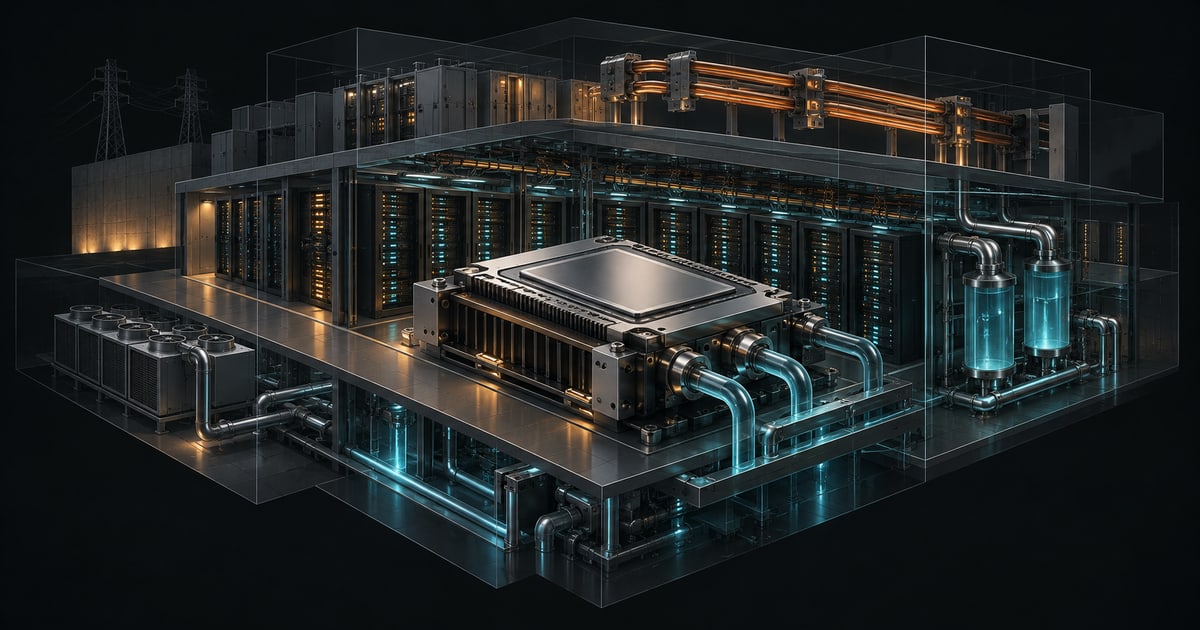
The reported $22 billion Crux AI loan connects Google, Blackstone and BNP. An investigation into chip collateral, power and the transmission of bank risk.
Google supplies the processors. Crux AI has to turn them into revenue. Banks provide the financing. Making those transactions work together still requires an operating data centre, paying customers and contracts that survive a default. A reported $22 billion loan raises a practical question: what can a lender actually recover when its collateral consists of chips?
On 16 September 2026, Reuters reported, citing a source familiar with the matter, that ten banks, including BNP Paribas, were providing $22 billion to Crux AI, the venture created by Google and Blackstone. Chips and customer contracts would secure the borrowing; syndication is under way, with a possible bond refinancing later. Reuters attributes these latter details to Bloomberg. A potential refinancing is not a completed transaction. S01
A loan secured by computing equipment depends on what that equipment is worth after a default. Recovery value can fall if the machines lose access to their site, power, cooling or the software needed to operate them. Assessing the collateral therefore requires looking beyond the processors themselves.
Crux says it plans, owns and operates data-centre sites with integrated power and cooling. That description does not establish which rights lenders hold over the infrastructure. The company’s website does not document the security package or the conditions under which creditors could keep the business running or transfer it to a buyer. S03
Bank exposure depends on two distinct things: Crux’s ability to generate cash to repay its debt, and creditors’ ability to recover sufficient value after a default. A claim over equipment offers less protection if the rights needed to operate it do not survive.
Google sells the equipment; customers must support the debt
A TPU, or Tensor Processing Unit, is a processor Google designs for artificial-intelligence workloads. The proposed business is to operate this equipment and sell computing capacity. The chip is a production asset; the service sold to customers is the output. S02 S07
When the partnership was announced on 18 May 2026, Blackstone disclosed an initial $5 billion equity commitment from funds it manages. Google would supply hardware, software and services. Crux launched under its name on 9 September. The public target is an initial 500 megawatts of capacity in 2027: planned power capacity, not electricity already consumed or facilities already operating. S02 S04
Google is helping create a buyer for its own equipment. That supplier-customer relationship calls for scrutiny of the expected revenue, but does not itself establish fraud or fictitious sales. The financing’s viability depends on end-customers whose payments can cover operating costs and debt service without a permanent reliance on new funding.
Lender recourse depends on the legal obligations of the entities involved. Google’s participation does not, by itself, give lenders full recourse to Alphabet’s balance sheet. Nor is a commitment by Blackstone-managed funds an unlimited guarantee from Blackstone Inc. The public sources reviewed do not establish a general repayment guarantee from either group. Other protections may exist in the private loan documentation.
Equity can absorb losses before creditors suffer them. That protection depends on which entities receive the capital, when it is contributed and any further support obligations. Adding the announced equity commitment to the reported loan does not establish the value of the collateral, meaning the property or rights securing repayment, or a reliable loan-to-value ratio.
This supplier-customer relationship connects to AI’s circular financing: the key is to identify who brings in revenue from outside the network.
Operating continuity depends on site and power rights
Trade reporting describes a range of site arrangements contemplated by Crux, from colocation to site development. It does not establish which rights are pledged to lenders. S06
Where one company owns the servers, another owns the building and outside suppliers provide electricity and software, a pledge of the equipment does not automatically cover property rights or service agreements. This hypothetical structure illustrates how assets can be separated; it is not a description of Crux’s legal organisation.
After a default, those lenders could have a claim over the machines while still needing to negotiate permission to keep them running. Conversely, a tenant can be a sound borrower when creditors have durable rights to access the site, preserve essential contracts and replace the operator. Not owning the real estate is not, in itself, a financing defect.
Continuity is the decisive issue. If the operator stops paying, who can prevent the lease from being terminated? Who retains the grid connection and the arrangements needed for electricity supply? Who can appoint a replacement operator? A security interest in processors alone does not answer those questions.
Project finance has tools for this. Direct agreements with essential counterparties can give lenders time to remedy a default and rights to intervene or substitute an operator, often called step-in rights. Their purpose is to preserve the business rather than force an immediate break-up. The World Bank describes these mechanisms; their presence and enforceability in the Crux financing remain to be established. S13
Owning a power plant, holding an energy contract, reserving electrical capacity and having an operational grid connection also answer different questions. A credit assessment must examine the usable rights, how long they last and what happens to them if the borrower changes. A partner’s wider infrastructure portfolio cannot stand in for those contracts.
Chip value depends on the system around it
A creditor may seek to sell an operating business or sell its equipment separately. Those approaches need not produce the same price.
Google’s documentation for Ironwood illustrates the depth of the dependence: TPUs work within a system of interconnections, liquid cooling and software. This architectural example does not identify which chip generation the Crux loan will finance. It explains why recovery analysis needs more than the number of processors multiplied by their purchase price. S08
In a going-concern sale, the buyer acquires the ability to serve customers. In a break-up, it must find a use for the equipment, obtain the necessary technical rights and potentially pay for removal, transport, reinstallation and lost operating time. The same machine can be worth less to a buyer that has to rebuild the surrounding system.
Resale value depends on the pool of buyers able to take over the systems, the rights that can transfer, the time needed for a sale and the cost of putting the equipment back to work. The sources reviewed provide neither public, comparable liquidation transactions nor sufficient evidence to assign a specific haircut to Crux’s equipment. They also do not establish that the hardware would be unsaleable.
Obsolescence requires the same discipline. A processor does not stop working when its successor arrives. It may remain economical for particular workloads at the right acquisition and operating cost. A newer generation’s better energy efficiency could nevertheless push service prices down and reduce what a buyer will pay for older equipment. That is an economic hypothesis to test, not a universal expiry date.
An accounting depreciation schedule cannot settle the issue. It allocates cost across reporting periods; it does not guarantee future revenue or a resale price.
Risk builds before the first billable hour
On 8 September, Bloomberg reported difficulties at several sites intended for the project, involving site development and electrical equipment. Parts of the report relied on anonymous sources. In the same article, Crux’s chief executive maintained the initial 500 MW target for 2027 and pointed to multiple site options. Reported problems at individual locations therefore do not establish a delay to the entire programme. S05
Equipment delivered before a building is ready can tie up capital without earning revenue. A delayed grid connection can postpone service. If interest accumulates in the meantime, funding needs rise while receipts move further into the future.
Contracts can reduce this mismatch through conditional deliveries, drawdowns linked to verified milestones, equity contributed first or commitments to fund cost overruns. Cash reserves can also cover the waiting period. The public documentation reviewed does not specify which protections Crux negotiated.
A useful test compares four schedules: equipment delivery, actual site readiness, the customer’s first enforceable payment and debt repayment. Risk grows when one schedule must wait for the others without financing to cover the gap. The Bank for International Settlements identifies construction and energy constraints among the risks in financing the AI build-out. The European Banking Authority’s June 2026 report likewise brings together AI, energy and private-credit risks. S09 S15
Chips and contracts can weaken together
Chips and customer contracts can be exposed to the same economic shock. Including both in a security package does not necessarily provide two independent sources of protection.
In a scenario of falling compute rental prices, new contracts become less profitable and financially weaker customers may struggle. Second-hand equipment can lose value at the same time because it earns less money. Lenders could then face a simultaneous increase in the probability of default and the loss after default. This illustrates a risk mechanism, not a forecast for Crux.
The relationship is not inevitable. A firm contract with a strong customer may protect revenue from falling market prices for its duration. New uses may also create demand for older hardware. The analysis needs to test how long that protection lasts and whether customers depend on the same investment cycle.
A customer contract’s value depends on when billing starts, acceptance conditions, service credits, termination rights and whether it can transfer to a new operator. A requirement to pay for reserved capacity even when unused, known as a take-or-pay arrangement, does not necessarily resolve a failure to deliver that capacity or a customer bankruptcy. The terms of Crux’s customer contracts are not disclosed in the sources reviewed.
Cash available for debt service matters more than promised gross revenue. In a wholly fictional example, measured in arbitrary units over an annual period, the operator receives 100, spends 60 before debt service and owes lenders 30. The remaining cushion is 10. If receipts fall to 80 while other outgoings remain at 60, the debt-service shortfall is 10. Revenue has fallen by 20%, but cash available before debt payments has halved.
The debt-service coverage ratio, or DSCR, compares that available cash with interest and principal payments due: 40 / 30 = 1.33 initially, then 20 / 30 = 0.67. Below 1, current-period cash is insufficient. Reserves, an additional contribution or revised payments are needed. These figures describe neither Crux’s loan nor its margins.
Collateral valuation must also avoid double counting. Adding the present value of the entire operating business, based on customer-contract cash flows, to the full value of the machines producing those cash flows would count part of the same economic value twice. A coherent valuation distinguishes net operating cash flows during the forecast period from any residual value at its end. A gross order book is not immediately recoverable cash.
The difference between promised revenue, cash receipts and refinancing also underpins our guide to private credit.
Banks also bear the risk that distribution fails
Bank exposure begins with a binding commitment, subject to its terms, not just when the borrower defaults. An undrawn commitment differs from a funded loan, but it can still require the bank to provide liquidity when the agreed conditions are met.
A bank arranging a facility with the intention of selling part of it must therefore manage two horizons. It assesses the borrower’s capacity to repay, but must also be able to retain its commitment if other lenders withdraw or demand a less attractive price. A stalled distribution can leave the arranger with a larger or longer exposure than intended, or require it to accept a loss on sale.
Supervisors recognise this mechanism. In their 5 December 2025 statement on leveraged lending, the OCC and FDIC call for controls over loans intended for retention as well as distribution, and for monitoring refinancing risk. The statement helps explain the mechanism; it does not establish how the Crux loan should be classified for regulatory purposes. S14
Syndication divides a loan among lenders. It does not eliminate borrower risk and is not, by itself, securitisation. A subsequent bond issue might repay some or all of the bank facility. But a future bond market is not liquidity already in hand: investors must still be persuaded on the terms available at that time.
Nor does targeting the investment-grade market, which serves borrowers assessed as having stronger credit quality, amount to receiving a credit rating. Any eventual rating would need to be read with its date, scope and supporting guarantees.
BNP Paribas’s exposure depends on its initial commitment, the amount drawn, its final retained share and its credit protections. That breakdown is unavailable in the sources reviewed. Neither BNP’s individual exposure nor its potential losses can therefore be calculated from the headline loan amount and the number of lenders.
If credit quality deteriorates, the effects on a bank can include provisions, a loss on disposal or additional pressure on balance-sheet capacity. The precise impact depends on accounting and prudential treatment, hedges and net exposure. The gross amount of a financing is therefore not a measure of bank losses, still less evidence of a threat to a group’s solvency. S14
Financial links can extend exposure beyond a loan sale
Selling a loan without a continuing obligation to take it back can reduce a bank’s direct risk. The analysis must then ask whether the bank also lends to the buyer’s fund, supplies a liquidity line or remains exposed through another transaction. These are possible channels, not established Crux-related positions.
The ECB describes these links between banks, funds and financed companies in its May 2026 study of private credit. At that point it assessed aggregate direct exposures as limited, while highlighting concentrations and wider market spillovers. That sector-level assessment is neither an audit of the Crux loan nor a snapshot of September commitments. S11
Syndication can diversify risk for an individual lender. It does not necessarily diversify its underlying cause. Different banks may lend to different businesses that depend on the same customers, technology or electrical bottlenecks. That economic concentration matters more than the number of names on a loan agreement’s cover page.
There is also a distinction between legally valid security and collateral recognised as sufficiently protective for regulatory capital calculations. For certain physical collateral under the foundation internal ratings-based (IRB) approach, which combines internal ratings with certain supervisory parameters, the Basel framework requires, among other conditions, liquid resale markets, public prices and revaluations that account for obsolescence. This does not establish a breach or determine BNP’s risk weight; the applicable treatment still needs to be identified. S12
Operating cash flows can reduce dependence on resale value
A loan repaid from operating cash flows can remain sound even as equipment loses value. Outstanding principal falls with each repayment, while the hardware provides additional protection. How well this works depends on the amortisation schedule, customer credit quality and continuity of service.
A useful documentary precedent exists, although it does not establish identical terms at Crux. In its 2025 Form 10-K, CoreWeave describes delayed-draw facilities secured by assets and contractual cash flows, with amortisation as those cash flows are generated. The filing illustrates the intended alignment between investment, delivery of capacity and repayment. It does not prove Crux has equivalent protections. S10
Lower computing costs can also expand usage. Long contracts, competitive electricity costs, adequate reserves and transferable operating rights could sustain debt payments despite falling hardware prices. Conversely, a facility with most principal due at maturity and repayment dependent on a new loan would be more vulnerable to refinancing markets closing. The public sources reviewed do not establish the Crux loan’s amortisation profile.
Credit quality depends on how these protections work together: outstanding debt needs to fall at a pace consistent with expected cash flows and recoverable asset values. The following documents would allow that relationship to be assessed.
The missing documents that would decide the assessment
| Document or disclosure | Question it needs to answer |
|---|---|
| Credit agreement and guarantor list | Who must repay, on which balance sheet, when, and with what recourse? |
| Security schedule and intercreditor agreements | Which assets and rights are covered, and in what priority? |
| Site, supply and step-in agreements | Can service continue after a default or a change of operator? |
| Customer contracts and delivery schedule | When do payments become enforceable, and when can they stop? |
| Independent equipment valuation | What net value remains in a going-concern sale or a break-up? |
| Final lender allocations and credit protections | What exposure does each lender actually retain? |
These provisions may exist in private documentation. Their absence from the public record prevents a firm assessment of credit quality; it is not evidence that the contracts are defective.
For banks, credit risk therefore depends partly on industrial continuity: an accessible site, power, usable systems and customers obliged to pay. The protection provided by the chips depends in part on whether the operating business can be preserved or transferred after a default.
When creditors recover equipment without the rights needed to operate it, they must assess a separate asset sale and its costs. When those rights survive, a buyer may be able to preserve operations and the associated revenue. Without public documentation of those rights and the final lender allocations, the $22 billion headline does not, by itself, measure potential bank losses.
Method and limitations
This analysis is based on public sources reviewed as of 17 September 2026. Loan characteristics remain reported information, not findings from an executed credit agreement. Statements from Crux and Blackstone are identified as company claims. Reporting about local site difficulties is presented alongside management’s response. No party was interviewed directly for this article. Missing information is not used to manufacture a Crux-specific loss estimate, leverage ratio, resale price or numerical scenario. The cash-flow example is entirely fictional and serves only to explain the mechanism.
Sources and documents
S01: Reuters. Banks provide $22 billion chip loan to Blackstone, Alphabet AI cloud venture, source says (2026-09-16). Reported loan and participants; security and distribution details attributed to Bloomberg. No published credit agreement. Syndicated copy reviewed on MarketScreener.
S02: Blackstone. Blackstone Announces Joint Venture with Google to Create New TPU Cloud (2026-05-18). Initial equity commitment by managed funds, partnership and capacity target. An announcement, not evidence of disbursement.
S03: Crux AI. Official site / integrated infrastructure (date not stated). Claims site ownership and operation; does not document lender security.
S04: Crux AI / Business Wire. Crux AI Launches to Deliver Dedicated AI Compute at Industrial Scale (2026-09-09). Launch release distributed by Business Wire, syndicated copy reviewed on StreetInsider. A company statement, not independent corroboration.
S05: Bloomberg / Yahoo Finance. Google, Blackstone Venture Faces Delays at Data-Center Sites (2026-09-08). Reported local difficulties; management maintained its target. Does not establish a programme-wide delay.
S06: Data Center Dynamics. Google-Blackstone’s TPU neocloud named Crux AI, hires Meta’s data center engineering head Alan Duong (2026-09-10). Different contemplated site arrangements. Does not establish current ownership or the security package.
S07: Google Cloud. Cloud TPU (date not stated). TPU definition and function; supplier documentation.
S08: Google. Ironwood: The first Google TPU for the age of inference (2025-04-09). Updated 23 April 2025. Architectural example, not identification of Crux equipment.
S09: BIS / BRI. Financing the AI boom: from cash flows to debt: Bulletin No 120 (2026-01-07). AI infrastructure financing risks, including construction and power.
S10: CoreWeave / SEC EDGAR. Form 10-K: year ended 31 December 2025 (2025 reporting period; published 2026). Debt Financing section. Reporting period: 2025; published in 2026. A separate precedent, not evidence of Crux terms.
S11: BCE / ECB. Stress in global private credit markets and its implications for euro area financial stability (2026-05). May 2026 Financial Stability Review. Sector analysis, not BNP or Crux exposure as of September.
S12: Comité de Bâle / BCBS. CRE36: IRB minimum requirements, especially 36.143–36.144 (2022-12-08). Version in force from 1 January 2023. Conditional eligibility criteria, not a regulatory classification of the Crux loan.
S13: Banque mondiale / World Bank. Lender Protections and Government Support in PPPs (date not stated). Direct agreements and step-in rights in project finance. Explains a mechanism; does not establish the law or terms governing Crux.
S14: OCC / FDIC. Interagency Statement on OCC and FDIC Withdrawal from the Interagency Leveraged Lending Guidance Issuances (2025-12-05). Current principles on commitments, distribution pipelines and refinancing; these agencies withdrew the 2013 guidance.
S15: EBA / ABE. Risk Assessment Report: June 2026 (2026-06). Section on converging AI, energy and private-credit risks. General assessment, not an examination of Crux contracts.
All sources were consulted on 17 September 2026. Syndicated copies of the same article or release are not independent corroboration.
This analysis is not investment advice.
// cite this analysis
l0g, “Crux AI: the bank risk behind Google’s chips”, l0g.fr, published September 17, 2026, updated September 17, 2026, https://l0g.fr/en/analysis/crux-ai-google-blackstone-bank-risk-chip-collateral/
$ cd ../analysis