// analysis
The carrying cost of America’s copper stockpile
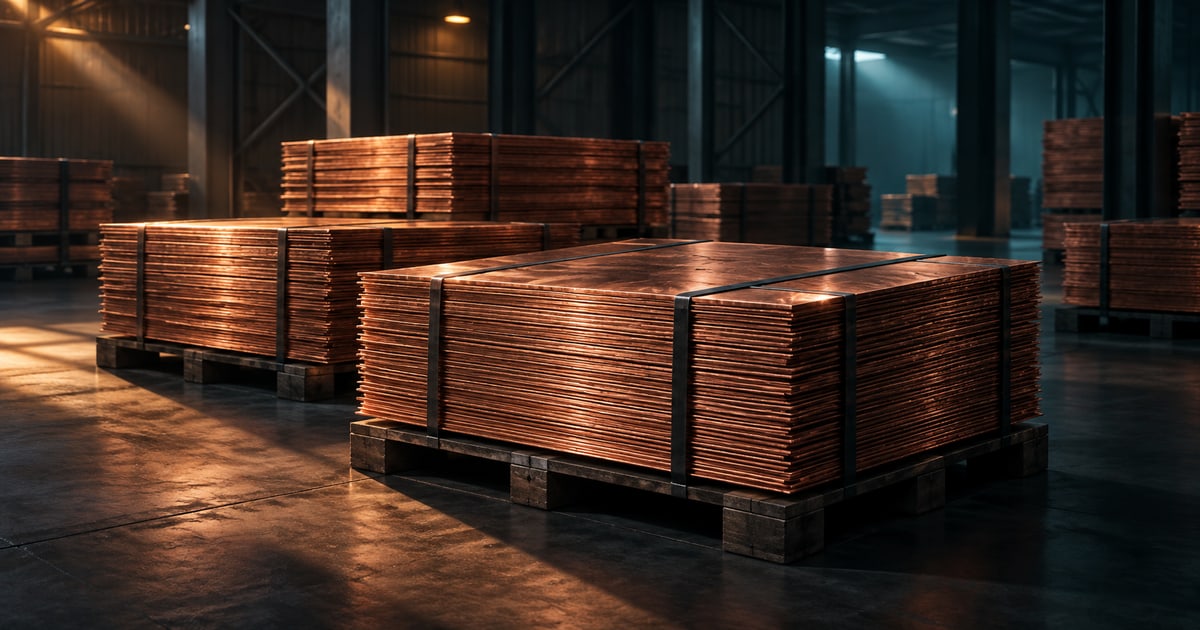
US copper inventories tie up capital amid tariff uncertainty. COMEX stocks, warehouse charges and a clearly hypothetical financing calculation.
On 3 September 2026, COMEX, CME Group’s metals futures exchange, approved Metal Ox Warehousing’s site in Glendale, Arizona, for storing copper deliverable against its futures contract. Its authorised capacity is 28,000 US short tons, equivalent to about 25,400 metric tonnes. The notice does not say the warehouse is full. It does put a price on leaving metal there: $15 per short ton each month. [1][5]
A week later, Reuters reported that the White House had still not decided whether to impose new tariffs on refined copper. An administration official confirmed that no final decision had been made. [2]
Those two notices describe different clocks. Trade policy can remain unsettled while the cost of holding an early shipment keeps accumulating. Someone has paid for the copper, someone must finance it, and the warehouse continues to charge. The question is what happens after the metal enters inventory.
Once copper has been mined and shipped, it still needs financing until it is sold or used. That interval, beyond the risks to mine production, raises a practical cash-flow question: how long can the owner wait, and who takes over the bill when the title changes hands?
Tariff uncertainty changes purchasing decisions
The legal distinction matters. The presidential proclamation of 30 July 2025 required an update to inform a decision on whether refined copper duties of 15% from January 2027 and 30% from January 2028 were warranted. Operative clause 7 did not automatically enact those rates. Processed copper products are covered by a separate regime, amended in April and June 2026. [3][11][12]
Yet an uncertain tariff can still change a purchasing decision. Consider a manufacturer that will need copper in six months. It could continue buying as requirements arise, accepting the future price, or bring the purchase forward. The latter choice creates costs today in exchange for less uncertainty tomorrow. Whether it pays off depends on the purchase agreement, the eventual customs rules and the manufacturer’s actual requirements.
A trader may have a different reason for holding the same metal: the expectation of a better resale opportunity. Both an industrial buffer and a commercial position can occupy exchange-approved storage. The inventory number alone cannot tell us how much belongs to either category.
Nor does a location in the United States establish that every tonne is protected from every future customs change. Product classification, the applicable legal text and customs-entry status matter. Warehouse geography is not a substitute for import documentation. There is no basis here for calculating a tariff saving across the whole stockpile. [3]
Opposing movements behind the total
For 4 September 2026, Chile’s copper commission, Cochilco, reports 694,674 metric tonnes in COMEX inventories, out of 991,849 tonnes across COMEX, the London Metal Exchange (LME) and Shanghai (SHFE). That is roughly 70% of the three-exchange total. Industrial stocks and inventories outside these exchanges are excluded. [4]
The LME approves warehouses across an international network. Its London name does not place all its inventories in Britain, so exchange totals should not be treated as a clean country-by-country breakdown. [8]
During the reported week, the combined stock rose by just 2,230 tonnes. COMEX added 10,983, Shanghai lost 9,428, and the LME gained 675. The nearly stable total therefore conceals a larger concentration of the reported inventories on COMEX. The figures do not trace a shipment from Shanghai to an American warehouse. [4]
For a physical buyer, location is only the start. Metal may be far from the plant, already owned by another buyer, or require withdrawal and onward transport. An inventory total supplies neither the owner’s asking price nor a promise to sell. It is a quantity measure, not a catalogue offering all those tonnes at the same delivered price.
Trading title to copper in storage
In this market, delivery does not necessarily mean a truck leaving a warehouse. COMEX delivery uses a warehouse warrant, an electronic document of title to the metal. The recipient can keep it in storage, sell it, or request physical removal. Ownership can change while the copper stays exactly where it is. [7]
The rules also distinguish eligible metal, which meets specifications but has no warrant, from registered metal backed by a warrant. A change between these categories need not represent a physical arrival or departure. Warehouses report physical movements separately. [6]
This has a useful implication for interpreting the stockpile. One holder can exit by selling the title to another, leaving the buyer to finance the next period of storage. The first seller has unwound a position, but no additional copper has reached a consumer. Contract delivery volumes and inventory reclassification are not enough to establish that material has returned to industrial circulation.
Physical withdrawal remains a logistical operation. COMEX requires the warehouse to report a delay if copper cannot be loaded out within five business days after the warrant has been cancelled for withdrawal and all applicable charges have been paid. The rules also set conditions for loading orders and the available means of transport. This reporting threshold is not a promise to transport any requested volume to the buyer within five days. [6]
Nothing in the documents reviewed establishes an exceptional queue in Glendale or deliberate obstruction of shipments there. An approved capacity and a schedule of charges are not evidence of abusive withholding. They are enough to investigate how the cost of waiting works.
The bill for holding a lot for six months
Glendale’s rates use US short tons, each comprising 2,000 pounds, rather than metric tonnes. One short ton is approximately 0.907185 metric tonnes. The quoted monthly rate therefore converts to $16.53 per metric tonne. Ignoring the unit difference would understate the storage bill. [1][5]
Take an entirely hypothetical position: 10,000 metric tonnes bought at $14,000 per tonne, for a purchase value of $140 million. Assume the entire amount is borrowed at 6% a year for six months. These are modelling assumptions, not an identified trade or a claim about anyone’s financing terms.
With simple interest and no principal repayment during the period, funding costs $4.2 million. Six full months at the published warehouse rate add about $992,080. The notice also lists outbound handling at $50 per short ton and blocking and bracing at $8. Applied to the whole hypothetical shipment, those two charges add about $639,341. [1][5]
The included costs total $5.831 million, or roughly $583 per metric tonne, on top of the purchase price. Freight, insurance, documentation, taxes and additional financing fees are excluded. The calculation assumes the published schedule without negotiated discounts. It is neither an estimate of Metal Ox customers’ actual costs nor a bill for America’s entire copper inventory.
Outbound handling belongs in the calculation only if the shipment physically leaves the warehouse. Selling the warrant alone does not require the same logistics. Interest would also change with a different rate, a shorter holding period, principal repayments or partial equity funding. The example breaks down the carrying cost of an inventory position.
Under the same assumptions, one extra month adds about $865,347: $700,000 of interest and $165,347 of storage, before other expenses. Political news can stand still while the carrying cost rises. Keeping the option to wait for clarity consumes resources.
A manufacturer using its own cash has no equivalent bank-interest invoice, but the money is still unavailable for another purpose. That opportunity cost must be distinguished from an actual charge. Adding both indiscriminately would double-count part of the capital cost.
The risks behind a copper position
A purchase price describes only one side of a transaction. In one possible arrangement, the owner has already agreed a resale price, date and location. In another, the holder has no final buyer and remains exposed to the future market price. Both arrangements can generate an identical inventory entry.
Calling all the American stockpile a speculative bet on tariffs would therefore go beyond the evidence. It would require information on forward sales, hedges and funding maturities. Cochilco’s exchange totals do not provide that position-level breakdown.
A futures hedge can reduce price risk while creating an awkward cash timetable. CME settles futures gains and losses daily. An owner who has sold futures against physical copper may have to supply cash when the price rises, before receiving the corresponding higher value from selling the metal. [10]
That cash requirement is not automatically a final economic loss. A hedge can work as intended and still need financing during its life. Equally, the eventual outcome can differ from expectations if the grade, place or timing of the physical sale fails to match the hedge. These are possible exposures to investigate, not losses established for current inventory holders.
The distinction matters to the wider market. A sale prompted by a financing constraint need not signal that the seller thinks copper has become abundant. Conversely, a company with secure funding can continue holding metal through a temporary price decline. Inventory behaviour reflects balance-sheet conditions as well as views about demand.
A related policy question arises in Europe’s aluminium scrap market: retaining metal within a jurisdiction can affect collectors and industrial buyers differently.
The owner’s options as tariff expectations change
A policy clarification that undermined the tariff trade could reduce the appeal of keeping copper in the United States. It would not automatically determine its next destination. A holder would still compare a local sale, a warrant sale to another investor, delivery to a plant and possible re-export.
For re-export, the price available at destination has to be set against the expenses still required to get there: withdrawal, freight, funding during transit and the other terms of the sale. COMEX’s copper contract specifies delivery without a freight allowance. An exchange price is not a transport quote to the eventual consumer. [9]
There is a further trap in the calculation. Costs already incurred are different from costs that can still be avoided. The full carrying bill helps determine whether the original trade made money. The decision to hold or sell today should compare the future receipts and expenses associated with each available option.
The hypothetical $583 per tonne is therefore not a magic floor below which the owner must refuse to sell. Some charges have already been paid; others depend on whether the metal is physically withdrawn. Accepting a loss can be rational when continued storage creates a worse expected outcome. Holding can also remain reasonable when there is a delivery commitment or a more attractive future sale.
This is why aggregate inventories might stay high even after the original reason for buying has weakened. Titles, funding arrangements and transaction prices can all change before the tonnes move. Stable warehouse quantities do not establish stable financial exposure.
A private bill, with an uncertain final bearer
The person paying the warehouse today need not bear the entire economic cost. A trader may absorb expenses in its margin or attempt to pass them into the sale price. A manufacturer may knowingly pay more for earlier access to metal. Contracts and the alternatives available to buyers determine that division. The public documents reviewed do not quantify it.
Nor does the existence of carrying costs establish waste. Where an interruption would be expensive, an inventory buffer can provide a valuable service. Additional approved warehouse capacity can give customers more options. A schedule of charges is not a profit statement: the facility must be financed and operated, and its occupancy is unknown here.
The evidence also resists a simple story of shortages worsening everywhere. Cochilco reports that the LME premium for immediate metal eased during the week under review. American stock accumulation alone cannot explain every part of the international market. [4]
A useful test would follow physical receipts and shipments, inventory-status changes, withdrawal times, and delivered prices matched for product, location and date. Those observations could distinguish metal returning to industrial use from a financial position merely changing hands. They would also help separate a genuine logistical problem from an owner’s commercial decision to keep waiting.
For trade policy, the lesson is narrower than a claim that tariffs caused every price movement. An unresolved border measure can bring purchases forward and leave capital committed for longer. That is a cost even before a government collects the proposed tax. Whether the early purchase was worthwhile still depends on the service provided and the eventual selling or replacement price.
Inventories count tonnes. Contracts and time determine the bill. The available documents let us describe that bill and calculate an explicit hypothetical case. Without the holders’ actual terms, they do not support an aggregate estimate of losses for the American copper trade.
Sources and documents
- CME Group / COMEX · 3 September 2026. Regularity Approval for Copper : MKR 09-03-26. Glendale approval and published rates. Approved capacity, not observed occupancy. Rates underpin the illustration; actual customer bills and discounts are unknown.
- Reuters · 10 September 2026. White House copper tariff plan stalls amid affordability concerns, sources say (reprint consulted on WSAU). News trigger: no final decision, according to the official cited. Not an official cancellation.
- White House · 30 July 2025. Adjusting Imports of Copper into the United States. Operative clause 7 calls for a decision on refined copper. It does not automatically enact the 15% and 30% rates. Distinct from recital 7.
- Cochilco · week of 31 August–4 September 2026. Informe del mercado internacional del cobre. Inventory table, p. 1. Observations at 4 September, compiled from LME, COMEX and SHFE. Changes are balances, not traced shipments. The immediate-delivery premium commentary is also on p. 1.
- NIST · accessed 10 September 2026. Guide to the SI : Appendix B.9, Mass. Mass units: the 2,000-pound US short ton and metric tonne. The conversion is used in the numerical example above.
- COMEX · version accessed 10 September 2026. Rulebook, Chapter 7 : Delivery Facilities and Procedures. 703.A(7), p. 5: inventory categories. 703.B, pp. 7–8: physical withdrawal and warehouse obligations. The complete rules govern.
- CME Group · accessed 10 September 2026. What is the Base Metals Delivery Process. Exchange educational material on warrant transfer and the recipient’s options. The rulebook [6] governs procedural requirements.
- London Metal Exchange · accessed 10 September 2026. Approved warehouses. Public description of the approved network across multiple regions. No owner-level inventory list was obtained.
- COMEX · version accessed 10 September 2026. Rulebook, Chapter 111 : Copper Futures. 111101, p. 1: contract specifications. Item 4 specifies delivery without a freight allowance.
- CME Group · accessed 10 September 2026. Mark-to-Market. Daily settlement of futures gains and losses. Cash-flow implications for a hedged copper holder are analytical, not an observed position.
- White House · 2 April 2026. Strengthening Actions Taken to Adjust Imports of Aluminum, Steel, and Copper. Amendment to the regime for covered products. The article does not apply its rates indiscriminately to all copper products.
- White House · 1 June 2026. Further Adjusting the Tariff Regimes for Imports of Aluminum, Steel, and Copper. Additional amendment checked to avoid treating the original 2025 tariff regime as unchanged in 2026.
This analysis is not investment advice.
// cite this analysis
l0g, “The carrying cost of America’s copper stockpile”, l0g.fr, published September 10, 2026, updated September 10, 2026, https://l0g.fr/en/analysis/copper-us-stockpile-carrying-cost-tariff-uncertainty/
$ cd ../analysis